



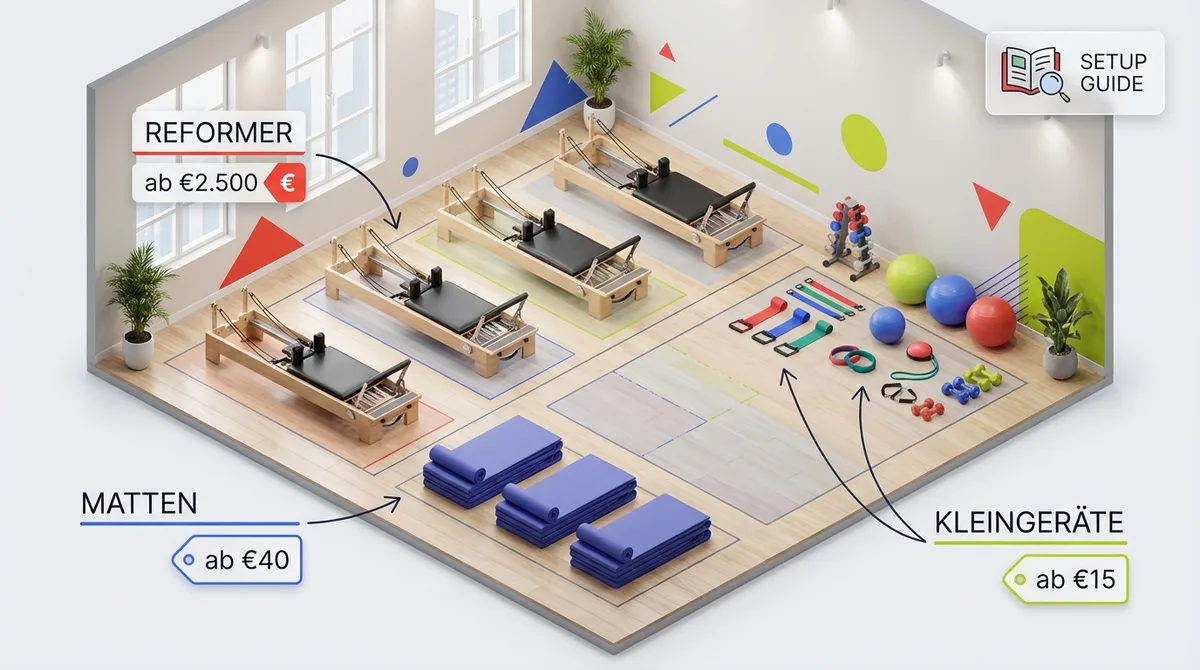
What do you need for a Pilates studio? This is the question many aspiring studio owners ask before taking the leap into entrepreneurship. The good news: with proper planning, you can set up a Pilates studio for various budgets — from a compact mat studio starting at around $5,000 to a fully equipped Reformer studio for $30,000 and up.
In this guide, you'll learn everything you need to know about the practical setup of your studio: which equipment is truly essential, how to optimize your space, and what everything actually costs. We compare Reformer brands, give you room planning tips, and provide a concrete cost overview and checklist at the end.
If you're also interested in the business side — business plan, legal requirements, and marketing — you'll find everything in our separate article How to Open a Pilates Studio. Here we focus entirely on the setup and equipment.
Mat vs. Reformer Studio: Which Concept Fits You?
Before you start setting up, the most important decision awaits: Will you go with a pure mat studio , a Reformer studio , or a combination of both? Both concepts have clear pros and cons — and your choice affects not just your budget, but also space requirements, target audience, and revenue potential.
The Mat Studio
A mat studio is the classic entry point into the Pilates world. You need significantly less space (430-650 sqft is enough for 10-15 participants), investment costs are manageable, and you can start quickly. Mat Pilates appeals to a broad target audience — from beginners to advanced, from young athletes to seniors.
The equipment is limited to Pilates mats, small accessories like resistance bands, magic circles, and foam rollers, plus a good sound system. Total setup costs: $5,000 to $15,000 — depending on how premium you go.
The downside: class prices typically range from $12 to $20 per participant. To be profitable, you need a high number of clients and a packed class schedule.
The Reformer Studio
Reformer Pilates is trending — and for good reason. The machines enable more intense, versatile training with individually adjustable resistance. For your studio, that means: higher class prices ($25-45 per participant), a clientele willing to pay more, and a clear unique selling proposition compared to traditional fitness studios.
The catch: you need more space (860-1,300 sqft for 8-12 Reformers), the machines cost between $2,000 and $8,000 each, and the total investment ranges from $30,000 to $80,000 . However, the revenue potential per square foot is significantly higher. Learn more about the benefits of Reformer training in our article What Is Reformer Pilates?.
Hybrid Concept: The Best of Both Worlds
Many successful studios combine both approaches: one room with Reformers for small-group training and a second room (or flexible use of the same room) for mat classes with larger groups. This way, you reach different target audiences and price segments. Space requirements increase, of course, but you maximize the utilization of your floor area.
| Criteria | Mat Studio | Reformer Studio |
|---|---|---|
| Investment | $5,000-15,000 | $30,000-80,000 |
| Space Required | 430-650 sqft | 860-1,300 sqft |
| Group Size | 10-15 participants | 8-12 participants |
| Class Price per Person | $12-20 | $25-45 |
| Target Audience | Broad, beginners to advanced | Premium, higher-paying clients |
Essential Pilates Equipment for Your Studio
Joseph Pilates originally developed over 20 different apparatus. For a modern studio, however, you don't need them all — the following are the most important and economically sensible.
The Reformer — The Centerpiece
The Reformer is the most well-known and versatile Pilates apparatus. It consists of a movable carriage on a frame, driven by springs of varying resistance. Over 100 different exercises can be performed on it — lying, sitting, kneeling, and standing.
For a Reformer studio, you need a minimum of 6, ideally 8-12 machines. Budget $2,000 to $8,000 per Reformer , depending on brand and features. When purchasing, pay particular attention to spring quality, carriage smoothness, and adjustability of the foot bar and headrest.
Cadillac / Trapeze Table
The Cadillac (also called Trapeze Table) is a large, stationary apparatus with a frame above a lying surface. Springs, loops, and a trapeze bar are attached to the frame. It's especially suited for rehab patients, seniors, and one-on-one training since it offers maximum support. A Cadillac costs between $3,000 and $8,000 . For a group studio, it's not essential — it's more of a premium add-on for personal training.
Wunda Chair
The Wunda Chair is a compact apparatus with a spring-loaded pedal. It's excellent for functional training and particularly challenges stability and balance. Priced between $800 and $2,500 , it's a worthwhile addition that requires little space. Ideal for studios looking to expand their offerings beyond the Reformer.
Ladder Barrel
The Ladder Barrel combines a curved surface (barrel) with a ladder. It's perfect for backbends, lateral stretches, and flexibility exercises. Cost: $1,000 to $3,000 . One or two are more than enough for any studio.
Small Equipment for Mat Pilates
Even if you're planning a Reformer studio, you should stock small equipment — they're often used as supplements and enable flexible class formats:
- Pilates Mats ($15-50 each): Thicker than yoga mats (approx. 15mm), for all floor exercises
- Resistance Bands ($5-20 each): Various strengths for resistance training
- Magic Circle / Pilates Ring ($15-30 each): For targeted training of adductors, arms, and chest
- Foam Roller ($10-30 each): For balance exercises and myofascial release
- Pilates Ball ($5-15 each): Small, soft ball for core activation and mobilization
Plan for a complete set per participant spot. With 12 spots, you'll spend around $600 to $1,500 total for all small equipment.
Buying a Reformer: What to Look For
The Reformer is the single largest investment in your studio setup. With 8-12 machines, costs add up quickly — making it all the more important to choose wisely. Here are the key criteria:
Quality Features of a Good Reformer
- Rail system and smoothness: The carriage must glide absolutely evenly and quietly. Cheap models often rattle or stick, which disrupts exercise execution and worsens over time.
- Spring system: High-quality Reformers offer 4-5 different spring strengths (often color-coded) that can be changed quickly. Springs should be made of stainless steel and individually replaceable.
- Adjustability: Foot bar, headrest, and shoulder rests must be easily and quickly adjustable for different body sizes — essential in group classes with changing participants.
- Frame and padding: Sturdy wood or aluminum frame rated for at least 330 lbs. Padding should be firm enough for stability but comfortable for longer sessions. Look for removable, washable covers — essential for studio hygiene.
- Ropes and straps: Cotton ropes with leather or fabric loops last longer than nylon. Check that replacement parts from the manufacturer are available and affordable.
Major Reformer Brands Compared
Balanced Body (USA) is the market leader in studio Reformers. Based in Sacramento, the company has been producing for over 45 years and offers the broadest model range — from the compact Allegro 2 (approx. $4,000-5,000) to the professional Studio Reformer (approx. $6,000-8,000). Their machines are known for durability, thoughtful design, and excellent resale value. Replacement parts are readily available.
Merrithew / STOTT Pilates (Canada) is the second-largest manufacturer worldwide. The SPX Reformer line offers excellent value (starting at approx. $3,500), while the V2 Max Plus models compete in the premium tier. Merrithew is especially popular with studios that also use the STOTT certification system.
Elina Pilates (Spain) has established itself as a European alternative. Their Reformers are solidly built, more affordably priced (starting at approx. $2,000), and have the advantage of shorter delivery times within Europe. An interesting option for budget-conscious studio founders.
Peak Pilates (USA) offers robust studio equipment in the mid to upper price range. Known for their MVe Reformer line, which is particularly popular in classical Pilates studios. Prices range from approx. $3,500-6,000.
| Price Range | Brand / Model | Price per Machine | Cost for 10 Machines |
|---|---|---|---|
| Budget | Elina Pilates / Merrithew At Home | $2,000-3,000 | $20,000-30,000 |
| Mid-Range | Balanced Body Allegro 2 / Merrithew SPX | $4,000-5,000 | $40,000-50,000 |
| Premium | Balanced Body Studio Reformer | $6,000-8,000 | $60,000-80,000 |
Room Design & Atmosphere
A Pilates studio thrives on its atmosphere. Unlike a traditional gym, it's all about concentration, body awareness, and well-being. Your room concept should reflect that — from the very moment a client walks through the door.
Planning the Layout
Beyond the actual training room, you need additional areas that must be considered in your floor plan:
- Reception area: First impressions count. A small, tidy reception with seating, coat hooks, and possibly a shelf for retail products (grip socks, water bottles, Pilates accessories).
- Changing rooms and restrooms: At least two changing areas and one restroom. Depending on size and local building codes, you may also need showers. Budget about 110-160 sqft for this.
- Storage room: For small equipment, cleaning supplies, and spare parts. Often underestimated, but you'll need it — especially if you need to store mats and props for different class formats.
Positioning Your Reformers
How you arrange your Reformers determines how many machines you can fit and how comfortable training is. Keep at least 5 to 6.5 feet of space between machines — on the sides and at the head/foot ends. It sounds like a lot, but it's necessary so instructors can walk between machines and correct participants.
Popular arrangements are parallel (all facing the same direction) or in a slight semicircle so all participants can see the instructor. The parallel layout is more space-efficient, while the semicircle offers better visual contact. For ceiling height: at least 9 feet , ideally 10 feet or more. Standing exercises on the Reformer and jumping exercises with the Jump Board require adequate headroom.
Color Scheme and Design
Pilates studios typically go for bright, calm color palettes: white, cream, light gray, or soft earth tones as a base, combined with one or two accent colors that match your branding. Avoid too many colors or bold tones — they're distracting and create visual clutter.
Natural materials like wood, linen, and cotton create a warm atmosphere that aligns with the Pilates philosophy. Plants can also enhance a studio — just choose low-maintenance varieties that don't need much light, and position them so they don't interfere with the training area.
Flooring, Mirrors & Lighting
These three elements significantly influence the look, functionality, and comfort of your studio. It's worth not cutting corners here.
The Right Flooring
The floor is your studio's work surface — it needs to be functional, hygienic, and visually appealing. The two best options for Pilates studios:
Vinyl / PVC flooring ($2-5/sqft) is the most popular choice for Pilates studios. It's durable, easy to clean, joint-friendly, and available in many wood-look finishes. A high-quality vinyl floor in oak finish looks elegant and lasts for years — perfect for studios that want a premium feel without spending a fortune.
Hardwood flooring ($5-10/sqft) is the premium option. Oak, maple, or birch create a warm, natural atmosphere and are extremely durable. However, hardwood is more sensitive to moisture and scratches, and installation costs more. For a Reformer studio where machines are stationary, this is less of an issue than for a mat studio with lots of floor contact.
Not suitable are carpet (unhygienic, hard to clean, allergy risk), hard rubber flooring like in CrossFit boxes (too stiff for Pilates floor exercises), and tile (too cold, too hard, slippery).
Mirrors
At least one wall should be mirrored — ideally the long side of the room, so participants can check their posture and form. Wall mirrors cost approximately $5 to $10 per square foot including installation. For a 26-foot wall at 6.5 feet of mirror height, you're looking at $850 to $1,700.
Some studios deliberately forgo mirrors to shift the focus to body feel rather than visual control. This can be an intentional design choice — especially in studios with a more meditative approach. Consider which philosophy fits your concept.
Lighting
Lighting has a huge impact on studio ambiance. The key rules:
- Dimmable: You need bright light for dynamic classes and dimmed light for relaxation sessions or cool-downs.
- Warm white (2,700-3,000 Kelvin): No cold fluorescent tubes! Warm white light creates an inviting atmosphere and is more flattering — your clients will feel the difference.
- Indirect lighting: LED strips behind coves or along the ceiling create soft, glare-free light. Especially pleasant when participants are lying on their backs looking straight up.
- Natural light: If possible, choose a space with natural light. Large windows boost mood but should be equipped with blinds or curtains for dimming.
Pilates Studio Setup: Cost Overview
The crucial question: how much does it cost to set up a Pilates studio? We've compiled a realistic cost breakdown — split between mat studio and Reformer studio. The figures are based on current market prices (as of 2025/2026) and include only setup costs, not ongoing expenses like rent, staff, or marketing.
Note: actual costs depend heavily on your location, the condition of the premises, and your quality standards. If you rent an already well-finished space, you'll save on flooring and lighting. If you're starting in a raw shell, renovation costs will be added.
| Item | Mat Studio | Reformer Studio |
|---|---|---|
| Reformer Machines (8-10) | — | $20,000-60,000 |
| Mats & Small Equipment | $800-2,000 | $600-1,500 |
| Flooring (Vinyl/Hardwood) | $600-2,400 | $1,200-9,600 |
| Mirrors (one wall) | $500-1,200 | $800-1,600 |
| Lighting (dimmable, LED) | $500-1,500 | $800-2,500 |
| Sound System | $200-800 | $300-1,000 |
| Reception, Furniture & Decor | $1,000-3,000 | $2,000-5,000 |
| HVAC / Ventilation | $500-2,000 | $1,500-3,000 |
| TOTAL (approx.) | $5,000-15,000 | $30,000-80,000 |
Checklist: Everything You Need
So you don't forget anything during setup, we've put together an interactive checklist. Check off what you've already organized — this way you'll keep track of all areas, from the major equipment to the small details that make the difference.
Conclusion: Setting Up Your Pilates Studio Right
Setting up a Pilates studio is an exciting project that requires thoughtful planning. The key insight: you don't need everything at once. A mat studio can be built with a manageable budget of $5,000 to $15,000. A Reformer studio requires a larger investment of $30,000 to $80,000 — but also offers significantly higher revenue potential per participant.
Invest in quality for the things used daily: Reformers, flooring, and lighting. For small equipment, you can start with simpler options and upgrade as needed. And don't forget the atmosphere — a Pilates studio is more than a gym with machines. It's a place where your clients want to feel comfortable, focus, and do something good for their bodies.
If you also want to plan the business side — business plan, permits, marketing, and pricing — you'll find everything in our comprehensive guide How to Open a Pilates Studio: The Complete Guide.

Written by
Felix Zink
Felix built Bookicorn from the ground up – from the booking system and credit system to trainer payouts. As a full-stack developer at Unicorn Factory Media GmbH, he builds software that makes everyday life easier for studios.
Was this article helpful?
Rate this post