



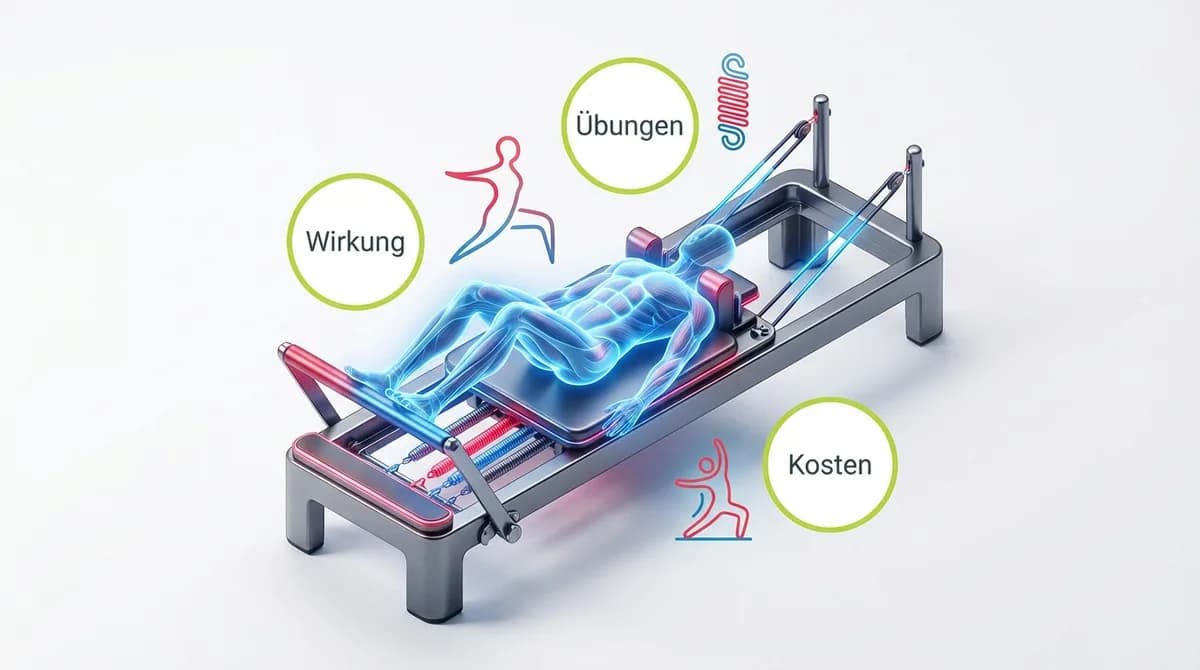
Reformer Pilates is one of the most popular workout styles worldwide and has evolved from a hidden gem to an absolute fitness trend in recent years. In Reformer Pilates, you train on a specialized machine called the Reformer, which uses springs, a sliding carriage, and straps. The result: an intense full-body workout that improves strength, flexibility, and posture all at once.
Whether you're a beginner or advanced, a rehab patient or competitive athlete, the Reformer adapts to every fitness level through its adjustable spring resistance. It's no wonder that Reformer studios are popping up everywhere and demand for classes continues to grow.
In this article, you'll learn everything you need to know about Reformer Pilates: how the machine works, the best exercises, what a class costs, and what results you can realistically expect. We'll also answer the most common questions about training on the Reformer.
How Does the Pilates Reformer Work?
The Pilates Reformer was invented in the 1920s by Joseph Hubertus Pilates . He originally called the machine the "Universal Reformer" because it was meant to literally "reform" the body. Pilates developed the device during World War I to help injured soldiers with rehabilitation, attaching springs to hospital beds so patients could exercise against resistance while lying down.
Anatomy of the Reformer
A modern Reformer may look complicated at first glance, but it has a logical design. Here are the key components:
- Carriage: The padded, moving platform where you lie, sit, or kneel. The carriage glides back and forth on rails.
- Springs: Typically four to five springs of varying strengths (often color-coded). They connect the carriage to the frame and create resistance. More springs means more resistance, but also more support for certain exercises.
- Foot Bar: A padded bar at the head end of the Reformer that can be placed in different positions. You push against it with your feet or hands to move the carriage.
- Shoulder Rests: Two padded blocks that prevent you from sliding off the carriage when pushing. They serve as stabilization points.
- Ropes & Straps: Attached at the foot end of the Reformer, running over pulleys. You grip the loops or handles and work against the spring resistance, ideal for arm, shoulder, and leg exercises.
- Headrest: Adjustable to two or three positions. It supports the natural neck alignment depending on the exercise.
The Principle: Variable Spring Resistance
What makes the Reformer special is its variable spring resistance . Unlike training with fixed weights, the resistance changes throughout the movement: the further you push the carriage out, the stronger the spring tension becomes. This means you work against resistance in both the concentric (shortening) and eccentric (lengthening) phases. This is particularly effective for building muscle while being easy on the joints, as there are no abrupt load peaks.
Your instructor can adjust the resistance by attaching or detaching individual springs within seconds. This allows every exercise to be tailored to your level, from complete beginner to advanced practitioner.
Reformer Pilates vs. Mat: The Key Differences
When people talk about "Pilates," they usually mean either Mat Pilates or Reformer Pilates. Both are based on the same principles developed by Joseph Pilates — concentration, control, centering, precision, breathing, and flow — but differ significantly in practice.
In Mat Pilates , you work exclusively with your own body weight on a mat. The resistance comes solely from gravity and your own muscle strength. This makes Mat Pilates very versatile — you need barely any equipment and can train anywhere — but it also limits the variety of exercises.
In Reformer Pilates , the machine adds an extra dimension. The springs create variable resistance that can both assist and challenge you. The straps and foot bar enable exercises in positions that simply aren't possible on a mat — such as supine leg work with controlled resistance or standing balance exercises on the moving carriage.
Another important difference: the Reformer gives you direct feedback through its guided movements on the rails. You'll immediately notice if your form is off, because the carriage starts to wobble or you can't control the resistance evenly. This proprioceptive feedback makes the Reformer an excellent training tool for body awareness and movement quality.
| Criteria | Reformer Pilates | Mat Pilates |
|---|---|---|
| Resistance | Variable springs (continuously adjustable) | Body weight only |
| Exercise Variety | Over 600 exercises possible | Approx. 50-100 basic exercises |
| Cost per Class | $25-45 | $10-25 |
| Joint Impact | Very low (guided movements) | Low to moderate |
| Ideal For | Beginners, rehab, cross-training | Anyone who wants flexible training |
Benefits & Effects of Reformer Pilates
Reformer Pilates offers a unique combination of strength training, flexibility work, and body awareness. Numerous studies confirm the positive effects of regular Pilates training on back pain, posture, and overall fitness. The Reformer amplifies these benefits because the variable spring resistance enables more targeted and versatile exercises than mat work alone.
Here are the key benefits at a glance:
The Best Reformer Pilates Exercises for Beginners
As a beginner, your first Reformer class will introduce you to a series of foundational exercises that form the basis for all advanced variations. Here are the key exercises you'll encounter in almost every beginner class:
1. Footwork
You lie on your back with your feet on the foot bar and push the carriage back and forth by extending and bending your legs. It sounds simple, but it's the perfect exercise to get familiar with the machine while activating your leg muscles and core. Depending on foot placement (parallel, V-position, on heels), different muscle groups are targeted. Footwork resembles a leg press but is much easier on the joints thanks to the supine position and spring resistance.
2. The Hundred
A Pilates classic that's also a staple of every Reformer class. You lie on your back, lift your head and shoulders, extend your legs (beginners: bent), and pump your arms rhythmically up and down — 100 times total (hence the name). The Reformer's straps provide gentle resistance, making the exercise more controlled than on the mat. The Hundred warms up the entire body and particularly activates the deep abdominal muscles.
3. Long Stretch / Plank Series
You hold a plank position on the Reformer — hands on the foot bar, feet on the shoulder rests — and push the carriage by moving your entire body forward and back. This is an intense full-body exercise that especially challenges the core, shoulders, and arms. Beginners often start with the kneeling variation ("Knee Stretch") before progressing to the full plank.
4. Leg Circles
You lie on your back with your feet in the straps and draw circles in the air with extended legs. The Reformer's ropes provide resistance and support simultaneously, allowing you to perform the movement with more control than on the mat. Leg Circles are excellent for hip mobility, inner thighs, and lower abs. The larger the circles, the more challenging the exercise.
5. Elephant
A standing exercise: you stand with your feet on the carriage, hands on the foot bar, in an inverted V-position (similar to "Downward Dog" in yoga). From here, you push the carriage back with your legs and pull it forward with controlled core engagement. The Elephant intensively trains the hamstrings, calves, and entire core while simultaneously stretching the back of the legs.
6. Arms in Straps
You lie on your back and hold the straps in your hands. From here, you perform various arm movements — circles, presses, pulls — always against the spring resistance. This exercise group strengthens the arms, shoulders, and upper back while your core must stabilize to keep the upper body still on the carriage. Especially effective for anyone who sits at a desk all day and suffers from shoulder and neck tension.
In a typical 50-minute class, your instructor combines these foundational exercises with further variations into a flowing workout. As a beginner, you typically need three to five sessions to get comfortable with the machine. After that, you'll notice how quickly you progress — both in technique and in strength and flexibility.
How Much Does Reformer Pilates Cost?
One of the most common questions about Reformer Pilates concerns cost. And yes: Reformer Pilates is more expensive than traditional Mat Pilates. There are solid reasons for that.
A professional Reformer costs between $2,000 and $8,000 per machine depending on the manufacturer and model. A studio with ten Reformers has invested $20,000 to $80,000 in equipment alone. Add to that the rent (each machine needs adequate space), spring and roller maintenance, and the training of qualified instructors. A comprehensive Reformer Pilates instructor certification takes a minimum of 300 to 500 hours.
Group sizes for Reformer classes are limited to 8 to 12 participants (some studios cap it at 6) so the instructor can individually correct each participant. Mat classes often accommodate 20 or more participants, which significantly lowers the per-person cost.
Here's an overview of typical Reformer Pilates pricing in the US (as of 2026):
| Pricing Model | Price Range | Per-Class Cost |
|---|---|---|
| Single Class (Drop-in) | $25-45 | $25-45 per class |
| 10-Class Pack | $200-400 | $20-40 per class |
| Monthly Membership (2x/week) | $100-200 | $12-25 per class |
| Private Session (1:1) | $60-120 | $60-120 per session |
Before & After: What Does Reformer Pilates Really Do?
Social media is full of spectacular Reformer Pilates transformations. But what can you realistically expect? The truth lies — as it often does — somewhere between the exaggerated before-and-after photos and the assumption that "a bit of stretching" won't make a difference.
After 4-6 Weeks (2-3x per week)
You'll feel the first changes relatively quickly: your body awareness improves, you stand taller, and you feel more stable overall. Back pain caused by muscular imbalances often subsides within just a few weeks. However, visible changes to your physique are still minimal at this stage — your body is primarily building deep stabilizing muscles that aren't directly visible from the outside.
After 3-6 Months
Now the changes become visible to others: a more defined core, toned legs, upright posture. Your flexibility has improved significantly, and you're mastering exercises that seemed impossible at first. Many also report positive effects on their stress levels and sleep quality.
After 12+ Months
Long-term Reformer training transforms not just your body but also your movement patterns in daily life. You sit better, lift heavy objects with proper technique, and have noticeably improved body awareness. Many long-term Reformer Pilates practitioners report feeling fitter in their 40s or 50s than they did in their 20s.
Important: Reformer Pilates is not purely a weight-loss program. A 50-minute class burns approximately 250 to 400 calories depending on intensity. If weight loss is your goal, you should combine Reformer Pilates with a balanced diet and potentially additional cardio training.
Who Is Reformer Pilates For?
One of the biggest misconceptions about Reformer Pilates: that it's only for young, fit women. In reality, the Reformer is one of the most versatile training machines out there and suitable for virtually any demographic.
Complete Beginners
The Reformer is actually often better suited for beginners than the mat . Why? The springs assist many movements, and the carriage provides a clear range of motion. On the mat, you have to stabilize everything through your own strength, which can be frustrating for untrained individuals.
People with Back Problems
Reformer Pilates is recommended by physical therapists and orthopedists worldwide for rehabilitation and prevention of back issues. The supine training position relieves the spine while the springs provide controlled resistance. Especially for disc problems, scoliosis, or post-surgery recovery, the Reformer can be used therapeutically — always in consultation with your physician.
Athletes and Cross-Trainers
More and more competitive athletes are incorporating Reformer Pilates into their training plans. Professional soccer players, dancers, golfers, and runners use the Reformer to correct muscular imbalances, improve core stability, and prevent injuries. The Reformer perfectly complements strength-based training because it targets the deep stabilizing muscles that are often neglected in conventional weight training.
Older Adults
Thanks to its joint-friendly nature and the ability to set resistance very low, the Reformer is also well-suited for older exercisers. It helps improve balance, prevent osteoporosis, and maintain overall mobility with age. Many studios offer specialized classes for seniors.
Pregnant Women and New Mothers
Reformer Pilates is — with medical clearance — very popular during pregnancy and for postpartum recovery. The Reformer enables exercises in side-lying and seated positions that accommodate the growing belly. After birth, targeted Reformer training helps rebuild pelvic floor muscles and address diastasis recti.
Conclusion: Is Reformer Pilates Worth It?
Reformer Pilates is more than a passing fitness trend. It's a well-designed, over 100-year-old training system that becomes even more effective with the Reformer machine. The variable spring resistance, guided movements on the carriage, and enormous exercise variety make the Reformer one of the most versatile pieces of training equipment available.
Yes, Reformer Pilates is more expensive than a gym membership or a mat Pilates class. But the small group sizes, individual attention, and quality of training justify the price. Especially if you suffer from back pain, want to improve your posture, or are looking for a joint-friendly full-body workout, the Reformer is one of the best investments in your health.
Our tip: Book a trial class at a studio near you and try it for yourself. Most studios offer discounted intro packages for new clients. After your first session on the Reformer, you'll understand why so many people are hooked on this workout.

Written by
Felix Zink
Felix built Bookicorn from the ground up – from the booking system and credit system to trainer payouts. As a full-stack developer at Unicorn Factory Media GmbH, he builds software that makes everyday life easier for studios.
Was this article helpful?
Rate this post