



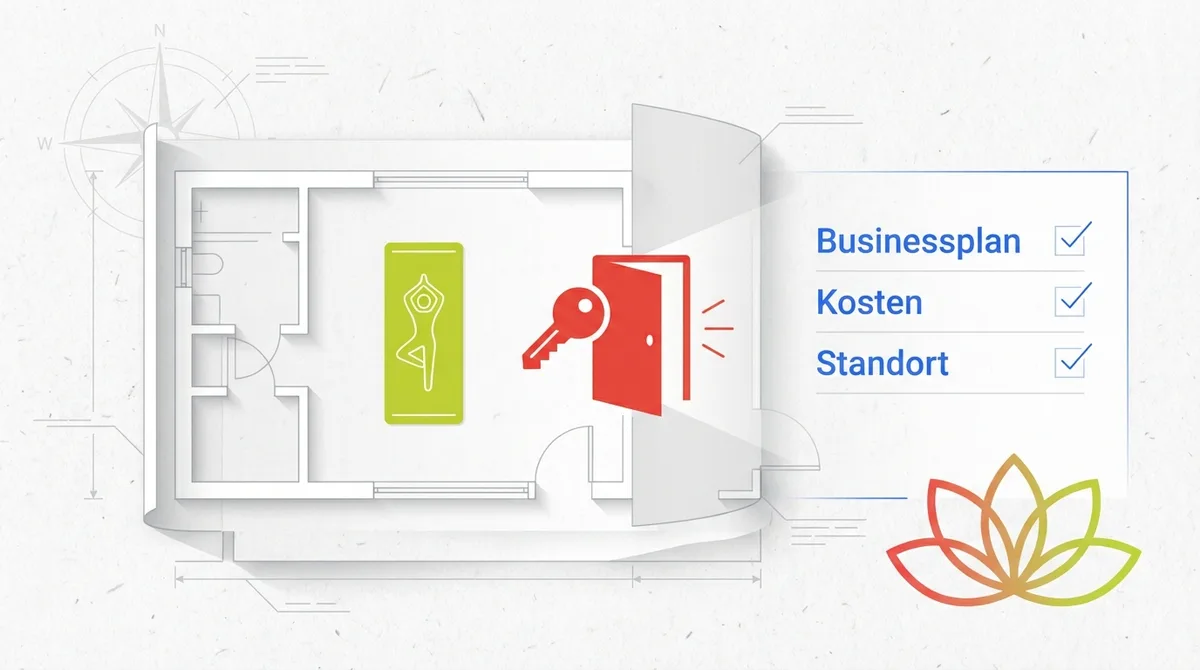
Dreaming of opening your own yoga studio? You're not alone: yoga is booming in Germany like never before. Over 16 million Germans practise yoga regularly and the market is growing by 10-15% every year. But before you roll out your mats and welcome your first students, there are a few things to consider.
In this comprehensive guide, you will learn everything you need to know to successfully set up your yoga studio: from training and financing to the current tax changes in 2026. With concrete figures, calculation examples and step-by-step instructions.
Requirements: What you need for your yoga studio
Before you open your yoga studio, you should fulfill a few basic requirements. The good news is that you don't need a master's certificate or a state license. Teaching yoga is a freelance activity.
Yoga teacher training
Sound training is the foundation of your success. The most important standards:
- 200-hour training (basic): Recognized by Yoga Alliance, approx. 2.500-4.000€
- 500-hour training (advanced): For deeper specialization, approx. 4,000-7,000€
- BDY certification (professional association): 2-4 years, highly respected in Germany
- Health insurance certification (ZPP): Enables prevention courses in accordance with §20 SGB V
Tip: With health insurance certification, your participants can be reimbursed up to 80% of the course fees - a powerful sales argument!
Funding and financing your yoga training
A yoga teacher training course costs between €2,500 and €11,000 - a considerable investment. The good news is that there are several funding options:
- Education premium: Up to €500 subsidy from the state for further training. Prerequisite: Income under €20,000/year (€40,000 for married couples)
- Education voucher (AVGS): For unemployed persons or persons threatened by unemployment. The employment agency covers up to 100% of the costs
- Upgrading BAföG: For advanced training. Up to €15,000 for course and examination fees, 50% of which is a grant
- Educational leave: In most federal states, you are entitled to 5-10 days of paid educational leave per year
- Payment by installments: Many training institutes offer interest-free installment payments over 6-24 months
Tip: Combine several funding options! Education bonus + educational leave + payment in installments can significantly reduce the financial burden.
Business plan for your yoga studio
A well-thought-out business plan is essential - not only for possible subsidies or loans, but above all for yourself. It forces you to think through all the important aspects.
The most important elements
- Executive Summary: Brief summary of your concept
- Business idea: What style of yoga do you offer? What is your USP?
- Target group analysis: Who are your ideal customers?
- Market analysis: How many yoga studios are there in your region?
- Marketing strategy: How do you reach your target group?
- Financial plan: Investments, running costs, sales forecast
- Legal form: Freelancer or business?
Your unique selling proposition (USP)
In a growing market, differentiation is key. Ask yourself:
- Which yoga style am I particularly good at?
- Which target group is underserved in my region?
- Can I specialize in a niche (pregnant women, senior citizens, athletes)?
- Do I offer anything special (aerial yoga, hot yoga, yoga retreats)?
Costs: How much does it cost to open a yoga studio?
The cost of opening a yoga studio varies greatly depending on location, size and equipment. Here is a realistic overview based on current market data for 2026.
| Cost Type | Minimum | Average | Premium |
|---|---|---|---|
| Deposit (3 months rent) | 1.500€ | 3.000€ | 6.000€ |
| Renovation & Remodeling | 500€ | 2.500€ | 8.000€ |
| Yoga Mats (15-20 pcs) | 300€ | 600€ | 1.500€ |
| Props (Blocks, Straps, Bolsters) | 200€ | 500€ | 1.200€ |
| Furniture (Reception, Changing Room) | 500€ | 1.500€ | 4.000€ |
| Sound System & Lighting | 200€ | 500€ | 2.000€ |
| Website & Booking System | 0€ | 500€ | 2.000€ |
| Marketing (Grand Opening) | 200€ | 500€ | 2.000€ |
| Total Startup Capital | 3.400€ | 9.600€ | 26.700€ |
Ongoing monthly costs
| Cost Type | Small Studio | Medium Studio | Large Studio |
|---|---|---|---|
| Rent (50-150 sqm) | 500-800€ | 800-1.500€ | 1.500-3.000€ |
| Utilities | 100-150€ | 150-300€ | 300-500€ |
| Insurance | 30-50€ | 50-100€ | 100-200€ |
| Booking Software | 0-30€ | 30-80€ | 80-150€ |
| Marketing | 50-100€ | 100-300€ | 300-500€ |
| Cleaning | 0€ (DIY) | 100-200€ | 200-400€ |
| Miscellaneous (Replacements, Decor) | 50€ | 100€ | 200€ |
| Total Monthly | 730-1.180€ | 1.330-2.580€ | 2.680-4.950€ |
Sample calculation: When will you break even?
Let's take a realistic example of a small yoga studio with 60 m² in a medium-sized city:
Monthly fixed costs: €1,200
For a course with 10 participants and 15€ per person:
- 1 course = 150€ turnover
- 8 courses per week = 1.200€/week = 4.800€/month
- Less fixed costs: €3,600 profit before tax
Sales can be further stabilized with 10-pack cards (€120) and subscriptions (€89/month). A realistic break-even is possible after 8-18 months.
How much does a yoga instructor earn?
The average hourly rate for yoga instructors in Germany is 25-60 EUR gross. As a studio owner with your own classes and additional revenue streams (workshops, retreats, online courses), monthly earnings of 3,000-6,000 EUR are realistic - depending on occupancy and location.
Legal basis: freelance or commercial?
One of the most important questions when setting up a business: Are you a freelancer or do you have to register a business?
Freelance work (the normal case)
Yoga teachers are generally considered to be self-employed, as they are engaged in teaching/teaching activities. This means that
- No business registration required
- No trade tax
- No compulsory IHK membership
- Simple income statement (EÜR) instead of balance sheet
- Registration only required at the tax office
When does it become a trade?
A trade exists if you:
- Sell yoga equipment (mats, clothing, etc.)
- Run a café or store in the studio
- Employing yoga teachers (can lead to a trade)
- The sale of goods predominates
Compulsory insurance for yoga teachers
- Professional liability insurance (MANDATORY): Protects against injuries to participants. Costs: 80-200€/year
- Public liability: If you have your own studio, for property damage. Costs: 100-300€/year
- Legal expenses insurance (optional): For disputes with customers or landlords
- Occupational disability insurance (recommended): Protect your ability to work
Tax update 2026: What you need to know
Tax legislation changes regularly. Here are the most important regulations for 2026 that are relevant for yoga teachers and studio owners.
Small business regulation (§19 UStG)
The small business regulation was adjusted in 2025. The new limits from 2026:
- Previous year's turnover up to €25,000 (net) - previously €22,000 gross
- Turnover in the current year up to €100,000 - previously €50,000
- No sales tax on invoices
- No input tax deduction possible
- On invoices: "According to §19 UStG no sales tax will be charged"
New since 2025: The switch to standard taxation takes place during the year as soon as you exceed the €100,000 limit - not in the following year.
Other important tax topics
VAT exemption for educational services:
Yoga classes are generally not exempt from VAT - contrary to what is often assumed. The Federal Fiscal Court has ruled that yoga does not constitute "medical treatment". Exception: yoga teacher training courses may be exempt under certain conditions.
Pension insurance obligation:
As a self-employed teacher, you are liable for pension insurance if:
- You do not employ an employee subject to compulsory insurance
- You are essentially working for one client
- Your profit is over €7,236/year (2026)
Trainer's allowance:
Increased to €3,300/year since 2025. Applies to part-time work for non-profit associations or public institutions - not for your own studio.
Finding the right premises
The location and premises are crucial to the success of your yoga studio.
Choice of location
- Accessibility: Good public transport connections or parking facilities
- Walk-in customers: City center location vs. quiet backyard - both can work
- Competition: How many studios are there within a radius of 2 km?
- Target group: Residential area, office district or student district?
Size and layout
Rule of thumb: 2-3 m² per participant in the course room. So for 15 participants you need at least 30-45 m² of pure practice space.
- Small studio: 50-70 m² (10-15 participants)
- Medium studio: 80-120 m² (15-25 participants)
- Large studio: 150+ m² (several rooms, 30+ participants)
You also need space for: Reception area, changing rooms (min. 2), WC, shower if necessary, storage space for equipment.
Basic equipment for your yoga studio
The right equipment creates an atmosphere and enables professional teaching:
- Yoga mats: 1.5-2 per participant (reserve for new customers). Quality pays off!
- Yoga blocks: 2 per participant
- Yoga belts: 1 per participant
- Bolster/cushion: 1 per participant for Yin Yoga or Restorative
- Blankets: For Savasana and cooler days
- Meditation cushion: Optional, for meditation
- Music system: Bluetooth speakers or permanently installed
- Lighting: Dimmable! Indirect lighting creates atmosphere
- Plants & decoration: for an inviting atmosphere
Marketing & customer acquisition
No sales without participants. How to win your first customers:
Online marketing
- Website with online booking: Indispensable! Today's participants expect to be able to book courses online
- Google My Business: Free and extremely important for local visibility
- Instagram: Perfect for yoga! Show off your studio, courses and personality
- Facebook groups: Local groups for your city/region
- Reviews: Actively ask satisfied participants for Google reviews
Offline marketing
- Cooperations: With cafés, organic food stores, physiotherapists, doctors' surgeries
- Flyers & posters: In the neighborhood, university, fitness studios
- Trial lessons: First lesson free or greatly reduced
- Referral program: "Bring a friend" - both receive a discount
- Events: Yoga in the park, workshops, open day
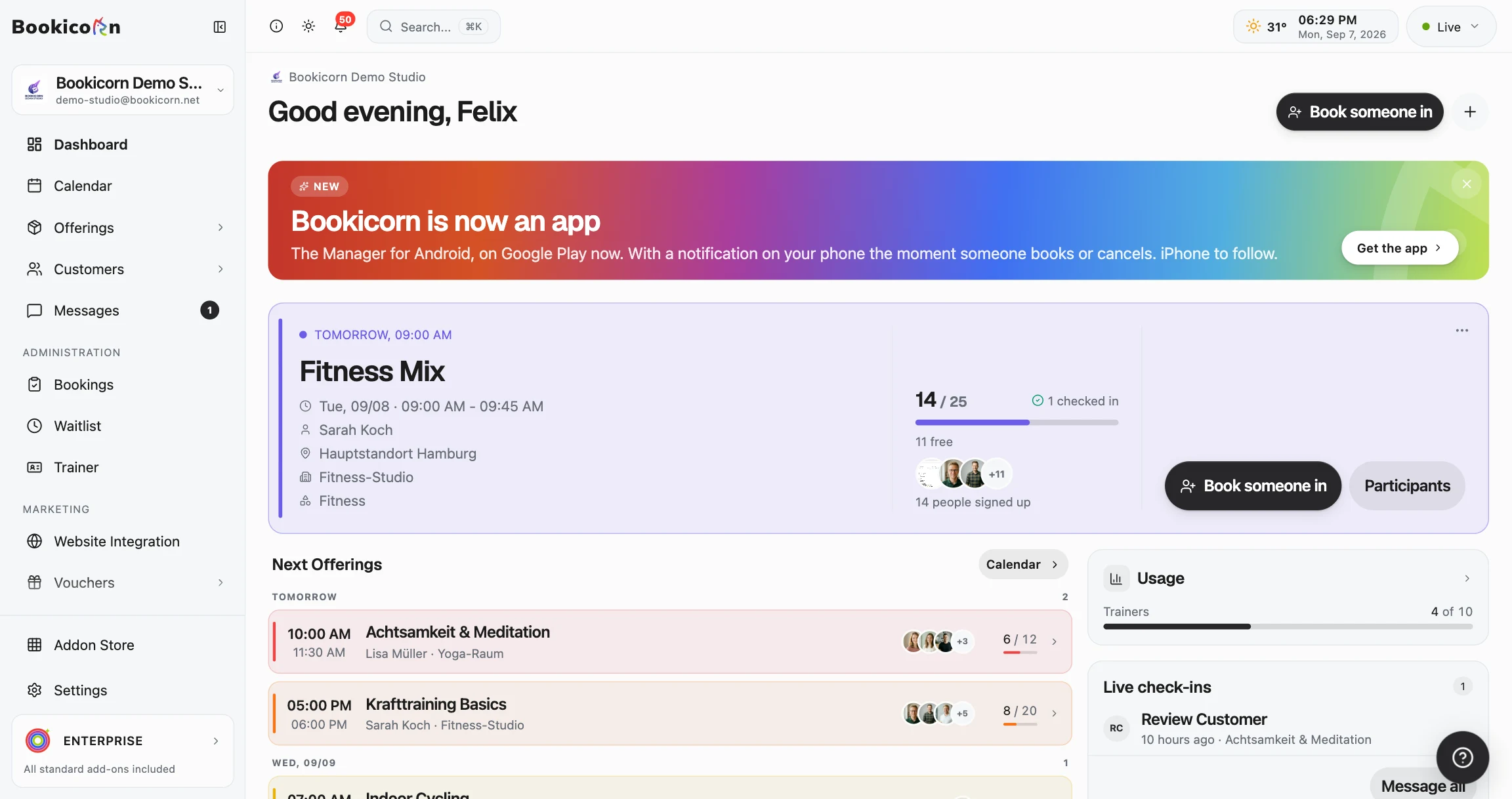
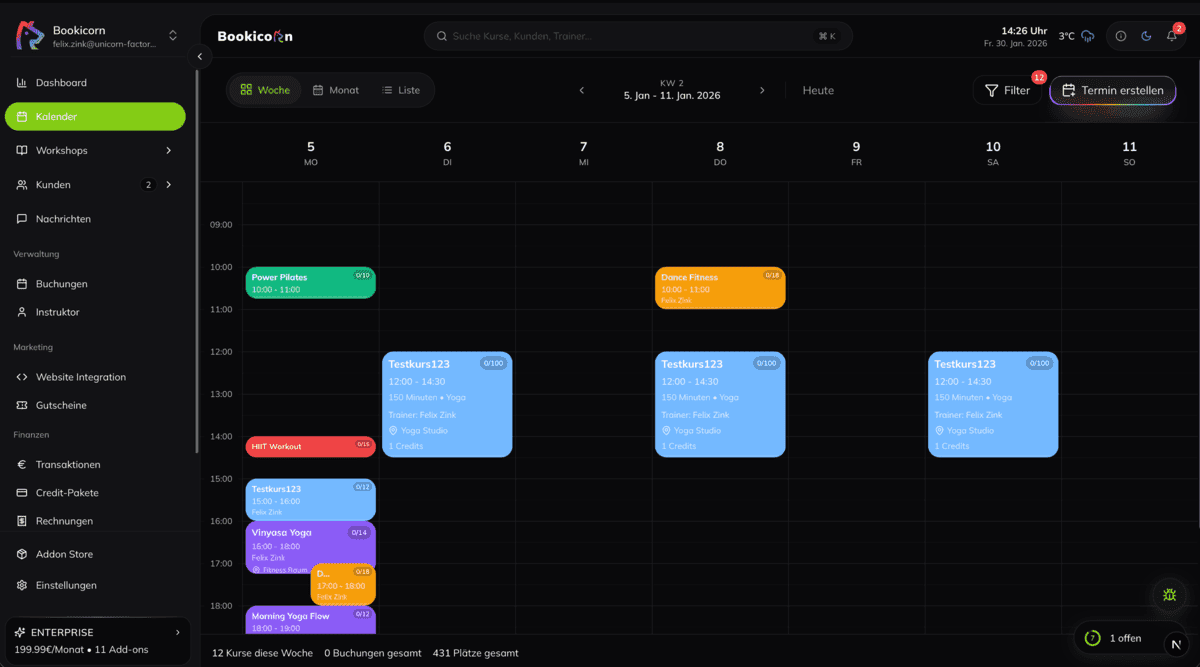
The right booking software for your yoga studio
Professional booking software saves you time and makes a professional impression. The most important functions:
- Online course booking (24/7 for your customers)
- Course plan management and display
- Automatic reminders by e-mail
- Payment processing (cards of 10, subscriptions)
- Customer management and statistics
- Waiting list function
- Multilingualism (for international customers)
Avoid common mistakes
Learn from the mistakes of others and avoid these typical beginner mistakes:
- Premises too large: Start small and grow with demand
- No reserves: Plan at least 6 months of fixed costs as a buffer
- Prices too low: Don't undercut the competition - quality has its price
- No online presence: A website with a booking option is mandatory today
- Do everything yourself: Delegate what you can't do (bookkeeping, website, etc.)
- No specialization: "Yoga for everyone" rarely works - find your niche
- Lack of legal advice: A tax discussion before the start-up saves trouble later on
Furnishing a yoga room: How to create the perfect atmosphere
The design of your yoga room is more than just decoration - it significantly influences the well-being of your participants and therefore the success of your studio.
Floor
The floor is the basis - literally. Recommended:
- Wooden flooring (parquet, floorboards): Warm, natural, easy to clean. Ideal for yoga
- Cork: sustainable, easy on the joints, natural cushioning
- Wood-effect vinyl: cheaper alternative, easy to clean
- Avoid: Carpet (unhygienic), cold tiles, concrete that is too hard
Lighting
Light has an enormous influence on mood:
- Dimmable lighting: absolutely indispensable! Bright for dynamic courses, dimmed for yin/meditation
- Warm light color: 2700-3000 Kelvin has an inviting and relaxing effect
- Indirect lighting: ceiling washlights, LED strips behind shelves - avoids harsh direct light
- Daylight: Large windows are worth their weight in gold, but with blackout options
Wall design & decoration
- Neutral, warm colors: White, beige, sand tones, muted green
- Accent wall: A wall in a darker color or with natural wood paneling
- Mirror: Helpful for alignment, but not desired for all yoga styles
- Plants: Bring life and improve air quality
- Minimalism: less is more - avoid visual overload
Acoustics
Often underestimated, but crucial for the atmosphere:
- Curtains and textiles absorb sound
- Acoustic panels on ceilings or walls in reverberant rooms
- Carpets in changing rooms and reception area
- Good music system with rich bass for mantras and relaxation music
Pricing: How to calculate your yoga classes
Setting the right price is an art - too cheap looks unprofessional and ruins your margin, too expensive puts customers off.
Standard market prices in Germany (2026)
- Single hour drop-in: 15-25€ (big city up to 30€)
- 10-card: 120-180€ (10-15% discount compared to unit price)
- Monthly subscription (unlimited): 79-129€/month
- Annual subscription: 69-99€/month (discount for commitment)
- Workshops (3-4 hours): 45-80€
- Retreats (weekend): 200-500€
Price calculation: The formula
Calculate your minimum price per course like this:
(monthly fixed costs + desired profit) / (courses per month × average participants)
Example: With fixed costs of €1,200, desired profit of €2,000, 32 courses/month and 8 participants on average:
(1,200 + 2,000) / (32 × 8) = 12.50€ Minimum price per person
Set your price 20-30% higher to have a buffer for slow months, discount campaigns and unforeseen costs.
Several pillars: Additional sources of income
A successful yoga studio doesn't just rely on regular classes. Diversify your offering for more stability and higher income.
Workshops and specials
Workshops are an excellent opportunity to delve deeper into topics and charge higher prices:
- Yoga for beginners (basic workshop)
- Handstand and arm balance workshop
- Meditation and breathwork
- Yoga philosophy and chakras
- Partner yoga or acro yoga
- Yoga and sound (with singing bowls)
Yoga Retreats
Retreats combine yoga with vacation and generate sales of several thousand euros per event:
- Weekend retreats in the region (300-500€/person)
- Week-long retreats abroad (800-2,000€/person)
- Cooperation with hotels and retreat centers
- Plan 6-12 months in advance for bookings
Online courses and memberships
Since the pandemic, online services have become established and remain in demand:
- Live streams: Parallel to studio courses or exclusive online times
- On-demand library: Recorded courses for subscription members
- Online course programs: 4-8 week programs (e.g. "30 days of yoga")
- Hybrid subscriptions: Studio + Online at a premium price
Other sources of income
- Private lessons: 60-120€/hour, ideal for flexibility
- Company yoga: 80-150€/hour, regular bookings
- Yoga teacher training: After a few years of experience, very lucrative
- Merchandise: mats, clothing, tees - but beware: then it becomes commercial!
- Subletting: Rent out your space to other teachers for massage, Pilates etc.
Alternatives: Franchise and studio succession
Building your own studio from scratch is not the only way. These alternatives can make it easier to get started:
Yoga Studio Franchise
Some concepts offer franchise models:
- Advantages: Established brand, proven concept, marketing support, training courses
- Disadvantages: High entry fees (€10,000-50,000), ongoing fees (5-10% of turnover), less freedom
- Examples: YogaSix, CorePower Yoga (still rare in Germany)
Take over an existing studio
Succession offers many advantages:
- Existing customer base
- Furnished premises
- Established location with a reputation
- Often training by the predecessor
- Financing often easier (verifiable sales)
Where to find? Yoga forums, Facebook groups, classified ads, direct inquiries to studios in your desired region. Many studio owners actively look for successors before they advertise publicly.
Customer loyalty: How to keep your participants in the long term
Acquiring new customers is more expensive than retaining existing ones. Focus on retention - the art of retaining participants in the long term.
Build a community
- Remembering names: a personal approach makes all the difference
- Before and after the course: time for small talk, don't disappear immediately
- WhatsApp/Telegram group: For regular customers, information and exchange
- Events: Breakfast together, movie night, hike
- Birthdays: A little attention works wonders
Incentives and programs
- Referral program: "Bring a friend" - both receive a 10% discount or a free lesson
- Loyalty bonus: After 10/50/100 courses a small gift or discount
- Early bird discount: For workshop and retreat bookings
- Annual subscription incentives: Significant discount for annual commitment
- Karma Yogis: Committed participants can help set up in exchange for free courses
Obtain feedback
Regular feedback shows that the opinion of your participants is important to you:
- Quarterly short surveys (Google Forms, Typeform)
- Personal discussions after courses
- Actively ask for Google reviews
- Take criticism seriously and communicate what you are changing
Timetable: When to start planning?
A realistic schedule will help you not to forget anything and to finish on time. Plan 6-12 months before the planned opening:
6-12 months before
- Create a business plan and clarify financing
- Find a location and negotiate a rental agreement
- Clarify legal issues (tax advisor!)
- Complete training (if not already done)
3-6 months before
- Sign a rental agreement
- Planning renovation and furnishing
- Set up website and booking system
- Create social media profiles and plan content
- Order equipment
1-3 months before
- Complete the renovation
- Create course plan
- Trial lessons for friends and family
- Start marketing (flyers, ads, cooperations)
- Collect pre-registrations
The last week
- Dress rehearsal - test everything
- Preparing the opening event
- Invite the press and local influencers
- Last social media posts for the launch
Conclusion: Your path to your own yoga studio
Opening your own yoga studio is a bold step - and a realistic goal with the right preparation. The most important points summarized:
1. Start with a solid education and gain teaching experience before opening your own studio.
2. Plan realistically: With €10,000-15,000 start-up capital and 6 months in reserve, you are on the safe side.
3. Clarify the legal issues early on: Freelance work, taxes, insurance - a meeting with a tax consultant is money well spent.
4. Use modern tools: Professional booking software saves time and makes a good impression.
5. Don't forget marketing: The best location is useless without participants. Start building your community early.
Frequently asked questions about opening a yoga studio

Written by
Felix Zink
Felix built Bookicorn from the ground up – from the booking system and credit system to trainer payouts. As a full-stack developer at Unicorn Factory Media GmbH, he builds software that makes everyday life easier for studios.
Was this article helpful?
Rate this post