



What Is Yin Yoga?
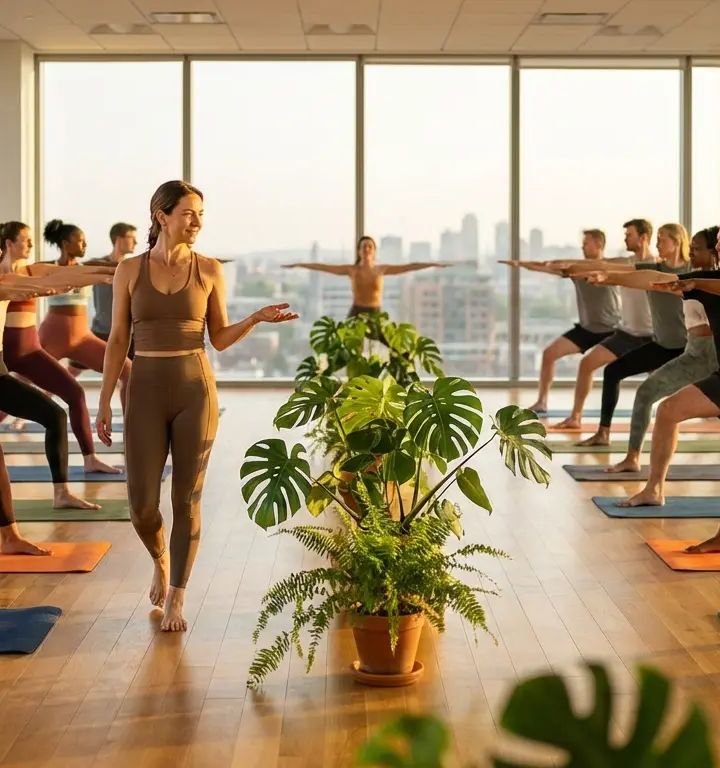
A yin yoga teacher training opens the door to one of the most sought-after yoga styles in recent years. Yin yoga combines long, passive holds with the principles of Traditional Chinese Medicine (TCM). Unlike dynamic styles such as vinyasa or ashtanga, the focus is not on muscular strength but on deeply stretching fascia, ligaments and connective tissue.
In this guide, you will learn everything you need to know about yin yoga teacher training: from the different formats and costs to career opportunities as a yin yoga instructor.
Origins and Philosophy
Yin yoga has its roots in Taoist philosophy and was developed by Paulie Zink in the 1980s. Paul Grilley and Sarah Powers later refined and popularised the style worldwide. The philosophy is based on the principle of yin and yang: while yang practices work actively and muscularly, yin yoga uses gravity and prolonged holds.
Typical postures are held for three to five minutes. This reaches deep tissue layers that are rarely addressed in dynamic yoga styles. At the same time, the practice works on the meridians – the energy pathways of TCM – and promotes the flow of energy throughout the body.
How Yin Yoga Differs from Dynamic Styles
Yin yoga fundamentally differs from most other yoga traditions. While vinyasa yoga connects flowing sequences with breath rhythm and ashtanga prescribes fixed, intensive series, yin yoga focuses on stillness and surrender. Hatha yoga occupies a middle ground: it combines held postures with breathing exercises but is considerably more active than yin yoga.
- Yin Yoga: passive, hold 3–5 minutes, fascia and meridians, meditative
- Vinyasa: dynamic, flowing movements, strength and endurance
- Hatha: moderately active, postures combined with breathing techniques
- Ashtanga: intensive, fixed series, high physical demands
It is precisely this quiet, inward quality that makes yin yoga an ideal complement for those who already practise active yoga styles – and an independent path for anyone looking to combine relaxation with bodywork.
What makes yin yoga special
The long holds work not only on fascia and connective tissue but also on the meridians – the energy pathways of Traditional Chinese Medicine. This connects physical practice with energy work, creating a unique pathway to deep relaxation.
Yin Yoga Teacher Training: Formats and Duration
Aspiring yin yoga teachers can choose from a variety of training formats. Depending on your existing knowledge, availability and career goals, the duration and scope differ considerably.
Short Courses (20–50 Hours)
Compact formats of 20 to 50 hours are particularly suited as continuing education for qualified yoga teachers. They teach the fundamentals of yin yoga and enable you to lead your own classes. Typical formats include:
- 20–32 hours: intensive weekend or 3–4 consecutive days
- 40–50 hours: spread over several weekends or as an intensive week
These short courses are ideal if you want to expand your teaching repertoire without committing to a full additional certification. Many providers recognise them as Continuing Education credits, for example with the Yoga Alliance (YACEP).
Intensive Programmes (100–200+ Hours)
For a comprehensive qualification, longer programmes are the way to go. A 100-hour training spans several weeks or months, deepening practice, anatomy and teaching methodology. Those seeking a standalone yoga teacher certification opt for a 200-hour programme registrable with the Yoga Alliance as RYT-200.
As a general rule: the higher the hour count, the deeper the engagement with the material. A 50-hour training provides solid foundations, while 200+ hours qualify you as a fully certified yin yoga teacher with in-depth expertise.
Online, In-Person or Hybrid?
The training format affects not only cost but also the learning experience. Each format has clear advantages:
- In-person: direct feedback from the trainer, hands-on corrections and group energy. Ideal for beginners who benefit from personal guidance.
- Online (live): flexible and location-independent, often 10–30% cheaper than in-person courses. You learn in real time via Zoom or similar platforms.
- Hybrid: combination of online modules and in-person workshops. Offers flexibility for theoretical learning with practical deepening on site.
Which format suits you best depends on your learning style and life situation. If you already have teaching experience, an online format may suffice. For beginners, however, many trainers recommend in-person training.
How Much Does Yin Yoga Teacher Training Cost?
The cost of yin yoga teacher training varies considerably depending on scope, format and provider. Here is an overview of typical price ranges.
Cost Range by Scope
The more training hours, the higher the investment. The following benchmark figures are based on current offerings:
- 20–32 hours: €400–700 – typically a weekend workshop. Ideal for a first insight.
- 40–50 hours: €550–1,200 – intensive week or several weekends. The most popular option for experienced yoga teachers.
- 100 hours: €1,500–2,500 – multi-week programme with deepened theory and practice.
- 200+ hours: €2,500–4,500 – full yoga teacher certification, registrable with the Yoga Alliance.
Online formats tend to be 10–30% cheaper than comparable in-person courses. Travel and accommodation costs, which can add €300 to €800 depending on location, are also eliminated.
What is included in the price?
Reputable providers typically include the following in the training fee:
- Teaching materials: handbooks, sequence templates and anatomy charts
- Examination fees: practical and theoretical exams
- Certificate: completion certificate, sometimes also in English
- Post-training support: some providers offer mentoring or observation opportunities after graduation
Not usually included: travel, accommodation and meals for in-person trainings. Budget an additional €300 to €1,000 depending on location and duration.
Funding and Financing Options
There are several ways to reduce your investment:
- Educational leave: in many German states, approved training can be taken as educational leave.
- Education vouchers: some regions offer subsidies of up to €500.
- Instalments: most providers offer interest-free payment plans over 2–6 months.
- Early bird discounts: early registration often saves 10–15%. Some providers offer discounts of up to €100.
Training Content and Prerequisites
What can you expect from a yin yoga teacher training in terms of content? The exact focus areas vary by provider, but certain core topics feature in every reputable programme.
Typical Training Content
A thorough yin yoga training covers the following areas:
- Anatomy: fascia, connective tissue, skeletal structure and individual body variations.
- TCM fundamentals: meridians, Five Element theory and qi flow.
- Yin yoga asanas: correct execution, safe variations and use of props such as bolsters, blocks and blankets.
- Sequencing: structuring classes thematically and anatomically – for example by meridians or body regions.
- Teaching methodology: cueing, language, voice and hands-on assists.
- Meditation and pranayama: breathing exercises and meditative techniques that complement yin yoga classes.
Prerequisites for Participation
Formal prerequisites are rare. Most providers expect:
- Your own yoga practice (at least 1–2 years of regular practice recommended)
- Minimum age: 16–18 years depending on the provider
- For short courses: often an existing basic yoga teacher training (200 hours)
In principle, yin yoga training is open to both aspiring teachers and practitioners who want to deepen their own practice.
Certification and Recognition
The recognition of your qualification depends on the programme chosen:
- Yoga Alliance: programmes with 200+ hours can be registered as RYT-200. Individual modules count as Continuing Education (YACEP).
- National associations: in Germany, the BDY is the relevant professional body.
- Provider certificates: even without Yoga Alliance registration, reputable providers issue certificates recognised in studios and health facilities.
Career Opportunities as a Yin Yoga Teacher
After training, various career paths are open to you. The yoga market has been growing for years and demand for specialised yin yoga classes continues to rise.
Employment in a Studio or Fitness Centre
As an employed yoga teacher, the average gross salary is approximately €2,300 to €2,900 per month. Pay depends on location, experience and qualifications.
- Yoga studios offering yin yoga classes
- Fitness and health centres
- Wellness hotels and rehabilitation facilities
- Adult education centres
- Corporate yoga (workplace health management)
The advantage of employment: a steady income, social insurance and no need to handle client acquisition. However, teaching hours are often limited, which is why many yoga teachers combine several income streams.
Self-Employed as a Yin Yoga Teacher
Many yin yoga teachers work freelance. Typical hourly rates range from €40 to €80 for private sessions. A well-booked yin yoga teacher with their own class schedule can achieve a gross income of €3,000 to €5,000 per month.
As a self-employed teacher, you need:
- Business registration or freelancer status – yoga teachers in Germany are often classed as freelancers
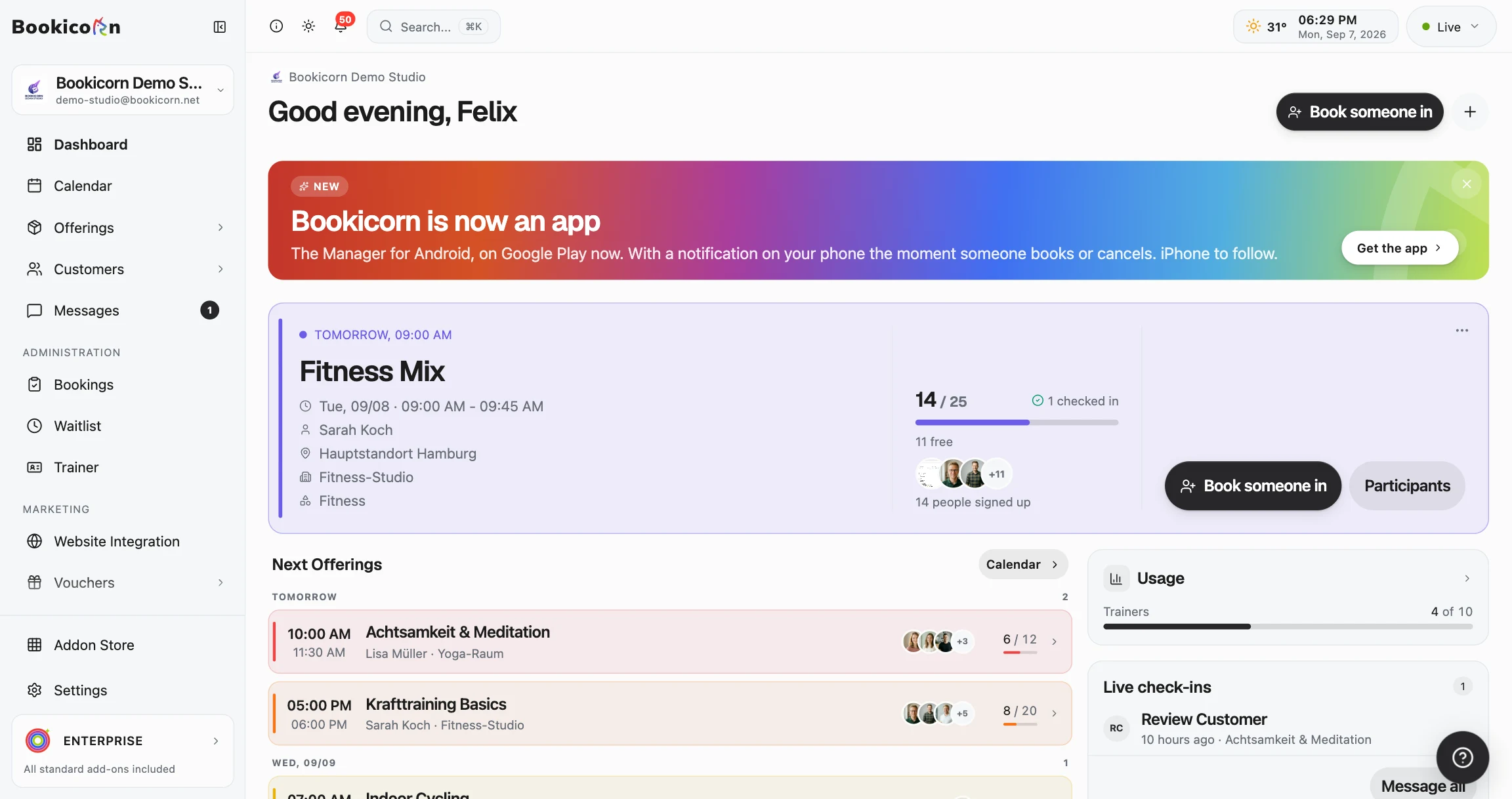
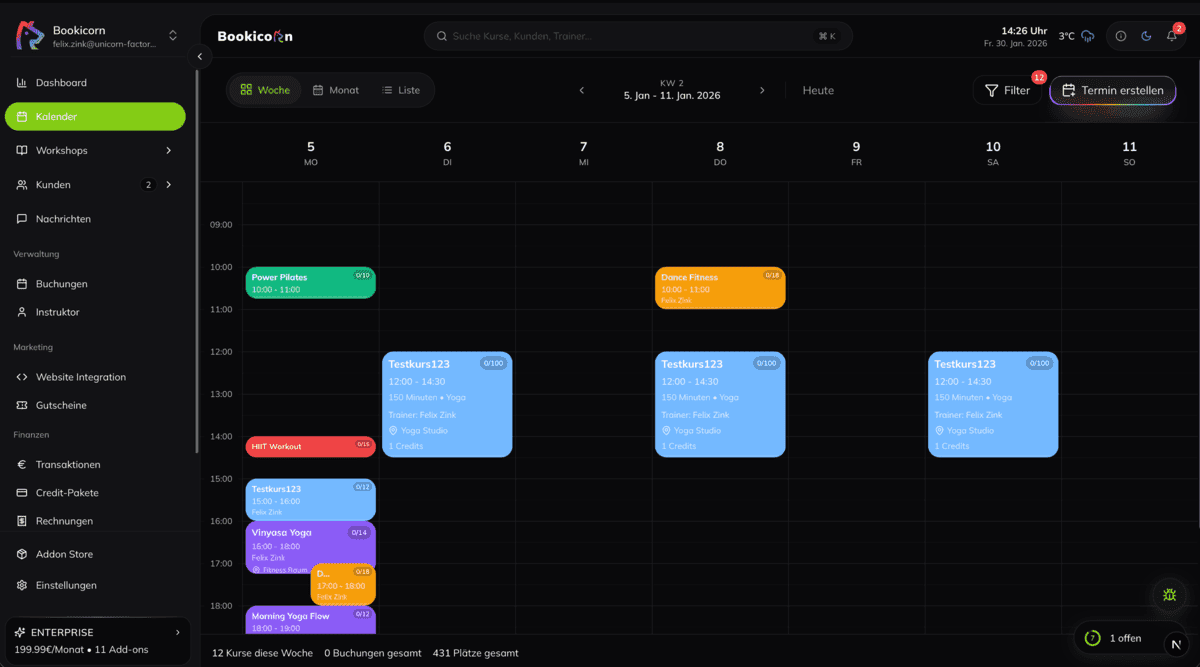
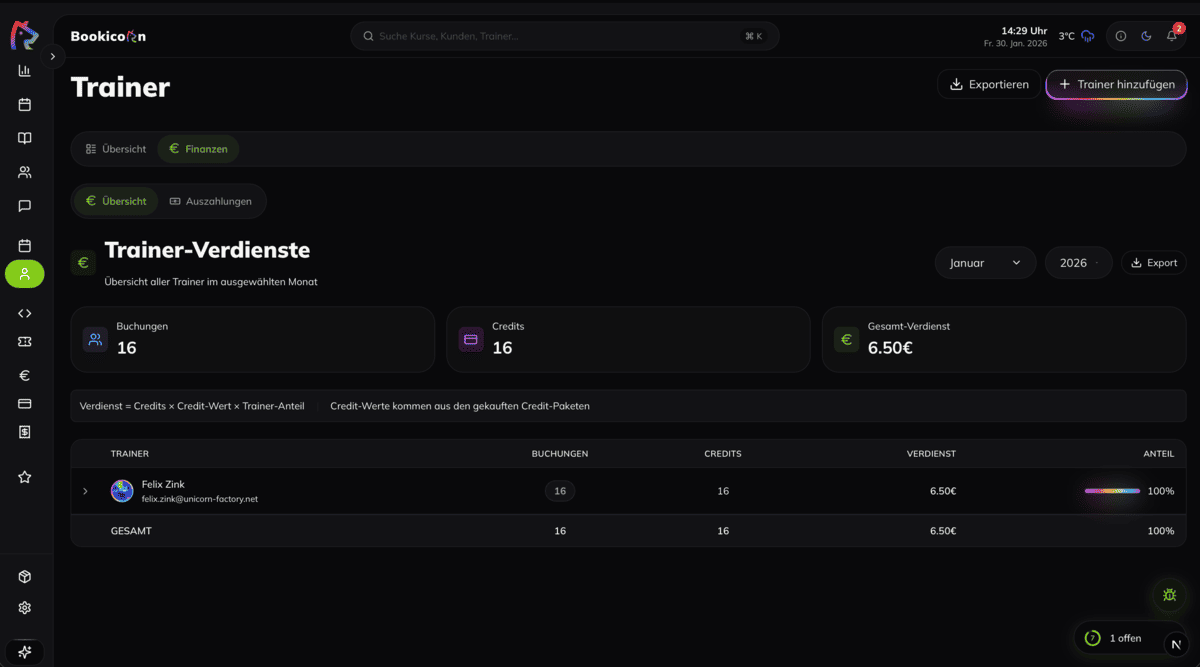
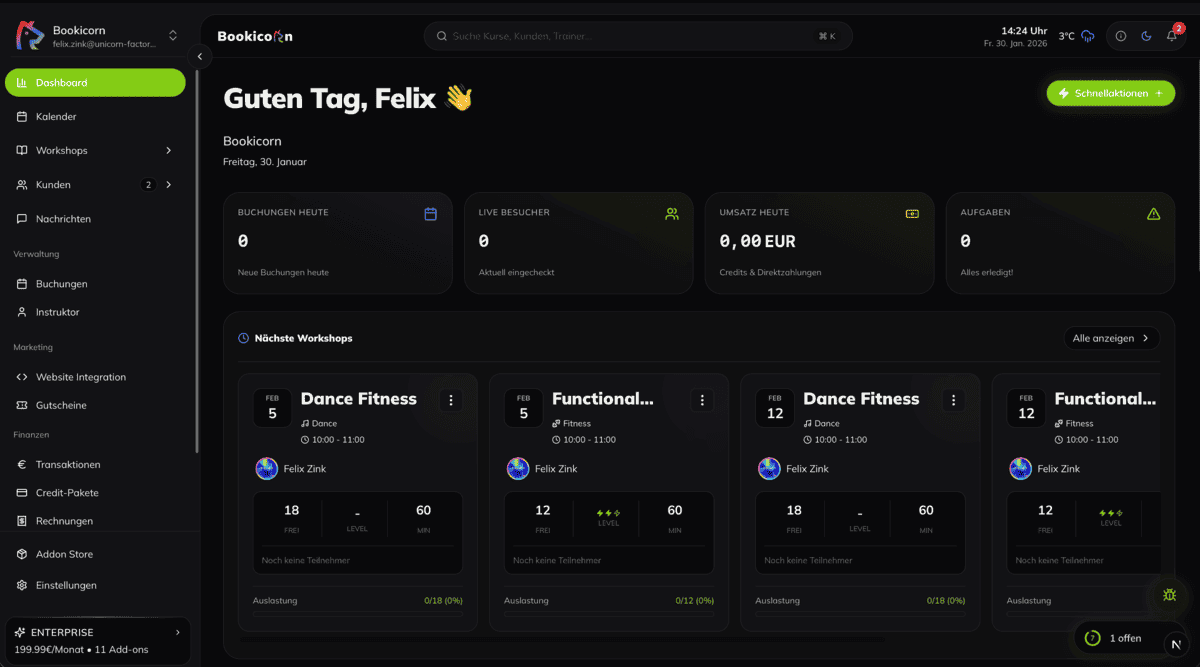
- Course management and booking software – a solution like Bookicorn automates bookings, payments and communication.
- Marketing and online presence (website, social media, Google Business Profile)
- Professional liability insurance (from approx. €50–100 per year)
- Accounting and tax returns (or an accountant)
A key success factor is digital visibility. In addition to your own website, listings on yoga platforms and a well-maintained Google Business Profile help attract new participants.
Specialisation and Continuing Education
After a basic yin yoga training, numerous specialisations can sharpen your profile:
- Yin Yoga & Meditation: combining with mindfulness – in high demand in corporate settings and burnout prevention
- Yin Yoga & TCM/Acupressure: deepening energy work, popular with therapeutically-oriented participants
- Yin Yoga for specific groups: seniors, pregnant women, athletes or people with chronic conditions
- Restorative Yoga: even more passive, with maximum prop support
- Fascia training: complementing with active fascial work
Each specialisation increases your market value and enables higher fees. The combination of yin yoga and meditation in corporate health management is currently a growth area with attractive rates.
Frequently Asked Questions About Yin Yoga Training
The most important questions and answers about yin yoga teacher training at a glance.
Conclusion
A yin yoga teacher training is worthwhile for anyone who wants to learn and share a calm, deep yoga style. The barriers to entry are low, the formats flexible and the career prospects promising. Whether as a compact weekend workshop from €400 or a comprehensive 200-hour programme – there is an option for every budget and timeframe.
When choosing, look for recognised certifications, qualified trainers and a format that suits your learning style. Specialising in yin yoga sets you apart in the growing yoga market and allows you to offer real value to your participants.

Written by
Felix Zink
Felix built Bookicorn from the ground up – from the booking system and credit system to trainer payouts. As a full-stack developer at Unicorn Factory Media GmbH, he builds software that makes everyday life easier for studios.
Was this article helpful?
Rate this post