






Offering Rehab Sports at Your Studio — What You Need to Know
Offering rehabilitation sports is an opportunity for studios to reach new audiences and build a second income stream. In Germany, insured patients have a legal right to rehab sports under §64 SGB IX, with the public health insurance covering the sessions — provided the offering studio meets the formal requirements.
This practical guide explains what licence your instructor needs, how your studio gets approved as a rehab sports provider, how billing with the health insurances works, and which common pitfalls to avoid. So that you can decide on solid ground whether rehab sports make sense for your studio.
What is Rehab Sports?
Rehabilitation sports (Rehasport) is a complementary medical rehabilitation service. It is doctor-prescribed, conducted in groups, led by a qualified instructor — and normally paid for by the health insurance. The legal basis is §64 SGB IX combined with the nationwide Framework Agreement on Rehabilitation Sports and Functional Training issued by the Federal Working Group for Rehabilitation (BAR).
Who is eligible for rehab sports?
Any insured patient with a medical diagnosis where exercise therapy is helpful — such as back conditions, post-surgery recovery, cardiovascular disease, neurological disorders or cancer aftercare. Prescription is issued on form 56, which the health insurance must approve.
How many sessions are covered?
Standard coverage is 50 exercise units within 18 months — significantly more for specific indications such as cancer aftercare or heart groups. Exact volumes are noted on the prescription. As a provider, you need to know this for capacity planning.
Requirements for Rehab Sports Providers
To offer rehab sports, you must fulfil three areas: staff qualification, suitable rooms and organisational approval. All three are reviewed by the responsible regional federation (Behinderten- oder Rehabilitationssportverband, BSV).
Staff requirements
The instructor needs the Licence B "Sport in Rehabilitation" — short: instructor B licence. It is indication-specific (e.g. orthopaedics, internal medicine, neurology) and only valid for that specific indication. Each group also needs a cooperating doctor who carries the medical responsibility.
Room requirements
Rooms must be suitable for exercise programmes — sufficiently large, well ventilated, with accessible sanitary facilities and barrier-free emergency access. Depending on the indication, equipment or a swimming pool is required. The BSV inspects the rooms before approval.
Organisational requirements
The provider is normally a non-profit association that is a member of the regional federation. Pure fitness studios or commercial providers cannot bill directly — they either cooperate with an existing rehab sports association or set up their own dedicated association. More on this below.
Instructor B Licence — Training in Detail
The licence is issued by the regional federations of the German Disabled Sports Association (DBS). It builds on a C trainer or instructor C licence and is valid for 4 years — after that, refresher training is mandatory.
Prerequisites for the training
You need: completed 18th year of life, an existing C trainer licence (or sports degree / equivalent qualification), valid first aid certificate (not older than 2 years) and an extended criminal record certificate when working with children or youth.
What does the training cost?
Course fees range between 700 and 1,200 euro depending on the federation and indication. Travel, accommodation and possible loss of earnings come on top. The licence usually pays off after the first two course blocks — provided you fill the groups.
Where do I find training dates?
Directly via your regional federation — a complete list is available on the DBS website. Since dates are in demand, early registration is worthwhile. Some federations also offer online theory with on-site practice, reducing travel costs.
Approval as a Rehab Sports Provider — Step by Step
Approval runs via your regional federation in three steps: application, inspection and entry into the provider database. Plan 3 to 6 months for the entire process.
1. Submit the application
You file an application with the BSV including: club statutes (proof of non-profit status), proof of the instructor B licence, cooperation contract with the supervising doctor, description of the rooms, planned group sizes and indications.
2. Site and group certification
The federation inspects the rooms and reviews your concept. After a positive evaluation, you are added to the official provider database — and appear in the public provider directory for insured patients.
3. Audits and ongoing quality assurance
Approved providers are audited regularly — usually unannounced. Auditors check attendance lists, licence proofs, content of sessions and the cooperation with the supervising doctor. Violations may lead to withdrawal of approval — so document everything thoroughly.
Billing with the Health Insurances — How It Works
Billing is the most complex aspect of running rehab sports. Mistakes here mean late or missing payments. Three points need to be clear: who bills, how high is the compensation, and what does the workflow look like.
Who actually bills?
The biller is always the association — never the studio or the individual instructor. So if you operate as a commercial studio, you need an association as a billing partner. Two models are common: founding your own association (more effort, you keep all income) or cooperating with an existing billing association (easier, but commission of 15 to 20 percent is typical).
How high are the compensation rates?
Compensation per participant and exercise unit varies considerably — depending on the federal state, the health insurance and the indication. More than 14,000 different compensation rates exist in Germany. The exact amount can be found in the compensation rate finder of the Federal Association for Rehabilitation Sports. As a rough guide: usually in the range of 5 to 8 euro per participant and unit.
The billing workflow
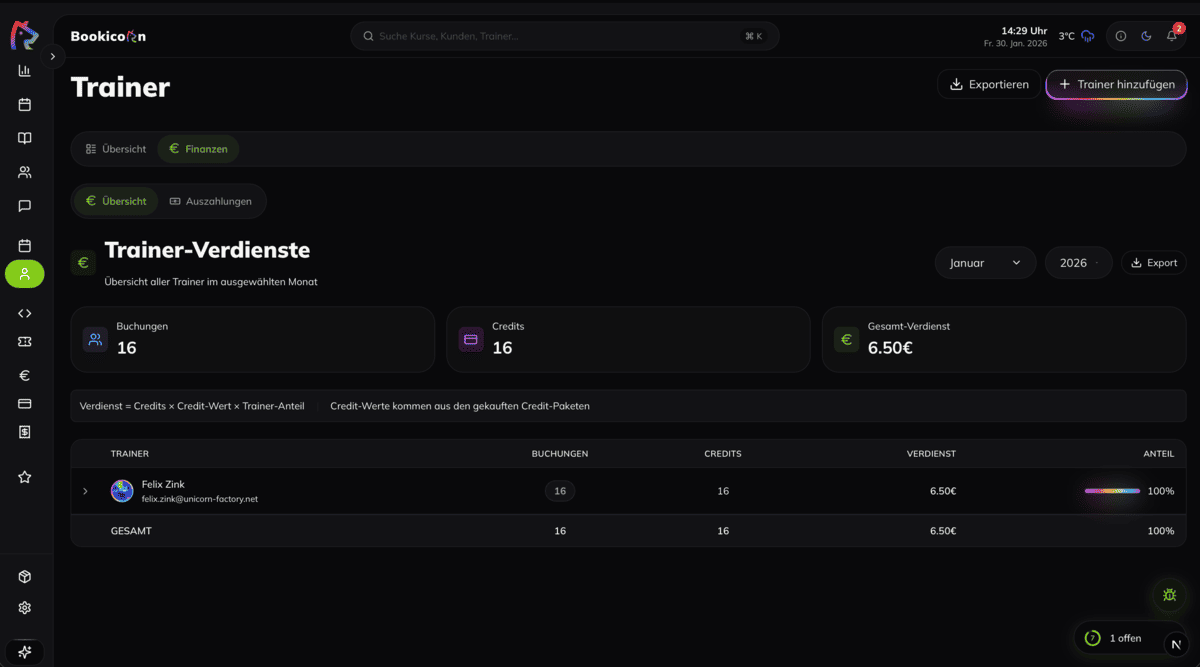
Per session you need: medical prescription of the participant, attendance proof (signed by participant and instructor), indication and number of sessions. These documents are collected, sorted by health insurance at the end of the quarter, submitted, and paid out 4 to 8 weeks later. Good administration software saves the largest part of this effort.
| Role | Tasks | Required |
|---|---|---|
| Association | Approval at BSV, billing with health insurances, maintaining statutes | Non-profit status, BSV membership |
| Studio (Provider) | Provide rooms, manage bookings, marketing, participant onboarding | Suitable rooms, insurance, cooperation contract if applicable |
| Instructor | Plan and run sessions, keep attendance lists, check prescriptions | Valid B licence, first aid certificate, refresher every 4 years |
| Supervising doctor | Medical responsibility, advice for instructor, emergency reachability | Medical licence, cooperation contract with the association |
Practical Tips for Studios
From the experience of hundreds of studios that offer rehab sports, three points emerge that decide between success and frustration.
Tip 1: Plan capacity realistically
A rehab sports group typically has 8 to 15 participants. Below that, you are quickly in the red. Plan with 4 to 6 months of ramp-up time in the first year before groups are full. Recommend your existing customers to redeem their prescriptions with you — that is the fastest way to high utilization.
Tip 2: Choose software early
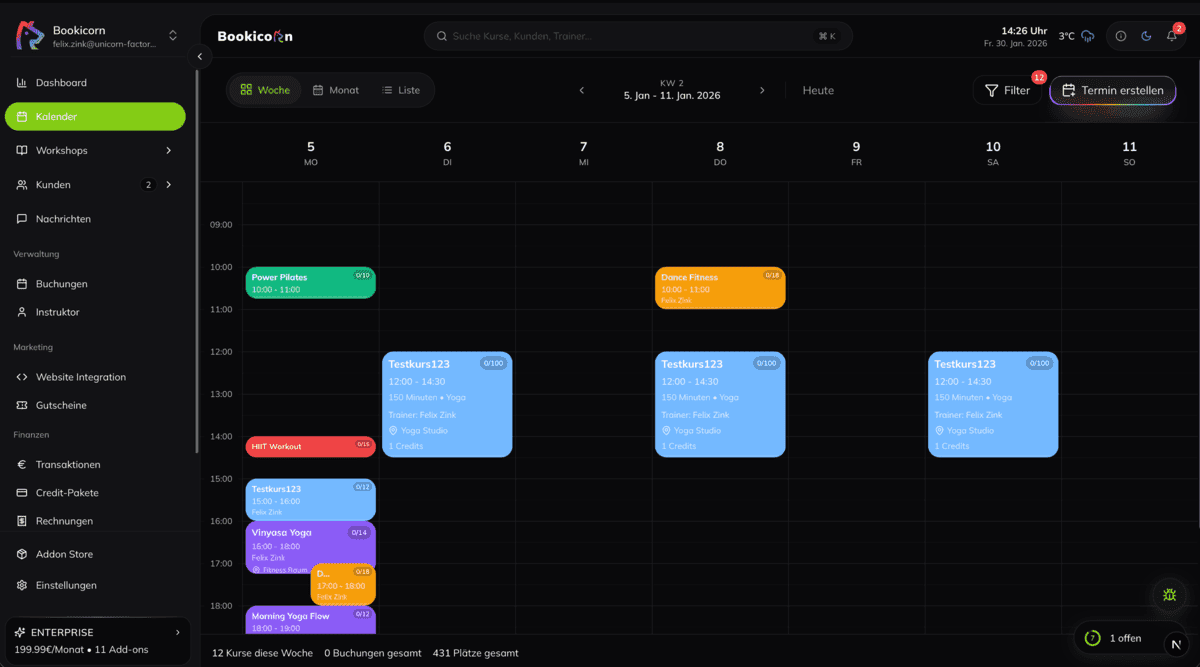
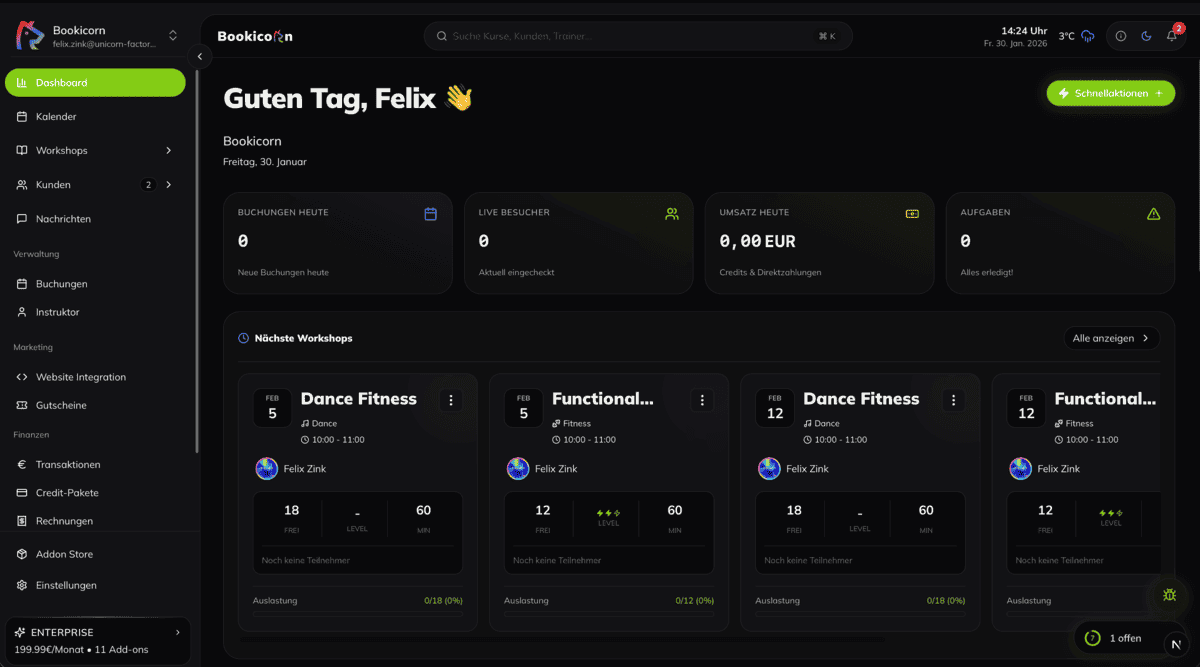
Manual attendance lists and Excel billing work for up to two groups. Beyond that, you need booking and management software that handles prescriptions, captures attendance digitally and generates billing exports. This saves 2 to 4 hours of administration per group per month — and massively reduces error rates.
Tip 3: Audit preparation from day one
Audits arrive unannounced. Those who keep documentation up to date have no stress. Those who try to catch up three months before the audit risk approval. So keep attendance lists, prescription copies and licence proofs centrally available and findable from day one.
Frequently Asked Questions about Offering Rehab Sports
The most important questions and answers around starting in rehab sports — compactly summarised for you.
Conclusion: Rehab Sports Pays Off — If You Set It Up Properly
Rehab sports is not quick revenue but a reliable second pillar. Those who take the formal requirements seriously, win over a good instructor and build clean documentation from the start create a predictable income stream and at the same time strong loyalty among existing customers.
Our recommendation: start with one indication, one instructor and one group. Gather experience, optimise workflows and only then scale up. This avoids the classic mistake of starting several groups in parallel and failing on administrative effort.

Written by
Felix Zink
Felix built Bookicorn from the ground up – from the booking system and credit system to trainer payouts. As a full-stack developer at Unicorn Factory Media GmbH, he builds software that makes everyday life easier for studios.
Was this article helpful?
Rate this post