







Offering outdoor fitness classes is trending. More and more studios and trainers are moving their classes outside – whether to a city park, a meadow, or their own garden. But before you start your first outdoor class, there are several things to consider: from permits to insurance and the right location choice. In this practical guide, you will learn everything you need for successful fitness classes outdoors.
Why outdoor fitness classes are becoming more popular
Outdoor fitness is no longer a niche trend. The demand for classes under the open sky is growing steadily – and for good reasons.
Benefits for participants
Training in fresh air offers measurable health benefits. The body produces vitamin D, the immune system is strengthened, and mood measurably improves. Studies show that exercising outdoors reduces stress more effectively than indoor training. Additionally, many participants find outdoor classes more motivating because the environment is more varied than a closed studio room.
- Vitamin D production through sunlight
- Strengthening the immune system
- Higher motivation through nature experience
- Better mood and stress reduction
- Variety compared to indoor training
Benefits for studios and trainers
For you as a provider, outdoor classes open up new revenue streams without high fixed costs. You don't need additional studio space and can expand your offering seasonally. Outdoor classes also attract a new target audience: people who don't want to visit a traditional gym but enjoy guided group workouts.
- Low space costs – no rent for additional areas
- Seasonal addition to indoor offerings
- Reach new target audiences
- Visibility in public spaces as a marketing effect
Permits and legal requirements for outdoor fitness
Before offering your first class in the park, you need to know the legal framework. Anyone offering commercial fitness classes in public spaces usually needs a special use permit.
When do you need a special use permit?
In Germany, the Administrative Court of Berlin clarified in 2022 that commercial fitness classes in public parks do not fall under general use. They are considered special use and require a permit. This means: as soon as you charge money for your class, you need authorization from the responsible authority.
Exceptions may apply when you train on private grounds – such as your own garden, company premises, or rented space.
How to apply for a permit
- Identify the responsible office: Usually the public order office or the parks department of your city.
- Submit the application: Describe the class type, participant count, times, and exact location.
- Site inspection: Some authorities want to inspect the location beforehand.
- Receive approval: Processing takes 2 to 6 weeks depending on the municipality.
Costs and fees
Fees vary significantly by city. As a reference: in Berlin, a seasonal license for one weekly class costs around 230 euros. In other cities, fees can be lower or higher. Check with your municipality early so you can factor the costs into your budget.
Important: Fines possible without permits
Offering commercial classes in public spaces without authorization can result in fines and prohibition by authorities. Always check with your municipality beforehand.
Insurance and liability
Besides permits, protection against liability risks is a must for every outdoor trainer. Risks are higher outdoors: uneven ground, weather influences, and lack of infrastructure.
Professional liability for outdoor trainers
A professional liability insurance is essential for fitness trainers – especially for outdoor classes. It covers personal injury and property damage during training. Private liability insurance does not cover professional activities.
Costs for professional liability are manageable: starting from about 70 euros per year you get solid basic coverage. Make sure your plan explicitly includes outdoor activities.
What to do in case of accidents?
As a class leader, you have a duty of care. This means: you must check the training area for hazards before each class – holes, branches, or slippery spots. Keep a first-aid kit ready and ensure you have an emergency plan.
- Check training area before each class
- Always have a first-aid kit
- Keep emergency numbers at hand
- Inform participants about special risks
Finding the right location for outdoor classes
The location largely determines the success of your outdoor classes. A good location combines accessibility, enough space, and a pleasant atmosphere.
Parks and public green spaces
City parks are the most popular choice. They offer flat lawns, shade from trees, and good accessibility. Many parks also have calisthenics equipment or fitness trails. Remember: commercial use usually requires a permit.
Private spaces and alternatives
Not every class needs to take place in a public park. Private spaces have the advantage that no special permit is needed. Possible alternatives:
- Company grounds (e.g., for corporate fitness)
- Rooftop terraces of office buildings or hotels
- Sports fields of clubs (outside training hours)
- Own garden or courtyard
- Beach areas or lakefront promenades (with permit)
Checklist for the perfect location
- Level, well-maintained ground
- Enough space for all participants (min. 4 sqm per person)
- Shade options for hot days
- Good accessibility by public transport or bike
- Parking nearby
- Toilets within walking distance
- No noise disturbance for residents
Equipment and organization
Compared to indoor classes, outdoor fitness classes require less equipment but better planning. You need to bring everything you need on site.
Basic equipment for outdoor classes
- Fitness mats (or participants bring their own)
- Resistance bands – lightweight, versatile, space-saving
- Dumbbells or kettlebells (only if transport is feasible)
- Bluetooth speaker for music and instructions
- First-aid kit
- Drinking water and cups
- Sun protection (sunscreen, possibly canopy/umbrella)
Transport and storage
Plan your equipment transport realistically. A hand cart or large backpack is usually sufficient for basic equipment. If you regularly train at the same location, consider arranging storage with a nearby cafe or shop.
Class formats that work outdoors
Not every indoor format transfers directly to outdoors. These formats work particularly well:
- HIIT and Bootcamp – need little equipment, high group motivation
- Yoga and Pilates – idyllic atmosphere, only mats needed
- Circuit training – stations can be set up flexibly
- Running courses and interval training – no equipment needed
- Mobility and stretching – perfect as a complement
Weather management and Plan B
Weather is the biggest challenge for outdoor fitness classes. With clear rules and a good backup plan, you can handle unpredictable days.
Clear cancellation rules
Define fixed cancellation criteria and communicate them to all participants from the start.
- Thunderstorms and storms: class always cancelled
- Continuous rain: cancelled or rescheduled
- Light rain: class takes place (unless cold)
- Extreme heat (above 35°C): move to early morning or evening
Inform your participants at least 2 hours before class whether the class will take place.
Alternatives for rain or heat
An online class as backup is the simplest solution. Participants can join from home via video call. Alternatively, you can switch to a covered area.
Seasonal planning: When are outdoor classes worthwhile?
In Central Europe, outdoor fitness classes are typically viable from April to October. The best months are May, June, and September. Plan your outdoor offering as a seasonal complement to your regular program – not as a replacement.
Booking and participant management
Outdoor classes bring special organizational requirements. Last-minute cancellations due to weather, changing locations, and flexible group sizes make a digital booking solution almost essential.
Online booking for outdoor classes
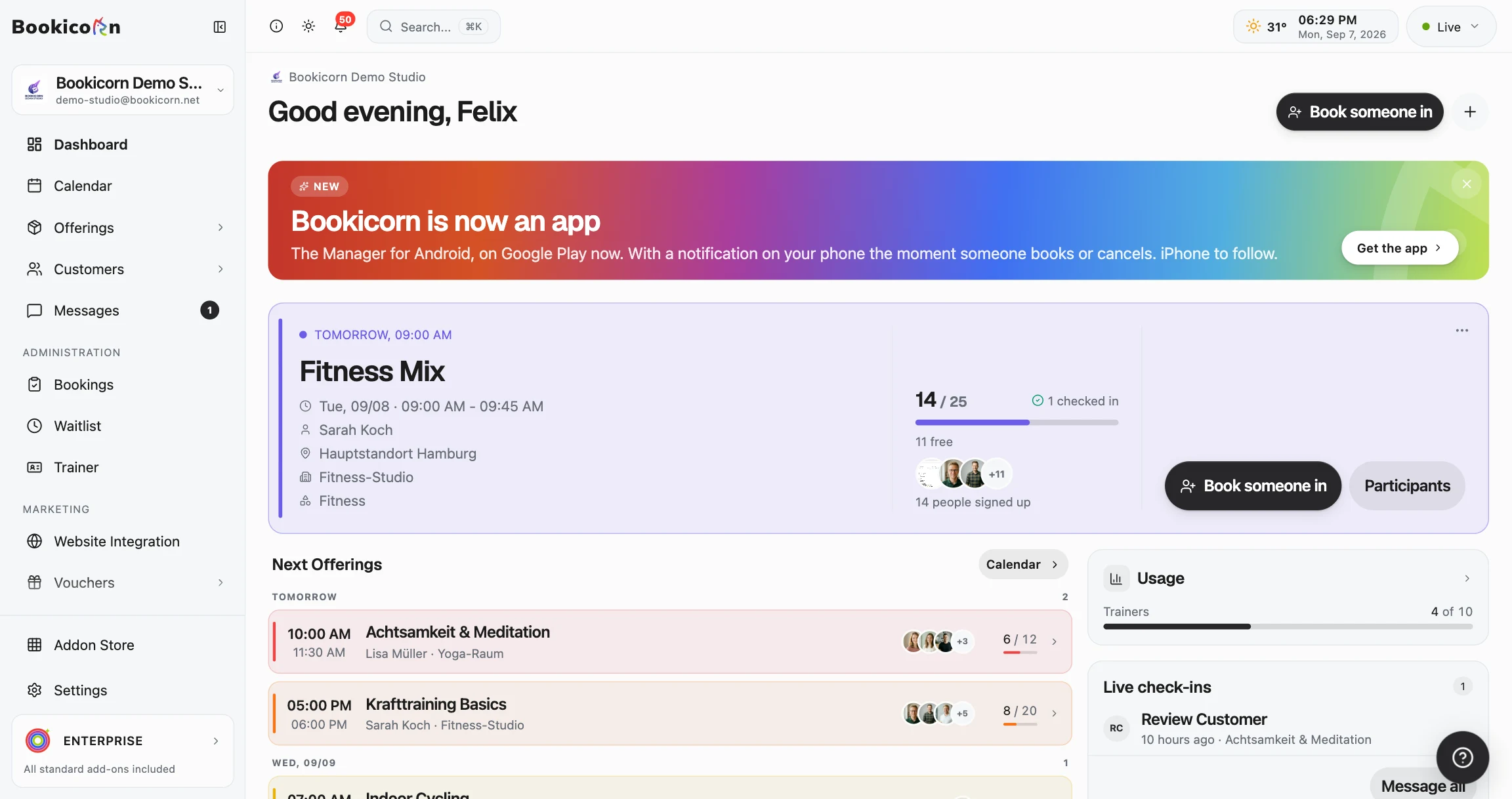
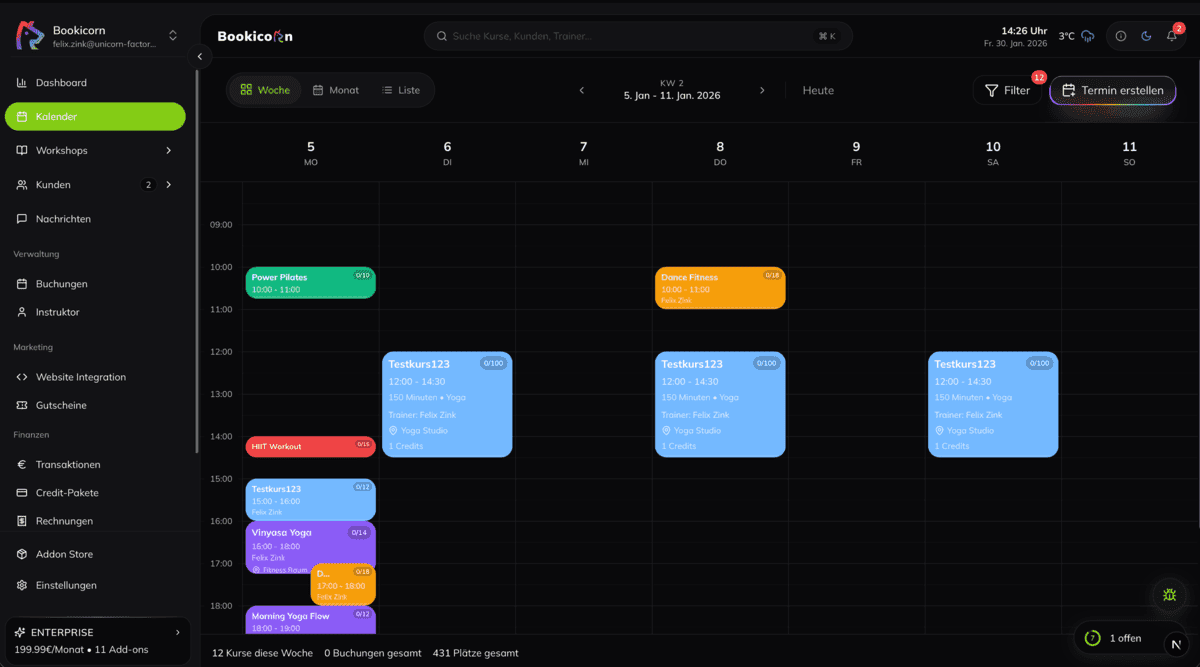
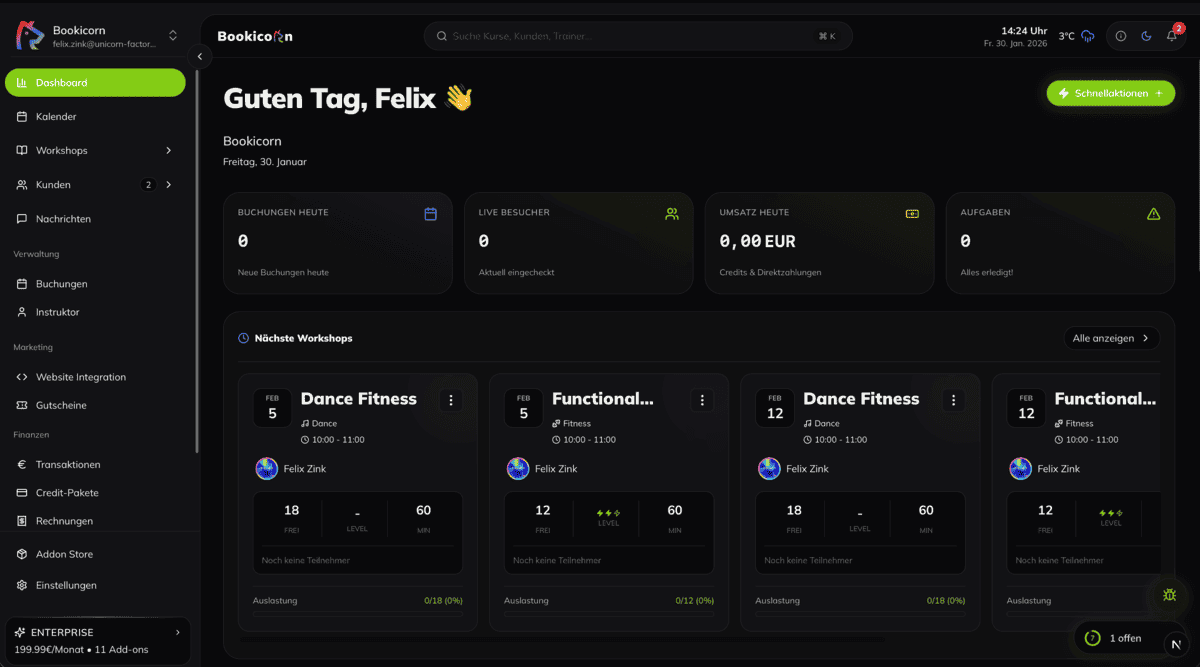
With an online booking system like Bookicorn, participants can sign up independently, cancel when weather is bad, and receive automatic notifications.
- Participants book and cancel independently
- Automatic reminders before class
- Waitlist for fully booked classes
- Flexible class sizes
Communication for last-minute changes
With outdoor classes, last-minute changes happen more frequently. Ensure you can reach all participants quickly – via push notification, email, or SMS through your booking system.
Frequently asked questions about outdoor fitness classes
The most important questions and answers about outdoor fitness classes at a glance.
Conclusion
Offering outdoor fitness classes is worthwhile – for you and your participants. Entry costs are low, demand is growing, and you reach audiences who would never enter a traditional studio.
Preparation is key: get the necessary permits, secure yourself with professional liability insurance, and plan clear weather rules. With a digital booking system you keep overview even with last-minute changes.
Start small with one class per week, gather experience, and expand your outdoor offering step by step.

Written by
Felix Zink
Felix built Bookicorn from the ground up – from the booking system and credit system to trainer payouts. As a full-stack developer at Unicorn Factory Media GmbH, he builds software that makes everyday life easier for studios.
Was this article helpful?
Rate this post