







A no-show fee affects every studio that works with fixed appointments: participants book a class, fail to attend, and the spot remains empty. For yoga studios, Pilates studios, dance schools and fitness class providers, this means lost revenue, wasted capacity and frustrated waitlisted clients.
Studies from the service industry show that up to 20 percent of all appointments can be affected by no-shows. For a studio with ten classes per day and an average of 15 participants, losses quickly add up to several hundred euros per week. Over a year, this can mean five-figure amounts.
The problem extends beyond pure revenue loss: trainers prepare for full classes, rooms and equipment are blocked, and waitlisted participants would have gladly taken the spot. Without a clear policy, a system emerges that punishes those who reliably show up.
This guide explains the legal framework for studios, provides sample terms and conditions clauses ready to use, and presents proven strategies to permanently reduce no-shows in your studio. You will also receive email templates for the most important communication scenarios.
What Is a No-Show Fee?
Definition and distinction
A no-show fee (also called a cancellation charge or failure-to-attend fee) is an amount that a service provider charges when a client does not attend a scheduled appointment and fails to cancel in time. It differs from a cancellation fee, which becomes due when a cancellation occurs within a specific timeframe, while the no-show fee applies when the client fails to appear without any notification.
For studios, this distinction matters: a cancellation 24 hours in advance allows the spot to be filled by another participant. A no-show, on the other hand, leaves no room for action.
No-show rate: how many clients fail to attend?
No-show rates vary by industry and business model. In the restaurant sector, rates of 10 to 20 percent have been reported. In class and fitness studios, rates typically range from 5 to 15 percent, depending on factors such as class type, time of day, and payment model.
Free bookings tend to result in higher no-show rates than bookings where payment has already been made. This phenomenon is psychologically explainable: people who have already paid perceive the appointment as more valuable.
Legal Framework: Can Studios Charge a No-Show Fee?
The short answer is: yes, under certain conditions a no-show fee is legally permissible. The exact requirements depend on the contract structure.
Legal basis
Booking a class typically constitutes a service contract. If the client does not attend, this constitutes a default of acceptance. Under the law, the service provider can in principle demand the agreed fee. However, they must deduct what they saved by not providing the service or earned through alternative use of their capacity.
Courts have confirmed that a failure-to-attend fee can be charged under certain conditions when a client does not appear at the agreed appointment without timely cancellation.
Requirements for valid no-show fees
For a no-show fee to be valid, several conditions must be met:
- Contractual agreement: The fee must be clearly communicated and accepted by the client before booking.
- Transparency: The terms and conditions must clearly state when the fee applies and how much it is.
- Proportionality: The fee must not exceed the actual damage. Flat rates must be proportionate.
- Demonstrability: In case of dispute, the studio must be able to prove the damage incurred.
Appropriate fee amounts
The amount of a no-show fee should reflect the actual financial damage. The following guidelines have proven effective:
- Single bookings: 50 to 100 percent of the class price
- Subscription classes: A proportional amount, e.g., the single class price
- Premium offerings (personal training, individual coaching): Higher fees are justifiable as the damage is greater
Important: The fee must allow the client the opportunity to demonstrate a lesser damage. A rigid flat rate without this option may be deemed unreasonable by courts.
Drafting Terms and Conditions: Templates and Wording
Your terms and conditions are the backbone of your no-show policy. Only when the clause is correctly worded and presented to the client before booking is it enforceable in a dispute.
Mandatory elements of a no-show clause
An effective no-show clause must contain the following elements:
- Cancellation deadline: When is a cancellation considered late? (e.g. 24 hours before class)
- Fee amount: Specific amount or percentage of the class price
- Proof option: Note that the client can demonstrate lesser damage
- Exceptions: Rules for unavoidable absences (e.g. illness with medical certificate)
- Payment method: How and when is the fee collected?
Sample wording for studio terms
The following wording serves as a guide and should be adapted to your business model:
"In the event of non-attendance at a booked class without prior cancellation (no-show) or cancellation less than 24 hours before the class, a fee of [amount/percentage] of the class price will be charged. The participant may provide evidence that no damage or lesser damage was incurred. In case of documented illness (e.g. medical certificate), the fee is waived."
Common mistakes in terms clauses
- Excessive flat fee: Fees exceeding the class price are invalid.
- Lack of transparency: The clause must be clearly and understandably worded.
- No exceptions: A clause without any exceptions may be deemed unreasonable.
- Hidden placement: The clause must be actively presented to the client before booking, not buried in lengthy terms.
Strategies to Reduce No-Shows in Your Studio
A no-show fee alone does not solve the problem. The most effective studios combine multiple approaches to proactively prevent missed bookings.
Automatic reminders and confirmations
The most common reason for no-shows is simply forgetfulness. Automatic reminders via email, SMS or push notification 24 hours and again 2 hours before class can reduce no-shows by up to 80 percent.
Ideally, the reminder includes a cancellation link. This allows participants who cannot attend to release their spot with a single click. Booking software like Bookicorn sends these reminders fully automatically.
Waitlist management
An active waitlist turns cancellations from a problem into an opportunity. When a spot opens up, the next interested person moves up automatically and receives a notification. This only works when cancellation happens early enough.
That is why the waitlist system should be closely linked to the cancellation deadline. If you set a 24-hour deadline and the waitlist automatically fills spots, every timely cancellation becomes a satisfied new participant instead of an empty space.
Advance payment and credit card guarantee
The most effective measure against no-shows is a financial commitment at the time of booking. This can be an advance payment of the class price or requiring a credit card on file, from which the fee is automatically charged.
Studies from the restaurant industry show that advance payment can reduce no-show rates to below 1 percent. For studios with drop-in classes, this model is particularly suitable. For subscription clients, a credit system can alternatively be used where no-shows are deducted from the existing balance.
Communicate cancellation deadlines clearly
Formulate your cancellation deadline so that clients cannot miss it:
- In the booking confirmation: "Free cancellation up to 24 hours before class"
- In the reminder email: "Can’t make it? Please cancel by [time]."
- In the booking process: Checkbox or notice before confirmation
- On the class page: "Free cancellation up to 24h before, no-show fee applies after."
Use goodwill policies wisely
A rigid no-show policy can alienate clients. Smart studios use graduated goodwill policies:
- First no-show: Friendly reminder of the cancellation policy, no fee.
- Second no-show: Notice about the fee, possibly a reduced flat rate.
- From the third no-show: Full no-show fee per terms and conditions.
This tiered model shows goodwill while creating a clear incentive for reliable behavior. Document each tier in the system so you can prove in a dispute that the client was repeatedly notified.
No-Show Communication: Email Templates and Examples
The right communication around no-shows determines whether clients accept the policy or become frustrated. Here are proven templates for the most important situations.
Class reminder before the appointment
The reminder email is your most powerful weapon against no-shows. It should be friendly, contain essential information, and offer an easy cancellation path:
Subject: "Your class tomorrow at [time] – we look forward to seeing you!"
Content: Class name, date, time, location, and a prominent "Cancel booking" button. Add a note: "If you cannot attend, please cancel by [deadline] so we can offer the spot to waiting participants."
Message after a no-show
After a no-show, the tone is crucial: factual, not accusatory.
Subject: "We missed you today – [class name]"
Content: "Unfortunately, we could not welcome you to [class name] today. As no timely cancellation was received, a no-show fee of [amount] will be charged per our booking terms. If there were special circumstances, please do not hesitate to contact us."
Invoicing the no-show fee
If you do not collect the fee automatically, a clear, factual invoice referencing the relevant terms clause is recommended. Include the class name, date, relevant terms section, and fee amount. The more professional the invoice, the fewer disputes.
Implementing No-Show Fees Technically
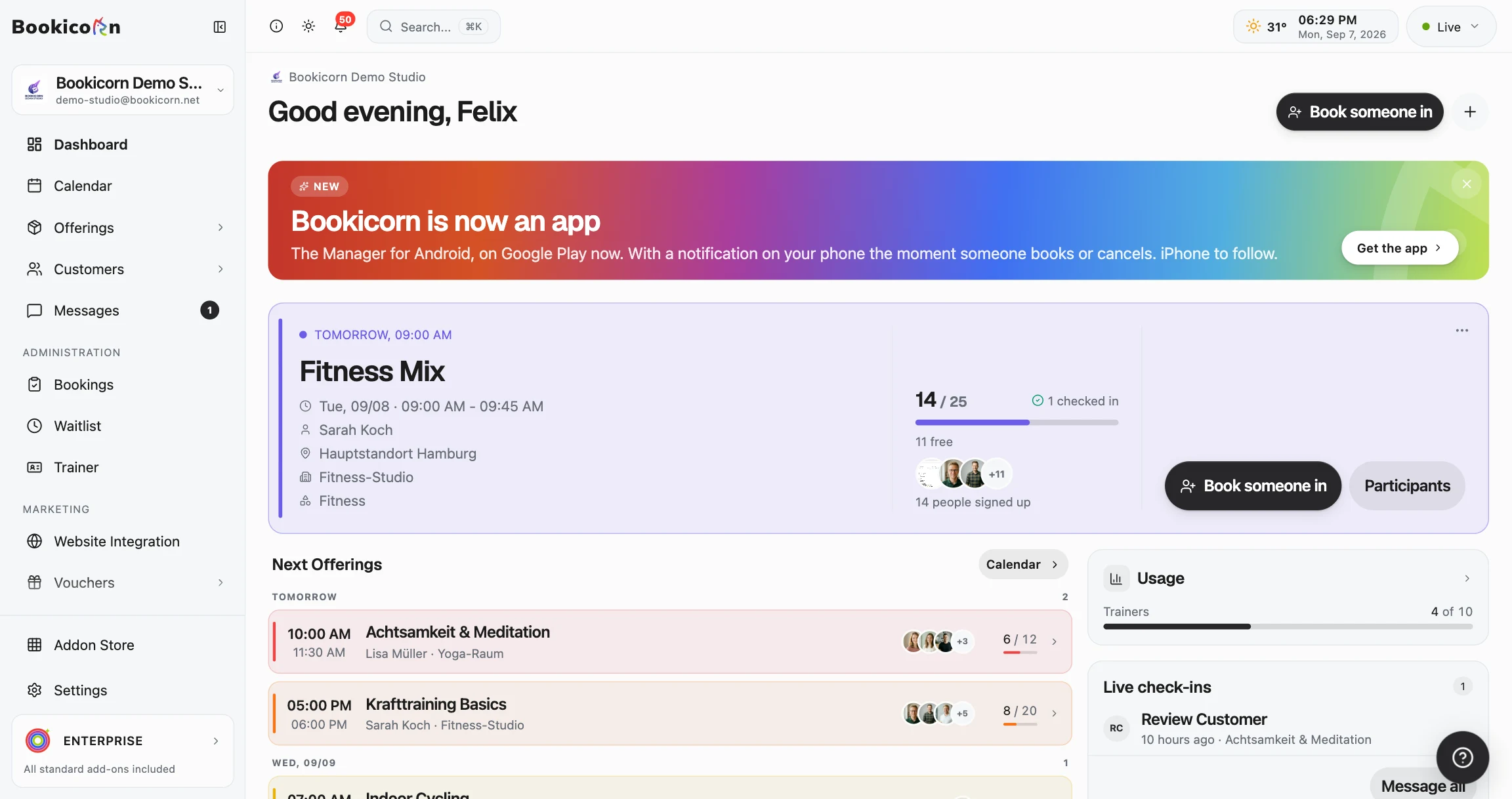
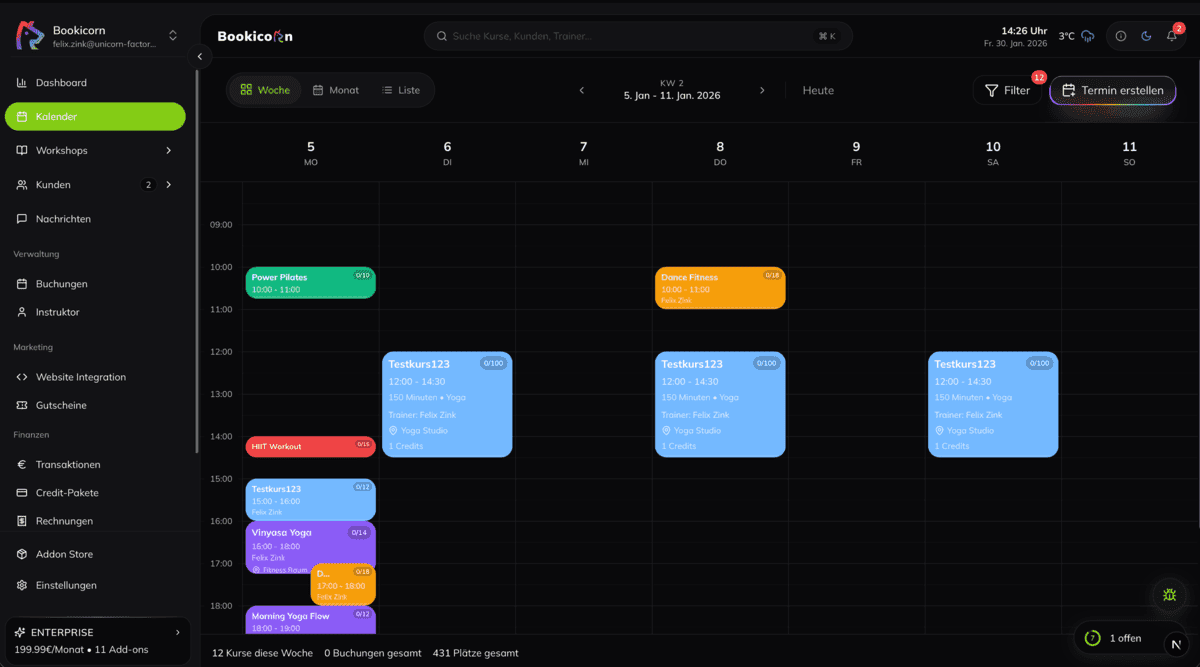
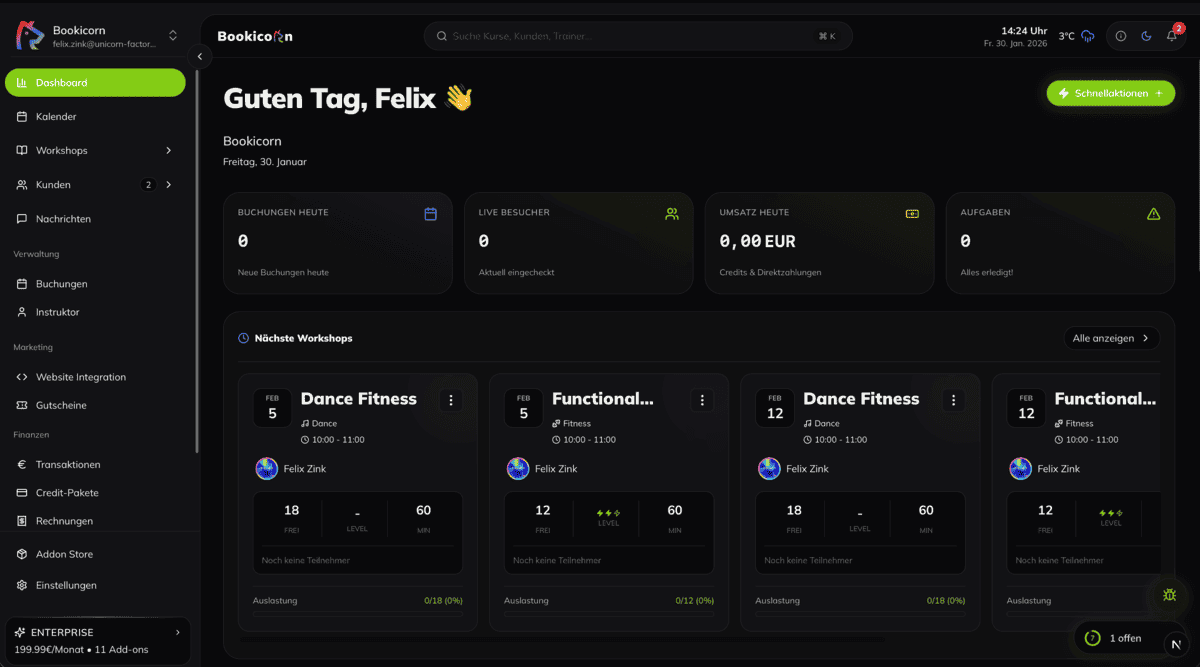
Manual no-show management is time-consuming and error-prone. Class management software automates the entire process.
Automatic fee collection with booking software
Modern booking systems offer integrated no-show features:
- Automatic detection: The system recognizes when a participant has not checked in and marks them as a no-show.
- Automatic fee collection: The stored payment method is charged or the amount is deducted from the credit balance.
- Automated reminders: Email and push reminders are sent automatically before each appointment.
- Waitlist progression: When a cancellation occurs, the next person on the waitlist is automatically moved up.
Integration into the booking process
The no-show policy should be seamlessly embedded in your booking workflow. During online booking, the client confirms the terms including the no-show clause via checkbox. The system automatically logs the consent, providing documented proof in case of a dispute.
Additionally, it is recommended to repeat the cancellation deadline in the booking confirmation and all reminders. This avoids surprises and increases acceptance among your participants.
Frequently Asked Questions About No-Show Fees
The most important questions and answers about no-show fees in class and fitness studios at a glance.
Conclusion
A no-show fee is a legitimate and effective tool for class and fitness studios against missed bookings. The key is proper legal structuring: transparent terms, proportionate fees, and clear communication.
Even more effective is the combination of fees and prevention. Automatic reminders, active waitlist management, and a financial commitment at the time of booking can reduce the no-show rate in your studio to nearly zero.
Invest in professional booking software that automates these processes, and draft your terms carefully. This protects your revenue, promotes fairness toward waiting participants, and gives you full control over your class occupancy.

Written by
Felix Zink
Felix built Bookicorn from the ground up – from the booking system and credit system to trainer payouts. As a full-stack developer at Unicorn Factory Media GmbH, he builds software that makes everyday life easier for studios.
Was this article helpful?
Rate this post