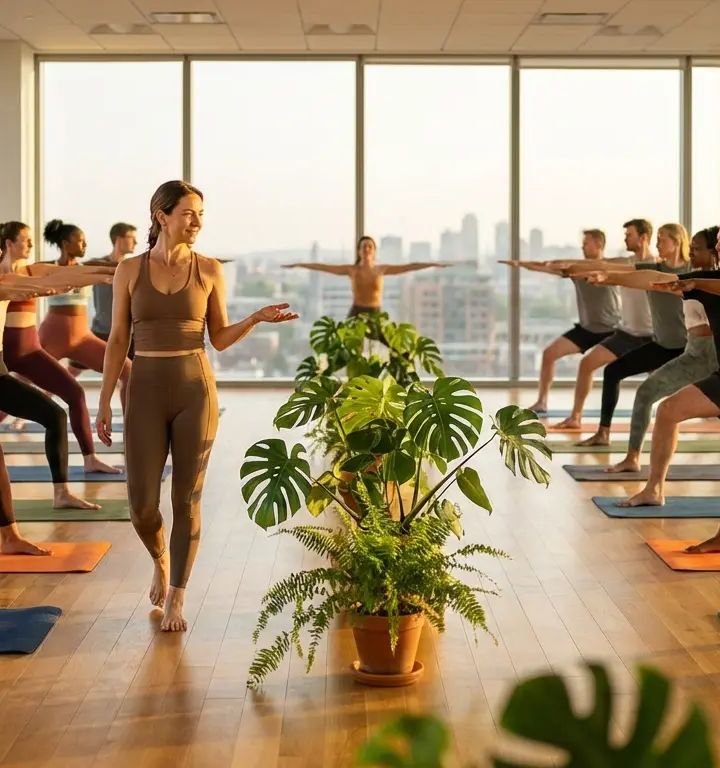






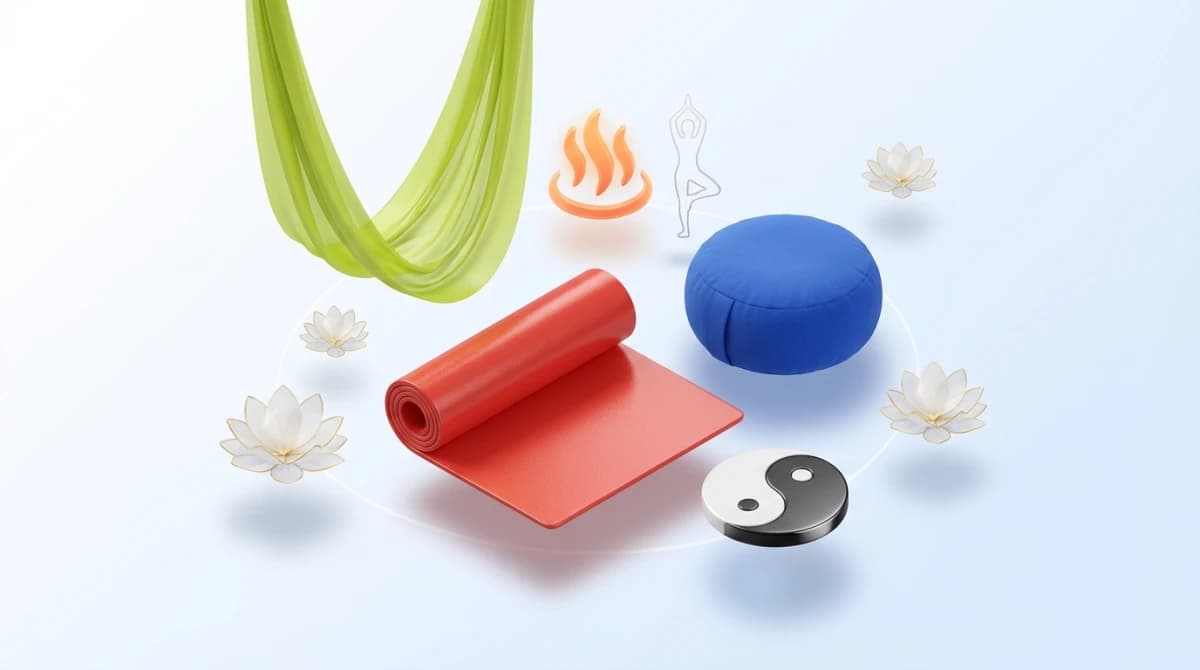
Yoga styles differ fundamentally in pace, intensity and objectives. Whether dynamic Vinyasa, relaxing Yin or acrobatic Aerial Yoga - the variety of styles is as vast as the target audiences they attract. For yoga enthusiasts and studio owners alike: knowing the different yoga types leads to better decisions - whether choosing your own training or planning classes for your studio.
In this comprehensive overview, we present the 12 most popular yoga styles. You will learn which types are currently most in demand, who they are suited for, and which yoga trends in 2026 are shaping the industry. Each style is described with its effects, difficulty level and target audience - helping you or your class participants find the perfect starting point.
What makes yoga so popular?
Yoga as a holistic workout
Yoga combines physical movement with mental relaxation - a concept that is becoming increasingly important in our performance-driven society. According to the German Yoga Teachers Association (BDY), over 11 million people in Germany practise yoga regularly. The market has been growing continuously for years, with demand for specialised class formats rising particularly strongly.
Unlike many sports, yoga is extremely adaptable: from high-intensity Power Yoga to meditative Yin Yoga, the spectrum covers every level of intensity. This diversity of yoga styles explains why yoga appeals to people of all age groups and fitness levels.
Who is yoga suitable for?
In principle, yoga is suitable for everyone - provided the right style is chosen. Three factors are decisive:
- Fitness level: Beginners are best starting with Hatha or Yin Yoga, while advanced practitioners can try Ashtanga or Power Yoga
- Goals: Stress relief (Yin, Restorative), fitness (Vinyasa, Power Yoga), flexibility (Hatha, Iyengar)
- Health conditions: For back problems, Iyengar and Yin Yoga are particularly suitable as they have a therapeutic focus
Classic Yoga Styles: The Most Well-Known Types
The classic yoga styles form the foundation on which all modern variations are built. These types have proven themselves over decades and are taught in yoga studios worldwide.
Hatha Yoga - the timeless classic
Hatha Yoga is arguably the most well-known of all yoga styles and the ideal entry point for beginners. The term "Hatha" translates to "force" or "effort" and describes the conscious connection of body postures (asanas), breathing exercises (pranayama) and meditation.
In Hatha Yoga, individual positions are held for comparatively long periods - typically 30 seconds to 2 minutes. The pace is calm, with the focus on correct alignment. This method is excellent for building a solid foundation and understanding the core principles of yoga.
Benefits: Improved flexibility, muscle strengthening, stress reduction. Hatha Yoga is particularly popular with studios that want to appeal to a broad audience - from teenagers to seniors.
Vinyasa Yoga - dynamic and creative
Vinyasa Yoga is characterised by flowing movement sequences in which breathing and movement are synchronised. Unlike Hatha Yoga, positions change quickly here - each inhalation and exhalation accompanies a position change.
The creativity lies in the sequence: no two Vinyasa classes are identical. Teachers design their own flows, making this style particularly varied. Vinyasa Yoga burns significantly more calories than static styles and primarily appeals to people who are looking for a real workout alongside the mental component.
Typical participants: Fitness-minded individuals aged 25 to 45 who want to combine a sporting challenge with mindfulness. In many studios, Vinyasa is among the most highly demanded class formats.
Ashtanga Yoga - powerful and structured
Ashtanga Yoga follows a fixed sequence of positions organised in six progressive series. The first series ("Primary Series") takes around 90 minutes and comprises approximately 75 positions. Each position is held for five breaths before moving to the next.
This structured approach makes Ashtanga particularly measurable: practitioners can clearly track their progress. At the same time, the style is physically very demanding and requires a certain baseline fitness. In the so-called "Mysore Style", participants practise the series at their own pace while the teacher provides individual corrections.
Ashtanga is suited for disciplined personalities who value clear structures and are willing to work on their practice long-term.
Iyengar Yoga - precise and therapeutic
Iyengar Yoga was developed by B.K.S. Iyengar and places extreme emphasis on correct body alignment in every position. Characteristic is the use of props such as blocks, straps, bolsters and chairs, which enable positions to be adopted in an anatomically correct manner - regardless of individual flexibility.
This precise method has a therapeutic approach: Iyengar Yoga is frequently recommended by physiotherapists and is particularly suitable for people with back pain, joint problems or recovering from injuries. Classes are often smaller than with other styles, as individual corrections are the focus.
For studio owners, Iyengar Yoga is a differentiating feature: the therapeutic orientation opens up a target group that purely sports-oriented offerings cannot reach. Yoga studios benefit from this expanded clientele.
Relaxing Yoga Styles for Inner Balance
Not everyone seeks an athletic challenge in yoga. The following yoga types focus on slowing down, deep stretching and mental regeneration. They are ideal for stressed professionals, rehabilitation patients or as a counterbalance to intensive sport.
Yin Yoga - deep stretching and letting go
Yin Yoga is the counterpoint to dynamic styles. Positions are held for 3 to 5 minutes, with the muscles consciously relaxed. The goal: reaching deep connective tissue layers (fascia), ligaments and joints that remain untouched during fast movements.
The practice is physically undemanding but mentally challenging. Remaining in a position for several minutes without distraction requires patience and mindfulness. This is precisely where the therapeutic value lies: Yin Yoga has been proven to reduce stress hormones and improve joint mobility.
Yin Yoga is one of the most highly demanded styles. For studios, it is an essential part of the class schedule. Since classes require little equipment and are suitable for large groups, they are particularly economically attractive.
Restorative Yoga - gentle regeneration
Restorative Yoga goes one step further than Yin Yoga: here, the focus is exclusively on passive relaxation. The body is fully supported by props in every position - bolsters, blankets, blocks and eye cushions ensure that no muscle tension is required at all.
Typically, only 4 to 6 positions are taken in a 75-minute class. The focus is on activating the parasympathetic nervous system. Restorative Yoga is frequently recommended for burnout, chronic pain or as an accompaniment to psychotherapy.
For studio owners, Restorative Yoga offers an opportunity to stand out from purely fitness-oriented offerings. The target group is willing to pay a higher class price for this specialised experience.
Yoga Nidra - conscious sleep
Yoga Nidra differs fundamentally from all other yoga types: there are no body postures. The entire practice takes place lying down, while a guided meditation leads practitioners through various states of consciousness.
A typical Yoga Nidra session lasts 20 to 45 minutes and is described as the equivalent of 2 to 4 hours of sleep. The state between waking and sleeping activates profound regeneration processes. Studies show positive effects for sleep disorders, anxiety disorders and post-traumatic stress.
In a studio context, Yoga Nidra is suitable as a complement to active classes - for example, as a 30-minute session after an intensive Vinyasa class. Many yoga studios now integrate Yoga Nidra as a fixed component of their class schedule.
Active and Demanding Yoga Styles
The following yoga styles are aimed at everyone who sees yoga as a real workout. They combine classic yoga elements with high intensity and appeal to a fitness-oriented target group.
Hot Yoga - intense in the heat
Hot Yoga is practised in a room heated to 35 to 40 degrees Celsius. The heat is intended to make muscles more supple, deepen stretching and promote detoxification through sweat. The best-known variant is Bikram Yoga with a fixed sequence of 26 positions in 90 minutes.
Physiologically, the heat causes an increased heart rate and higher calorie expenditure - comparable to moderate endurance training. However, Hot Yoga also carries risks: dehydration, circulation problems and overstretching are possible. Adequate fluid intake is absolutely essential.
For studio owners, Hot Yoga is an investment: room heating requires special technology and increases operating costs. At the same time, the format enables higher class prices. With over 3,400 monthly searches in Germany, demand is stable.
Aerial Yoga - training in weightlessness
Aerial Yoga uses fabric hammocks hanging from the ceiling to perform classic yoga positions in the air. The weightlessness enables inversions that would only be possible for advanced practitioners on the ground. Simultaneously, the fabric trains the deep stabilising muscles as the body must constantly balance.
The experience factor is particularly high with Aerial Yoga: the sensation of floating and the playful component appeal to a younger target audience. On social media, Aerial Yoga is one of the most frequently shared styles, providing studios with free reach.
The investment in aerial equipment (fabrics, ceiling mounting, carabiners) ranges from 2,000 to 5,000 euros for a room with 10 to 15 spots. The return on investment comes quickly, as aerial classes typically justify higher fees. With 6,600 searches per month, Aerial Yoga is one of the fastest-growing formats.
Power Yoga - fitness meets yoga
Power Yoga is the Western interpretation of Ashtanga Yoga, freed from the fixed sequence. The focus is on strength, endurance and flexibility. Classes are intensive, the music louder, the pace high. Power Yoga specifically targets people who come from the gym and are looking for an alternative to HIIT or functional training.
Characteristic are long holds in powerful positions such as warrior variations, planks and arm balances. A typical class lasts 60 minutes and can burn 400 to 600 calories. This makes Power Yoga one of the most calorie-intensive yoga styles.
For studios, Power Yoga offers the chance to reach a male target audience: while the proportion of women in classic yoga styles exceeds 80 per cent, Power Yoga attracts significantly more men.
Kundalini Yoga - energy and meditation
Kundalini Yoga combines dynamic exercises (kriyas) with breathing techniques, mantras and meditation. The goal is to activate the "Kundalini energy" that symbolically rests at the base of the spine. The practice includes rhythmic movements, chanting and intensive breathing exercises such as "Breath of Fire" (Kapalabhati).
Kundalini Yoga differs visually and atmospherically from other styles: practitioners traditionally wear white clothing and head coverings, and classes begin and end with mantras. This spiritual orientation appeals to a very specific target group.
In a studio context, Kundalini Yoga is a niche with a loyal regular clientele. Classes require specially trained teachers, which limits availability. At the same time, Kundalini practitioners are particularly loyal and willing to commit to long-term memberships.
Yoga Trends 2026: What Is Changing
The yoga industry does not stand still. Alongside the established yoga types, several developments are emerging for 2026 that will change the class offering in studios.
Hybrid yoga and online classes
The pandemic showed that yoga also works digitally. The trend towards hybrid formats has since solidified: studios offer classes simultaneously on-site and via livestream. For participants, this means maximum flexibility; for studios, an expansion of their catchment area beyond the city.
According to industry reports, around 35 per cent of yoga practitioners now use an online offering at least once a week. The technology has become affordable: a camera, a tripod and a stable internet connection are sufficient. Platforms like Bookicorn enable the management of in-person and online classes in one system.
Niche yoga for specific target groups
Specialisation is increasing. Prenatal yoga, yoga for seniors, yoga for chronic pain or yoga for children are no longer fringe areas but independent business fields. Studio owners who specialise in a niche report higher customer retention and less price pressure.
Further emerging niches include:
- Yoga for athletes: Targeted sequences for runners, cyclists or climbers
- Trauma-sensitive yoga: Specially trained teachers work with people after traumatic experiences
- Workplace yoga: Companies book classes for their employees - a growing B2B market
- Yoga 50+: Gentle formats focusing on mobility and fall prevention
Yoga in a corporate context
Corporate wellness is one of the strongest growth drivers. Companies recognise that workplace yoga reduces absenteeism, increases employee satisfaction and helps with recruitment. Studio owners can build a lucrative additional business here: corporate classes are typically booked at fixed prices and offer predictable revenue.
The entry barrier is low: short sessions of 30 to 45 minutes in conference rooms or outdoors, combined with simple breathing exercises and meditation. Many companies prefer yoga styles that do not require changing rooms - such as Chair Yoga or gentle Vinyasa in everyday clothing.
| Yoga Style | Intensity | For whom? |
|---|---|---|
| Hatha Yoga | Low-Medium | Beginners, seniors |
| Vinyasa Yoga | Medium-High | Fitness lovers, 25-45 |
| Yin Yoga | Low | Stressed |
| Hot Yoga | High | Detox fans |
| Aerial Yoga | Medium-High | Adventurous |
| Power Yoga | High | Gym-goers |
| Kundalini Yoga | Medium | Spiritually interested |
Yoga Equipment: What Studios and Participants Need
The right equipment depends significantly on the chosen yoga style. While some yoga types only require a mat, others need elaborate infrastructure. For studio owners, this is an important cost factor.
Basic equipment for every yoga studio
Regardless of the style offered, the basic equipment for a yoga studio includes yoga mats, blocks, straps and bolsters. High-quality mats cost between 30 and 80 euros each; with 15 spots, the initial investment is 450 to 1,200 euros. Cleaning supplies, disinfection spray and storage areas for participants are also needed.
The floor surface is important: a wooden floor or special yoga flooring absorbs impact and conveys a high-quality room feel. Carpet is unsuitable for most yoga types as it is slippery and difficult to keep hygienically clean.
Specialist equipment by yoga style
- Iyengar Yoga: Requires the most extensive equipment - in addition to standard props, wall ropes, folding chairs and special wooden benches. Investment: 3,000 to 8,000 euros for a fully equipped room
- Aerial Yoga: Silk hammocks, professional ceiling mounting and carabiners. The ceiling construction must be statically tested and support at least 300 kg per hanging point. Investment: 2,000 to 5,000 euros
- Hot Yoga: Requires a heating system that evenly heats the room to 35-40 degrees, plus efficient ventilation for humidity regulation. Monthly energy costs can be 500 to 1,500 euros
- Kundalini Yoga: Needs meditation cushions, sheepskins (traditional) or wool blankets and a good sound system for mantras. Comparatively low additional costs
Costs for participants
For yoga newcomers, the financial entry barrier is low: a yoga mat (from 20 euros) and comfortable clothing are sufficient to start. Advanced practitioners often invest in a high-quality mat (80 to 150 euros), their own block and a strap. For Hot Yoga, a non-slip towel (grip towel) and a large water bottle are added.
The average class visit in Germany costs 15 to 25 euros for a drop-in visit. Monthly memberships range from 60 to 120 euros, depending on the city and studio level. Special classes like Aerial Yoga are usually more expensive as group size is limited to 8 to 12 people.
Yoga in Transition: From Tradition to Modern Practice
To understand today's diversity of yoga styles, it is worth looking at the development of the discipline. Yoga originated over 5,000 years ago in the Indus Valley as a philosophical-spiritual practice. The physical exercises that are central today originally played a subordinate role - the focus was on meditation and breath control.
From the ashram to the West
The spread of yoga in the West began in the late 19th century when Indian scholars like Swami Vivekananda introduced yoga at Western universities. Yoga experienced its breakthrough as a mass movement in the 1960s and 70s when the Beatles travelled to India and yoga became part of the counterculture.
In the 1990s, professionalisation began: yoga teacher training was standardised, studio solutions were established and yoga was recognised by health insurers as preventive healthcare. Today, many German health insurers reimburse up to 80 per cent of course costs - an important argument for studio owners and participants alike.
Modern yoga fusions
The latest development shows a trend towards fusion formats that combine yoga with other disciplines. Examples include Barre Yoga (ballet meets yoga), Yogalates (yoga meets Pilates) and even Broga (yoga specifically for men). These hybrid formats lower the barrier for people who do not feel addressed by "classic" yoga.
For studio owners, fusion classes open up new target groups. A Yogalates class can, for example, introduce existing Pilates clients to yoga - and vice versa. Bookicorn's class management supports the flexible organisation of different class formats in one system.
Certifications and quality standards
With growing popularity, quality assurance becomes increasingly important. In Germany, the training standards of the Yoga Alliance (200h and 500h) and recognition by the BDY serve as quality benchmarks. Studio owners are advised to employ only certified yoga teachers, as this facilitates recognition by health insurers and strengthens participant trust.
Certification also affects the insurance situation: professional liability insurance only applies with proven qualifications, which is particularly relevant for physically demanding styles like Ashtanga, Aerial and Hot Yoga.
Putting Together the Right Class Schedule: Strategies for Yoga Studios
The selection of yoga styles for your own class schedule is one of the most important strategic decisions for studio owners. A well-thought-out schedule maximises room utilisation, addresses different target groups and creates a balanced mix of beginner and advanced offerings.
The 3-pillar strategy
Successful yoga studios build their class schedule on three pillars:
- Mass-market formats (60-70% of schedule): Hatha Yoga and Vinyasa Yoga form the backbone. These styles are accessible to most people and fill classes reliably. Ideally offered at various times - early morning before work, lunchtime and evening classes after work.
- Relaxation formats (20-25%): Yin Yoga, Restorative Yoga and Yoga Nidra complement the offering for participants seeking regeneration. These classes are particularly suitable for evening and weekend slots when demand for relaxation is highest.
- Specialist formats (10-20%): Aerial Yoga, Hot Yoga or Kundalini Yoga differentiate the studio from competitors. These classes justify higher prices and attract new target groups who would otherwise not visit a yoga studio.
Optimising time slots
The time of day significantly influences which yoga styles are in demand:
- 06:00-08:00: Dynamic formats like Vinyasa or Power Yoga. Early risers seek an energising start to the day.
- 10:00-12:00: Hatha and Iyengar Yoga. Mornings are often used by seniors, parents and freelancers.
- 12:00-13:30: Short, intensive sessions (45 min). Power Yoga or Vinyasa during lunch break.
- 17:30-19:30: Strongest demand. Vinyasa, Hatha and Aerial fill almost by themselves.
- 20:00-21:30: Yin Yoga, Yoga Nidra and Restorative. Evening is for relaxation.
Seasonal adjustments
Demand for different yoga types fluctuates seasonally. In January, demand for all styles rises sharply (New Year resolutions). In summer, outdoor sessions and lighter formats are popular, while in autumn and winter demand for Hot Yoga and Yin Yoga noticeably increases.
A flexible class schedule that responds to seasonal fluctuations can increase occupancy by 15 to 25 per cent. Summer specials like park yoga or rooftop sessions additionally generate attention and bring new participants to the studio.
Marketing for different yoga styles
Each yoga style addresses a different target group and requires accordingly adapted marketing:
- Vinyasa and Power Yoga: Instagram Reels, fitness influencers, gym cooperations. Emphasise the workout character.
- Yin and Restorative: Calm visuals, wellness blogs, cooperations with psychologists. Emphasise stress relief.
- Aerial Yoga: Visually spectacular content for TikTok and Instagram. The photogenic positions generate organic reach.
- Hot Yoga: Before-and-after stories, detox marketing, challenges. The community often forms by itself.
Regardless of the style, a professional online presence is crucial. A clear online class schedule with booking capability significantly reduces the barrier for new customers. Studies show that studios with online booking record up to 40 per cent more first-time visitors.
Which Yoga Style Suits Whom?
Choosing the right yoga style depends on individual goals, physical condition and personal preferences. Here is a guide for the most common starting situations.
Yoga for beginners
Those who have never done yoga before are best starting with Hatha Yoga or Yin Yoga. Both styles offer a calm pace, detailed explanations and require no prior knowledge. Iyengar Yoga is also suitable, as the props prevent poor posture. Beginners should avoid Ashtanga and Hot Yoga - the intensity without prior experience can lead to overexertion.
Yoga for advanced practitioners
Experienced practitioners looking to push their limits will find the greatest challenge in Ashtanga Yoga and Power Yoga. Aerial Yoga offers an entirely new range of movement and trains body awareness at an advanced level. For meditative deepening, Kundalini Yoga is recommended.
Yoga for athletes and fitness enthusiasts
Those coming from the gym and looking for a complement will find the familiar training stimulus in Vinyasa and Power Yoga. These styles improve flexibility and recovery - two areas that are often neglected in traditional strength training. Yin Yoga as a counterbalance to hard training is increasingly valued by professional athletes as a recovery method.
Yoga for back pain and stress
For physical complaints, the therapeutic effect takes centre stage. Iyengar Yoga is the first choice here: precise alignment and the use of props protect against incorrect loading. For stress-related complaints, Yin Yoga and Yoga Nidra are proven effective. Important: for acute complaints, medical advice should be sought before starting yoga practice.
Conclusion: Diversity as the Strength of the Yoga World
The world of yoga styles is more diverse than ever. From classic types like Hatha and Ashtanga, through therapeutic approaches like Iyengar and Yin Yoga, to innovative formats like Aerial and Hot Yoga - there is a suitable style for every goal and every fitness level.
For studio owners, this diversity represents a great opportunity: those who offer different yoga types appeal to different target groups and create multiple revenue streams. The 2026 trends - hybrid formats, niche yoga and corporate wellness - open up additional business fields.
The key is not to chase the latest trend, but to build a class offering that fits your own positioning and target audience. Three solid core formats, complemented by one or two specialised offerings, form the foundation for a successful yoga studio.

Written by
Felix Zink
Felix built Bookicorn from the ground up – from the booking system and credit system to trainer payouts. As a full-stack developer at Unicorn Factory Media GmbH, he builds software that makes everyday life easier for studios.
Was this article helpful?
Rate this post