






Starting your own music school is the dream of many musicians who want to turn their passion into a profession. But between the initial idea and the first lesson, there are numerous decisions to make: What qualifications do you need? How do you create a viable business plan? And what costs should you expect?
The market for music education is stable and growing. Approximately 1.5 million students regularly take music lessons in Germany alone – at public and private music schools, with freelance teachers, or online. Private music schools in particular have been experiencing steady growth for years, as they often offer more flexible lesson times, a wider range of instruments, and more personalized instruction than municipal institutions.
In this comprehensive guide, you will learn step by step how to start a music school: from the formal requirements and financial planning to proven strategies for attracting students. We will show you which legal structure is most suitable, how to calculate your prices, and which digital tools can reduce your administrative workload. Along the way, you will benefit from practical tips from experienced music school operators and concrete industry figures.
Whether you want to start as a solo teacher or build a team of music educators from the beginning – this article provides you with the tools for a successful launch.
Requirements for Your Own Music School
Before you hand out your first flyer, you should clarify the basic requirements. These concern your qualifications, the legal framework, and suitable premises.
Qualifications and Training
In principle, there is no legally mandated qualification to give music lessons in Germany. Neither a university degree nor a specific diploma is strictly required. Nevertheless, parents and students rightly expect a solid musical education. In practice, most successful music school operators have one of the following backgrounds:
- Music degree (instrumental or vocal pedagogy at a music conservatory)
- Music education training (e.g., Bachelor in Music Education)
- Extensive stage experience combined with additional qualifications such as the Suzuki Method, Kodály Method, or Orff Schulwerk
- Recognized certificates from music associations
Even without a formal degree, you can build a music school as a career changer. What matters is that you can demonstrate your competence – through performances, references, or documented teaching experience.
Business Registration or Freelance Status?
The question of tax classification is particularly important for music school founders. Music instruction is generally classified as a freelance profession if you teach personally. As a freelancer, you do not need to register a business, pay no trade tax, and can use a simplified income statement instead of double-entry bookkeeping.
However, once you employ teaching staff, operate a commercial music school with multiple locations, or sell instruments alongside teaching, this usually constitutes a commercial activity. In this case, you will need a business license and be subject to trade tax obligations.
Important: Review your individual situation with a tax advisor early on. The boundary between freelance and commercial activity in the music sector is often fluid.
Premises and Equipment
The choice of premises significantly influences your business model. You basically have three options:
Your own teaching rooms: The most professional appearance but highest fixed costs. Expect 10 to 20 euros per square meter in cold rent depending on location. A teaching room should be at least 15 to 20 square meters, soundproofed, and well ventilated.
Rented rooms on an hourly basis: Flexible and cost-effective for starting out. Community centers, churches, or cultural associations often provide rooms at favorable rates.
Teaching at the student’s home: No rental costs, but travel expenses and time. This model is particularly suitable for individual lessons with children.
For basic equipment, plan for: instruments for teaching, music stands, a mirror for posture control, chairs in various heights for children and adults, and basic teaching materials.
Business Plan for Your Music School
A solid business plan is your roadmap for the first years of operation. It not only helps with your own planning but is also a prerequisite for grants and bank loans.
Target Audience and Positioning
Define clearly who you want to reach. The target groups of a music school differ significantly in their needs:
- Children (ages 4 to 12): Early music education, playful introduction, short lesson units. Parents are the decision-makers.
- Teenagers (ages 13 to 18): Band projects, exam preparation, modern music styles. They want flexibility and a cool atmosphere.
- Adults: Late starters, returning learners, or advanced players. They prefer evening appointments and value individual attention.
- Seniors: A growing target group with high willingness to pay. Group offerings such as drum circles or choir singing are popular.
Your positioning results from the intersection of demand, competition, and your personal strengths. Analyze the local market: How many music schools exist in your area? Which instruments are offered? Where are the gaps?
Course Offerings and Pricing
A music school’s offerings typically include individual lessons, group lessons (2 to 5 students), ensembles, and workshops. Pricing is based on several factors:
- Region: In major cities, hourly rates of 40 to 70 euros for 45-minute individual lessons are common. In rural areas, prices range from 25 to 45 euros.
- Qualification: Trained music educators can charge higher prices than career changers.
- Teaching format: Group lessons are cheaper per student but generate more revenue per time unit.
A proven model is a subscription model with monthly flat rates. For 4 lesson units of 45 minutes per month, typical prices range between 100 and 200 euros monthly. This model ensures predictable income and binds students long-term.
Financial Planning and Start-up Capital
Create a detailed overview of your income and expenses for the first 12 months. Plan conservatively: assume that you will only utilize 30 to 50 percent of your capacity in the first three months and won’t reach full utilization until six to twelve months later.
The required start-up capital depends heavily on your business model. For a music school with its own premises, you should expect at least 10,000 to 30,000 euros. Those who teach at students’ homes or in rented rooms can start with as little as 2,000 to 5,000 euros.
Funding sources for music school founders:
- Start-up grant from the employment agency (when founding from unemployment)
- KfW start-up loan with favorable conditions
- Microloans up to 25,000 euros
- Equity capital and savings
- Regional funding programs
Music School Costs: What to Budget For
Cost transparency is crucial for economic success. Distinguish between one-time start-up costs and ongoing operating costs.
One-Time Start-Up Costs
A realistic breakdown for a small music school with two teaching rooms:
- Deposit and renovation: 3,000 to 8,000 euros
- Instruments: 3,000 to 15,000 euros (piano, guitars, drums)
- Furniture, soundproofing, equipment: 3,000 to 8,000 euros
- Website and marketing: 500 to 3,000 euros
- Reserve cushion (3 months): 3,000 to 6,000 euros
Total range: 13,000 to 41,000 euros. Those starting without their own premises can manage with 2,000 to 5,000 euros.
Ongoing Monthly Costs
- Rent (approx. 50 m²): 500 to 1,200 euros
- Utilities: 150 to 300 euros
- Insurance: 100 to 250 euros
- Marketing: 100 to 300 euros
- Administration and accounting: 130 to 400 euros
Total monthly fixed costs: 1,060 to 2,650 euros.
Earning Potential
A solo self-employed teacher with 25 students at 130 euros per month generates 3,250 euros in revenue. After deducting fixed costs (approx. 500 euros for hourly room rental) and social insurance, approximately 1,900 to 2,500 euros net remain. With a larger music school and three teaching staff, 2,500 to 4,000 euros net is realistic. The break-even point typically lies at 12 to 18 months.
Legal Foundations and Insurance
The legal framework for a music school is complex but manageable. Early attention to legal structure, social insurance, and coverage protects you from costly surprises.
Choosing a Legal Structure
Sole proprietorship (freelancer): The simplest option for solo teachers. No minimum capital requirement, low founding costs, but unlimited personal liability.
Partnership: For two or more founders. Easy to establish, but all partners have unlimited liability. Non-profit LLC: Particularly interesting for music schools with a social mission. Tax advantages and easier access to grants, but minimum share capital of 25,000 euros.
Social Insurance and Coverage
The Künstlersozialkasse (KSK) is a great relief for self-employed music teachers: you only pay half of the contributions for health, nursing, and pension insurance. Requirements: artistic activity, annual income above 3,900 euros, no more than one employee.
Essential insurance policies:
- Business liability insurance (from 200 euros/year) – mandatory when teaching children
- Disability insurance – your ability to work is your capital as a musician
- Instrument insurance – recommended from an instrument value of 5,000 euros
Attracting and Retaining Students Long-Term
Sustainable student acquisition is the biggest challenge in everyday music school life. A combination of local presence, referral marketing, and digital tools leads to success.
Local Marketing and Online Presence
Google Business Profile: Create a complete profile with photos, opening hours, and reviews. For many parents, the Google search is the first point of contact.
Own website: A professional website clearly showcasing your offerings, prices, and contact options is essential. Over 60 percent of visits are mobile. Ensure fast loading times and easy contact options via form or messaging.
Social media: Instagram and Facebook are excellent for sharing insights into daily teaching life. Post short videos of student performances (with consent), practice tips, or classroom impressions. TikTok reaches younger audiences effectively.
Actively Promote Referral Marketing
Over 70 percent of all new music school registrations come through personal recommendations. Actively foster this channel:
- Referral program: Offer existing students a month’s discount or a free extra lesson for every successful referral.
- Recitals: Organize regular concerts and invite families and friends. These events are the best advertisement for your teaching quality.
- School partnerships: Offer music clubs or instrument demonstrations at elementary schools. This gives you direct access to your core target group.
- Local presence: Place flyers in kindergartens, libraries, and community centers. Offer free trial lessons at neighborhood events.
Student Retention Through Quality and Service
Acquiring a new student is five times more expensive than retaining an existing one. Therefore, invest strategically in retention:
- Regular feedback: Inform parents about learning progress and schedule semi-annual meetings.
- Flexible lesson times: Offer make-up lessons in case of illness. Rigid cancellation policies lead to frustration and cancellations.
- Performance opportunities: Create stages for your students – whether summer concerts, Christmas recitals, or band nights.
- Sense of community: Ensembles, bands, and workshops create a school community that goes beyond individual lessons.
Digital Management and Booking Software
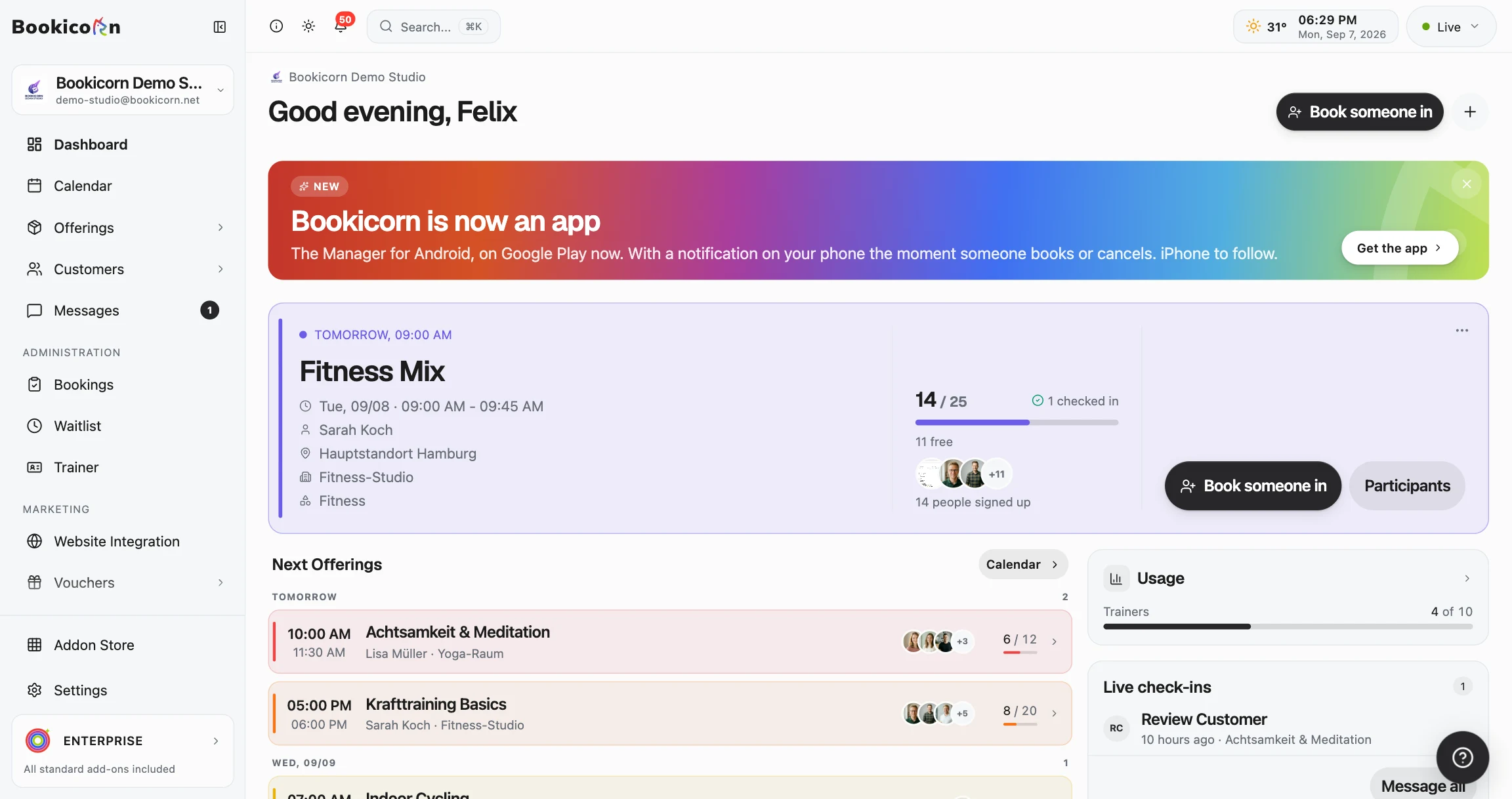
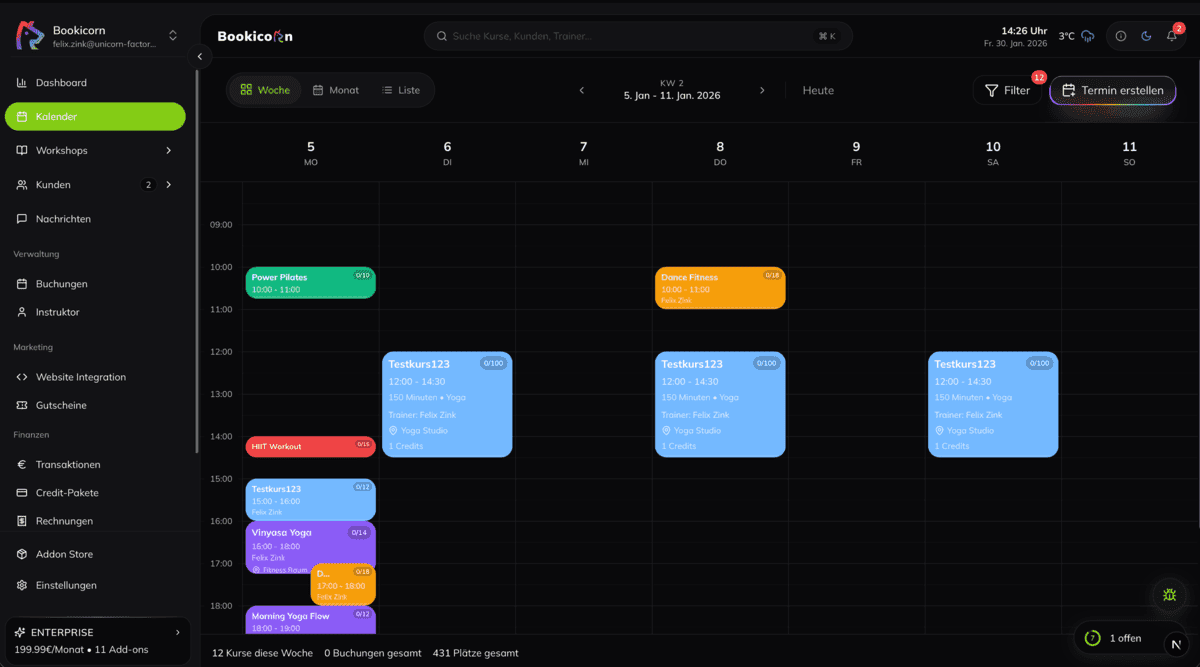
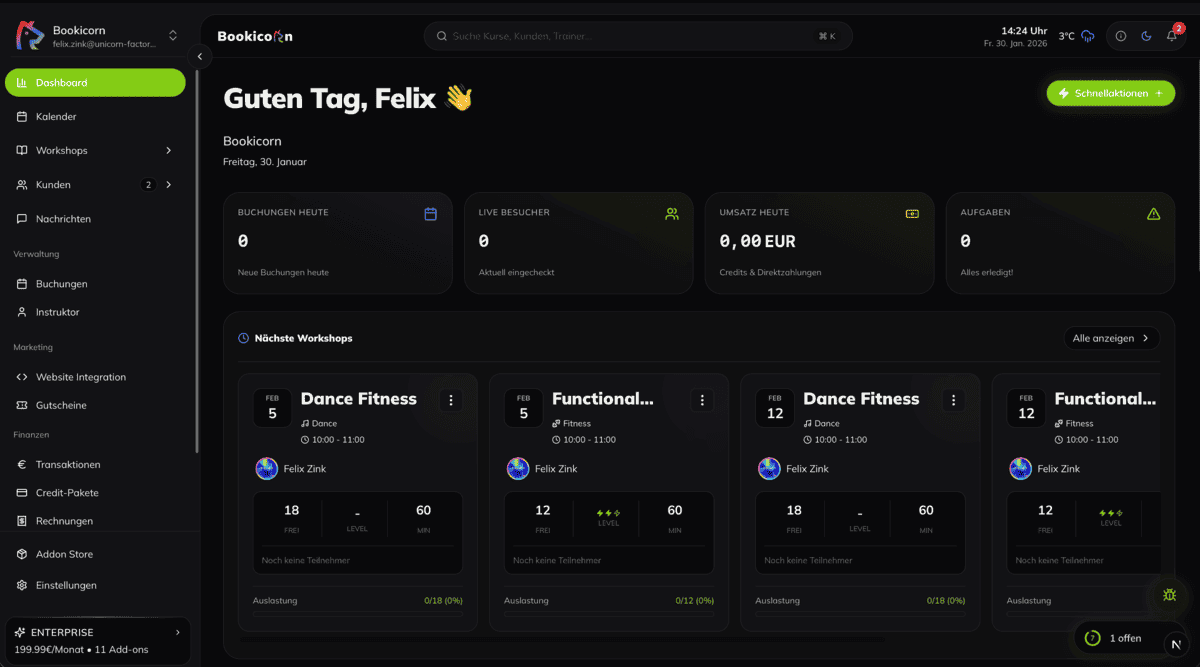
From 20 students onwards, manual management via spreadsheets becomes a time sink. A professional booking software for music schools automates scheduling, registrations, invoicing, and communication with students and parents. This saves several hours of administrative work per week.
When choosing, look for: intuitive operation, mobile usability, integrated payment processing (direct debit for subscription models), and a messaging function for students and parents.
Online Lessons as a Supplement
Hybrid teaching is a real unique selling point. Piano, guitar, voice, and music theory can be taught well online. The investment in a good microphone and webcam is 200 to 500 euros. Offer online lessons as an option for scheduling conflicts or illness – this significantly increases retention and reduces missed lessons.
Practical Tips for a Successful Start
The following recommendations come from the experiences of successful music school operators and help you avoid common beginner mistakes.
Start Small and Grow Organically
The most common mistake when founding music schools: thinking too big and investing too much. Instead, start with five to ten students, a manageable range of instruments, and low fixed costs. As demand grows, you can expand step by step – rent larger rooms, hire additional teachers, and broaden your offerings.
This organic growth approach has clear advantages: you keep financial risk low, get to know your target audience, and can adjust your concept before making larger investments. Many successful music schools started in a rented apartment or basement studio. Plan milestones: rent your first dedicated room at 15 students, hire a second teacher at 30, and consider a second location at 50.
Find Your Niche and Develop a Unique Selling Point
In a market with established music schools, you need a clear profile. Ask yourself: why should students come specifically to me? Successful niche strategies:
- Instrument specialization: Become the go-to address for piano, drums, or voice in your region.
- Target group focus: A music school specifically for adults, seniors, or toddlers under 4.
- Musical style: Jazz, pop, and rock instead of classical repertoire – or vice versa.
- Special formats: Music camps during holidays, band projects to join, or monthly open mic nights.
A clearly communicated unique selling point makes you visible and recommendable. It is better to be number one in a niche than to disappear in the broad market.
Build a Network and Leverage Synergies
Connect early with relevant partners in your region:
- Other music schools: Rather than fearing competition, refer students to each other – for example, when an instrument is not in your offering.
- Schools and kindergartens: Offer music clubs or instrument demonstrations at elementary schools. This gives you direct access to your core target group.
- Music associations and orchestras: Collaborations on performances and youth development strengthen your image.
- Professional associations: The Federal Association of Independent Music Schools offers advice, insurance rates, and a quality seal.
A strong network brings referrals, performance opportunities, and access to funding – three factors that are crucial for growth.
Franchise as an Alternative to Starting From Scratch
If you don’t want to start from zero, you can consider a franchise model. Providers like Yamaha Music School, Modern Music School, or KlingKlong offer proven concepts, teaching materials, marketing support, and a well-known brand name. In return, you pay a license fee and are bound to the specified concept.
Franchising is particularly suitable for founders who have less business experience but sufficient start-up capital. Review the contract terms carefully and speak with existing franchisees before committing.
Frequently Asked Questions About Starting a Music School
The most important questions and answers about starting a music school at a glance.
Conclusion
Starting a music school is a realistic and rewarding endeavor – provided you approach it in a structured way. You don’t need a million-euro investment or a doctorate. What you need is musical competence, entrepreneurial thinking, and the willingness to continuously work on your offering.
The key success factors:
- Clear positioning: Define your target audience and unique selling point before starting.
- Solid financial planning: Budget conservatively and keep a reserve of three months’ expenses.
- Digital management: Booking software saves hours weekly and conveys professionalism.
- Network and referrals: Invest in relationships with schools, associations, and other music schools.
Start small and grow organically rather than taking on too much risk with high fixed costs. The market for music education is stable and demand is growing. With the right concept, nothing stands in the way of successfully building your own music school.

Written by
Felix Zink
Felix built Bookicorn from the ground up – from the booking system and credit system to trainer payouts. As a full-stack developer at Unicorn Factory Media GmbH, he builds software that makes everyday life easier for studios.
Was this article helpful?
Rate this post