



Organizing swimming badge courses sounds routine – until the first session falls apart because the examiner gets sick, parents demand duplicate certificates, or the outdoor pool cuts your lane time. A Seepferdchen course ends well when every child passes. A well-organized course ends even better: parents book the follow-up course, your team works without stress, and you actually go home on time.
This guide walks you through planning, running, and examining swimming badge courses from Seepferdchen (the German early-swimmer badge) all the way to Gold in your swim school – with the official DLRG requirements, realistic group sizes, a proven lesson structure, and the organizational details that usually eat your time.
The four German swimming badges at a glance
Before you plan courses, you need to know the badges yourself. The Seepferdchen is not an official Deutsches Schwimmabzeichen in the strict sense – it is an early-swimmer badge, and children who hold it are not yet considered safe swimmers. The DLRG is clear about this: only a child who has passed Bronze has demonstrably learned to swim safely. Explain this distinction to every parent on day one, or you will create a dangerous false sense of security.
The three levels of the Deutsches Schwimmabzeichen – Bronze, Silver, and Gold – test rising distances as well as diving, jumps, and theoretical knowledge. A Gold candidate also handles rescue techniques such as transport swimming. Design your course structure so that each stage builds seamlessly on the previous one.
Seepferdchen: the entry level for young swimmers
For most children, the Seepferdchen is their first real swimming test. The official requirements are simple but didactically demanding, because kids enter the water under exam conditions for the first time.
Exam requirements
- Jump from the pool edge followed by 25 meters of swimming in any stroke
- Retrieve an object by hand from shoulder-deep water
- Knowledge of the basic pool safety rules
A sensible starting age
Most swim schools accept children from age five into Seepferdchen prep courses. Under four and a half, it is rarely productive – children are not yet coordinated enough to swim 25 meters without stopping. Water familiarization courses from ages three to four build the foundation but are not exam courses.
Typical course length
Plan for 10 to 15 sessions of 45 minutes each to bring an average child to the Seepferdchen exam. Kids who have already done water familiarization often need only 8 sessions. Anxious beginners can need 20 or more – factor that into your pricing, or make-up lessons will quietly become a money-losing side business.
Deutsches Schwimmabzeichen Bronze: the threshold to safe swimming
Only after passing the Bronze badge does the DLRG officially consider a child a safe swimmer. That makes Bronze the most important threshold in your offering – many schools and summer camps require precisely this badge for trips to lakes or unsupervised pool visits.
Exam requirements
- Headfirst dive from the pool edge followed by 15 minutes of swimming, covering at least 200 meters
- Of those, 150 meters in front or back body position in recognizable form, and 50 meters in the opposite position
- One deep dive of roughly two meters to retrieve an object
- Cannonball jump from the starting block or a one-meter board
- Knowledge of the pool safety rules
Didactic focus: the headfirst dive
The headfirst dive fails for many children not because of fear, but because of technique. Work systematically through a seated entry, a crouched entry, and only then the proper dive – each step individually validated. This avoids belly flops that block progress for days.
Typical course length
After Seepferdchen, children typically need 15 to 25 sessions to reach the Bronze exam. Endurance is the bottleneck: 200 meters in 15 minutes is a serious ask for seven- to eight-year-olds. Build endurance blocks from the start, or you will lose one in three children to the stopwatch on exam day.
Silver and Gold: the advanced levels
Silver and Gold separate good swimmers from genuinely skilled ones. Both exams demand significantly more endurance and diving ability – and, above all, a different kind of training. If you offer Silver or Gold, you need to be able to correct stroke technique cleanly and teach self-rescue concepts.
Silver badge in detail
Silver requires at least 400 meters in 20 minutes – 300 meters in one stroke, 100 in another. Add two deep dives, 10 meters of underwater swimming with a push off the wall, and either a jump from three meters or two different jumps from one meter. The theory test covers pool safety rules and basic self-rescue (cramps, exhaustion).
Gold badge in detail
Gold is demanding and sits just below a lifeguard preliminary qualification. Candidates swim 800 meters in 30 minutes (650 plus 150), 50 meters breaststroke in no more than 1:15 minutes, 25 meters front crawl with a racing start, 50 meters backstroke with whip kick and no arm movement, 10 meters of underwater swimming without a push off from a floating position, three deep dives within three minutes, one jump from three meters, and 50 meters of transport swimming. The theory test covers response to swimming, boating, and ice accidents.
Who should offer Gold?
Not every swim school needs to offer Gold. Be honest with yourself: you need at least a 25-meter pool, ideally with a three-meter board, and trainers who can cleanly teach underwater swimming and transport techniques. A school with only a shallow teaching pool is better off cooperating – for instance with the local DLRG chapter – rather than running half-baked exams and watching candidates fail.
Course planning: from demand analysis to exam day
Organizing a swimming badge course does not start with the first lesson – it starts at least three months earlier. Underestimate that lead time and you will hit the same bottlenecks every course: too little pool time, too few trainers, and parents forgotten on the waiting list.
Step 1: assess real demand
Look at last year’s waiting list and actively contact primary schools and kindergartens in your catchment area. Demand for Seepferdchen courses has outstripped supply in Germany for years – but many schools overestimate demand for Gold and underestimate Silver. Start with the courses you can reliably fill 80 percent of the time.
Step 2: lock in pool time
Pool contracts typically run per quarter or semester. Get your lanes in writing and note cancellation deadlines. If the pool closes for summer, you need either a fallback location or a clean course break in your parent agreement. If you work with outdoor pools, have a rain plan – every cancelled session costs goodwill.
Step 3: trainers, qualifications, roles
For Seepferdchen and Bronze, a C-level swimming trainer license or equivalent, a valid first-aid course, and ideally the Silver rescue-swimmer badge are sufficient. For Silver and Gold, plan for a higher-tier trainer license. Before a course starts, clarify with your team: who runs the exam, who stands in when someone is sick, and who owns parent communication?
Step 4: pricing and terms
Typical 2026 prices range from 120 to 220 euros for a Seepferdchen course of 10 to 15 sessions. Put it in plain language in your terms: what happens if the child is sick, repeatedly absent, or fails the exam? Goodwill rules should be fair, but they must not turn into unlimited free make-up lessons.
Group size and trainer-to-child ratio
Group size is the biggest lever for course quality – and the one with the sharpest trade-off against your margin. Groups that are too small hurt the bottom line; groups that are too large are pedagogically reckless. Reality lives somewhere between six and ten children per trainer, depending on course level.
Seepferdchen beginners
Four to six children per trainer. With absolute beginners, every minute of individual feedback counts – with ten newcomers, the session turns into supervision rather than teaching. Plan for a co-trainer if you want to push a group to eight children.
Bronze courses
Six to eight children is realistic. Kids swim more independently, you can move between lanes and correct individually. Watch out for uneven skill levels – a child still struggling with 25 meters will slow down a group ready to tackle 200 meters continuously.
Silver and Gold
Up to ten participants is feasible because candidates swim cleaner technique and cover longer distances. At the same time you need more water – deep diving and underwater swimming cannot be properly practiced in an overcrowded lane.
A typical lesson structure
A good children’s swim lesson runs 45 to 60 minutes and follows a fixed dramaturgy. Constantly changing routines confuse young participants – rituals create safety and save you explanation time.
Phase 1: arrival and safety check
Five minutes. All children shower, the trainer checks swim aids and asks about any discomfort. Critical for kids with asthma, middle-ear infections, or skin issues: skip a session rather than risk an emergency.
Phase 2: water familiarization or warm-up
Ten minutes. In Seepferdchen courses, playful water familiarization; from Bronze upward, active warm-up swimming at an easy pace. The cardiovascular system needs it, and the kids leave the rush of daily life outside.
Phase 3: technique and endurance
25 minutes. The core of the lesson. Run clear stations: breathing, kick, arm stroke, combined laps. Alternate technique drills and endurance blocks so children are neither under-challenged nor exhausted.
Phase 4: free swimming or exam elements
Ten minutes. Play-based application: diving games, edge jumps, short endurance challenges. In exam phases: practice individual exam parts under realistic conditions.
Phase 5: cool-down and feedback
Five minutes. Short check-in with each child: what worked today, what do we practice next week? Parents should get a quick poolside update – two sentences are enough but save you follow-up calls.
| Phase | Duration | Content |
|---|---|---|
| Arrival & safety | 5 min | Shower, check, health status |
| Familiarization/warm-up | 10 min | Play or easy warm-up swim |
| Technique & endurance | 25 min | Stations, corrections, laps |
| Application/exam elements | 10 min | Jumps, diving, challenges |
| Cool-down & feedback | 5 min | Brief recap with each child |
Running the exam and handing over certificates
The exam is the most visible moment of the course – for children, parents, and your school. A poorly organized exam is what everyone remembers, even after excellent training.
Clarify examiner authority
Swimming badges may be issued by qualified swim teachers, pool staff, DLRG instructors, and comparably trained personnel. For an officially sealed certificate, you usually need a partnership with a federation or your own instructor status. Sort this out before promoting your first course – nothing embarrasses more than certificates without a valid stamp.
Structure the exam day
Run the exam as a dedicated session, not as a fifteenth training. Candidates arrive less tired and parents can watch without disrupting regular classes. Split the exam into blocks: first jumps, then distances, then diving, theory last. This prevents lost attention at the poolside.
What happens on a fail?
Communicate well before the exam what happens if a child fails individual elements. Many schools offer a retake within four to six weeks, often at a reduced price. Important: document the reason, so trainer and parents can target the practice.
Certificates and patches
Hand over certificates the moment the child passes – it is an emotional moment you should not defer to "it will come by mail." Budget for official fabric or plastic patches. The material cost is low and the emotional impact is high. Many parents share the certificate photo online – free marketing for your swim school.
Common organizational pitfalls to avoid
We see these mistakes again and again in swim schools that grow fast. Each of them eventually costs money, time, or a trusted relationship with parents.
Mistake 1: no clear no-show rule
When parents fail to cancel, you lose pool time and trainer capacity. Define by when a cancellation is possible (24 hours before the lesson is industry standard) and whether make-up sessions are offered. Communicate it in the booking confirmation, not only when things turn sour.
Mistake 2: mixed skill levels
A Seepferdchen course that includes a child who can already swim 25 meters loses both kids: the beginner is intimidated, the advanced one is bored. Run a short trial lesson or ask parents specifically about prior experience.
Mistake 3: missing documentation
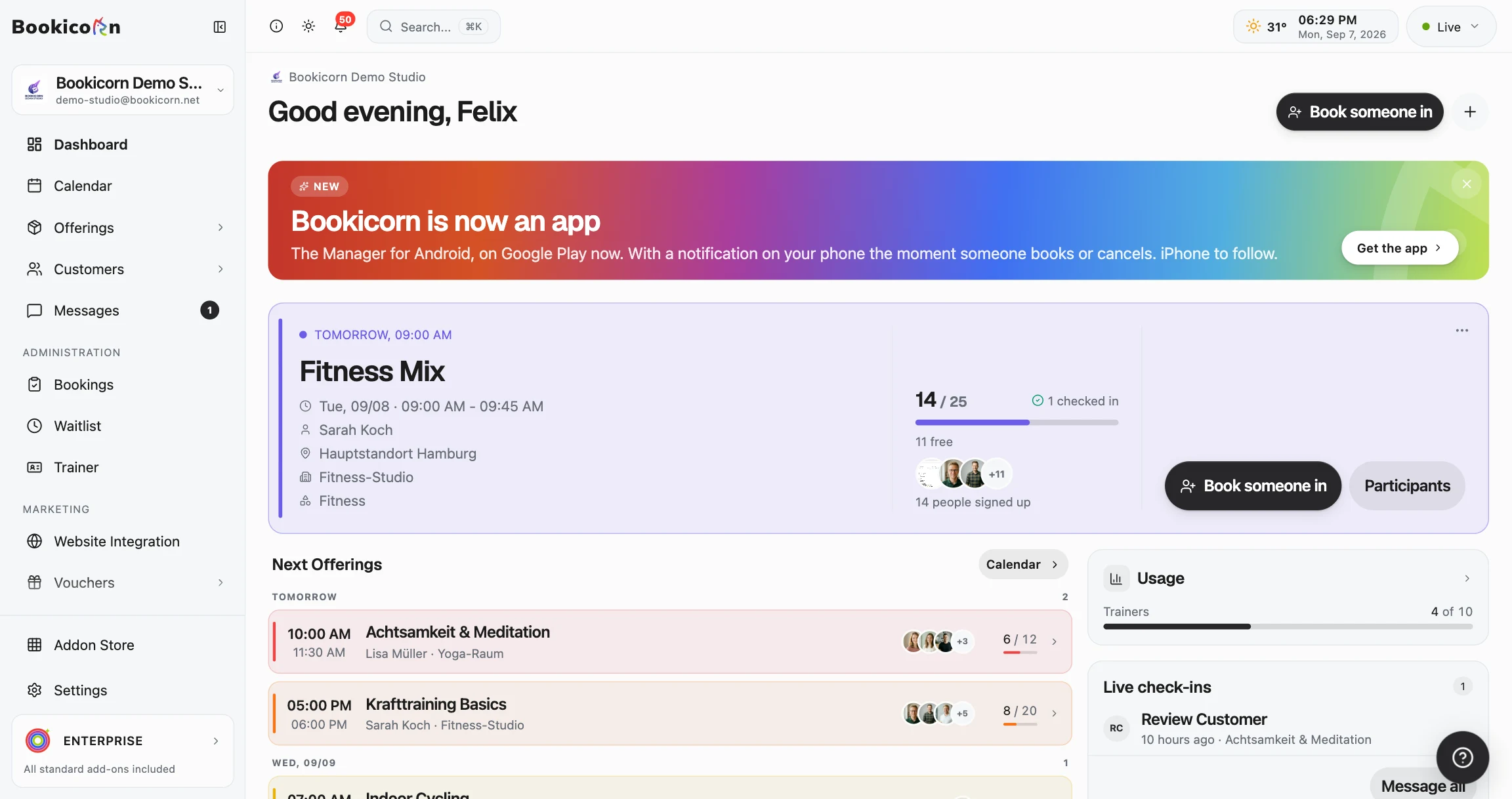
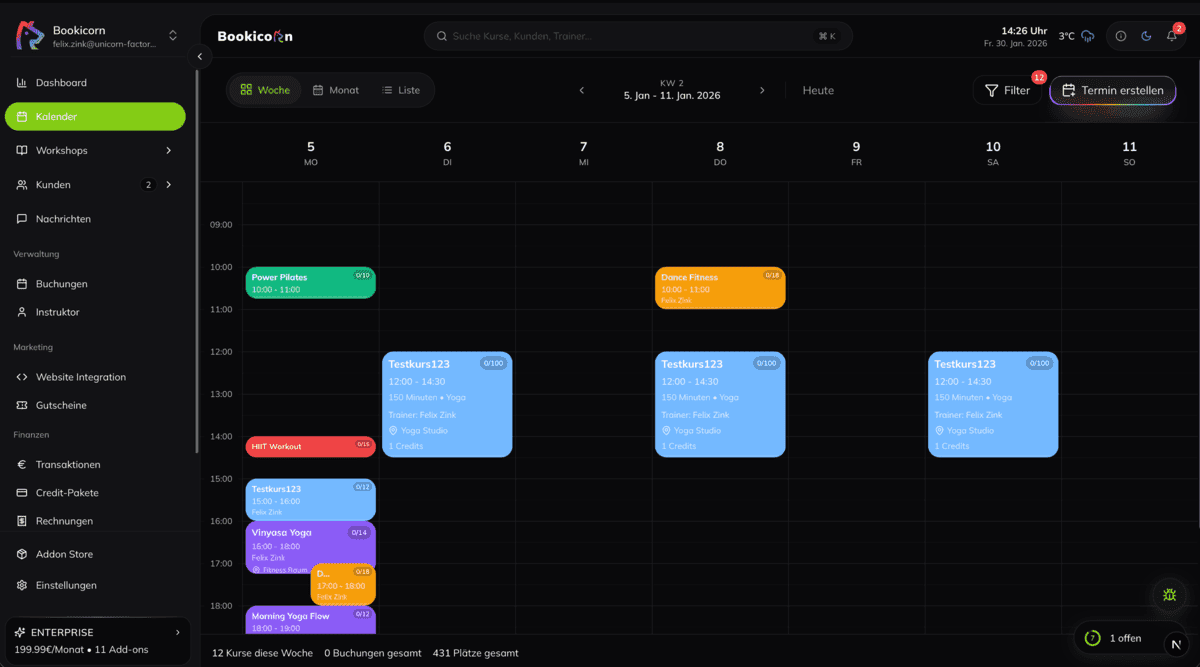
Training progress, attendance, readiness for the exam – without a system, your team loses oversight. A simple list per child is enough: which exam parts are pending, which parent conversations happened? A booking and course management tool like Bookicorn removes that burden and connects registration, attendance, and billing in one place.
Mistake 4: only communicating when there is a problem
Parents who only hear from you when something is wrong never feel well looked after. A short mid-course update – two sentences – prevents 80 percent of complaints. Schools that engage parents early get more follow-up bookings.
Frequently asked questions about swimming badge courses
The key questions swim schools ask us about organizing Seepferdchen, Bronze, Silver, and Gold courses at a glance.
Conclusion: structure beats improvisation
A well-organized swimming badge course rests on four pillars: reliable pool time, appropriate group sizes, a clear lesson structure, and clean exam processes. Plan these early and you will save dozens of emails, make-up sessions, and parent conversations every single week.
The DLRG requirements have been stable for years – you do not need to reinvent the wheel. The difference between a good and a great swim school is not the technical training; it is the organization around it. If you move registration, course management, and communication online, you win back the time that really matters at the poolside: time for every single child.

Written by
Felix Zink
Felix built Bookicorn from the ground up – from the booking system and credit system to trainer payouts. As a full-stack developer at Unicorn Factory Media GmbH, he builds software that makes everyday life easier for studios.
Was this article helpful?
Rate this post