




Martial Arts Trial Training: Your Most Important Conversion Lever
A trial training in martial arts is the moment when interest turns into decision. No flyer, no Instagram ad, and no homepage is as persuasive as the experience of the first 60 minutes on the mat. If you design this experience thoughtfully, a prospect becomes a paying member who stays for years. If you get it wrong, you have wasted time, money, and reach.
This guide is for owners and coaches of martial arts schools, boxing gyms, karate, taekwondo, judo, and BJJ clubs. You will learn how to structure a trial training, which mistakes prevent conversions, and which metrics measure success.
Why the Trial Training Determines Growth
In practice: schools with a structured trial process convert significantly more prospects into members than schools that simply drop guests into regular class. The reason is simple — the first training session is an emotional event for the guest: new environment, unfamiliar movements, strangers. Those who professionally absorb this uncertainty win trust. Those who ignore it lose the guest after 60 minutes.
The Three Decision Layers of the Guest
During the trial training, the guest evaluates three layers in parallel:
- Rational layer: Does this training match my goals? Will I learn what I want here?
- Social layer: Do I feel comfortable in the group? Am I accepted?
- Emotional layer: Am I having fun? Will I go home with a good feeling?
Only when all three layers are positive does the membership decision fall. A technically perfect training without personal connection fails just as much as a friendly chat without a clear learning effect.
Before the Trial Training: Preparation Decides
The trial training does not begin when the guest steps on the mat — it begins the moment they submit your form or call you. The time between inquiry and training is an underestimated conversion lever. Prospects who receive no communication between inquiry and appointment show up far less often — no-show rates of 30 to 50 percent are daily reality in many schools.
Simple Online Booking Without Friction
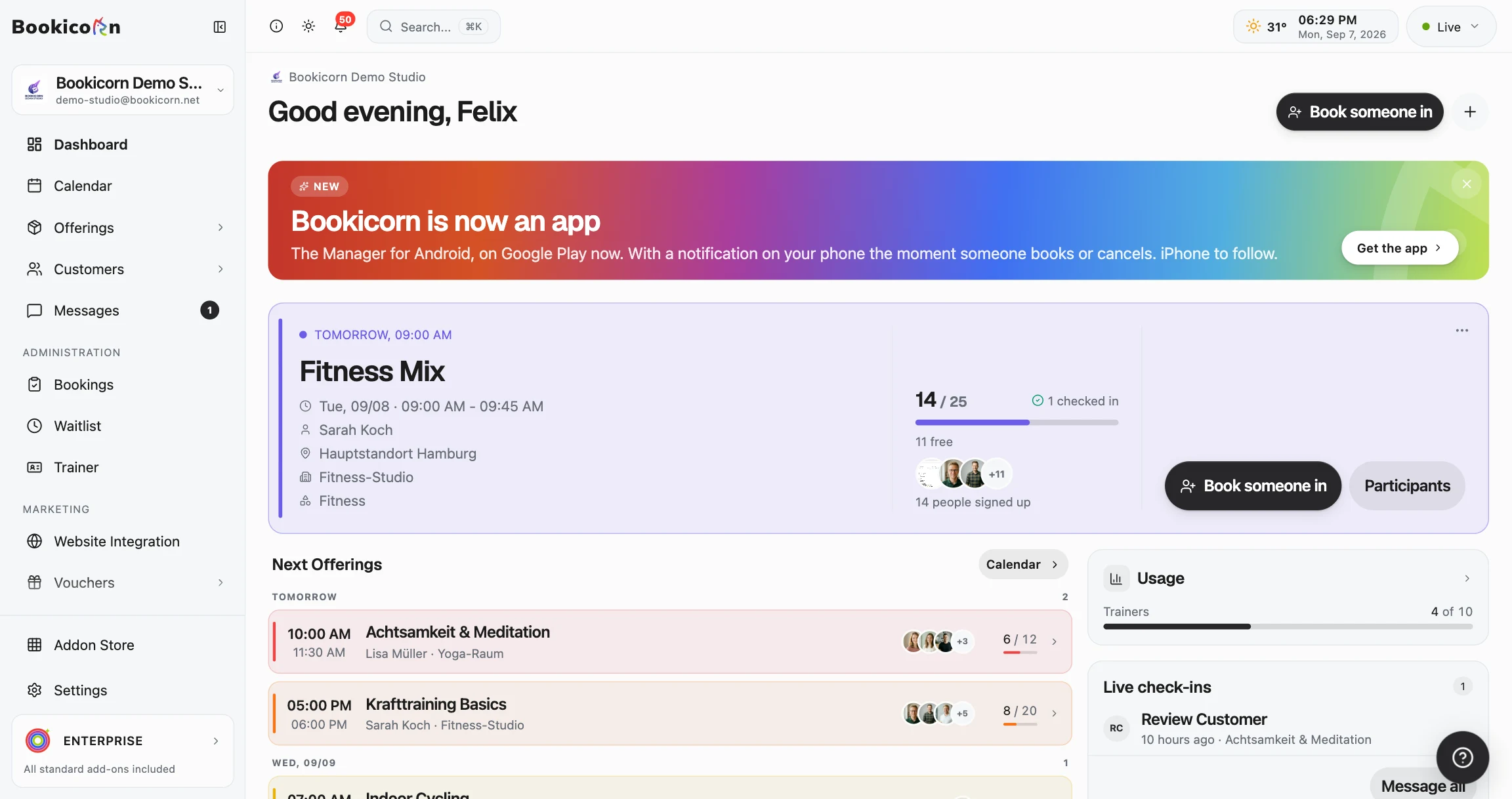
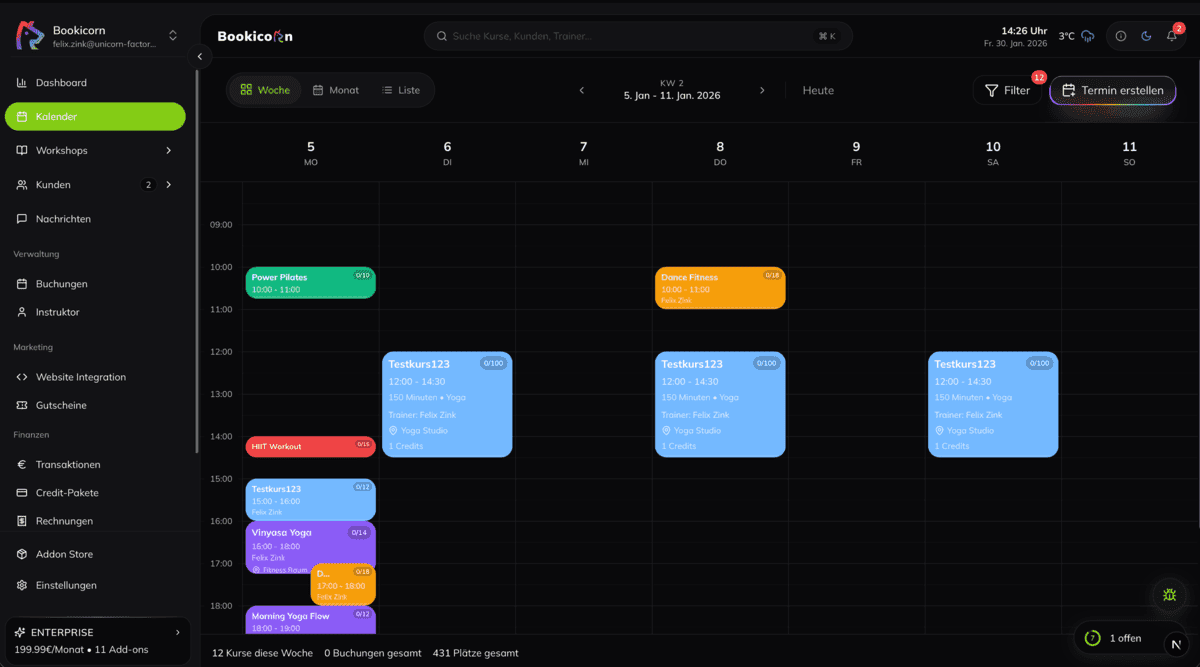
The most common mistake: the trial booking process is too complicated. Email to the school, two days waiting for a reply, a phone call to set the date — that loses every second prospect. An online booking system that lets guests pick their own trial slots increases sign-up rates significantly and looks far more professional.
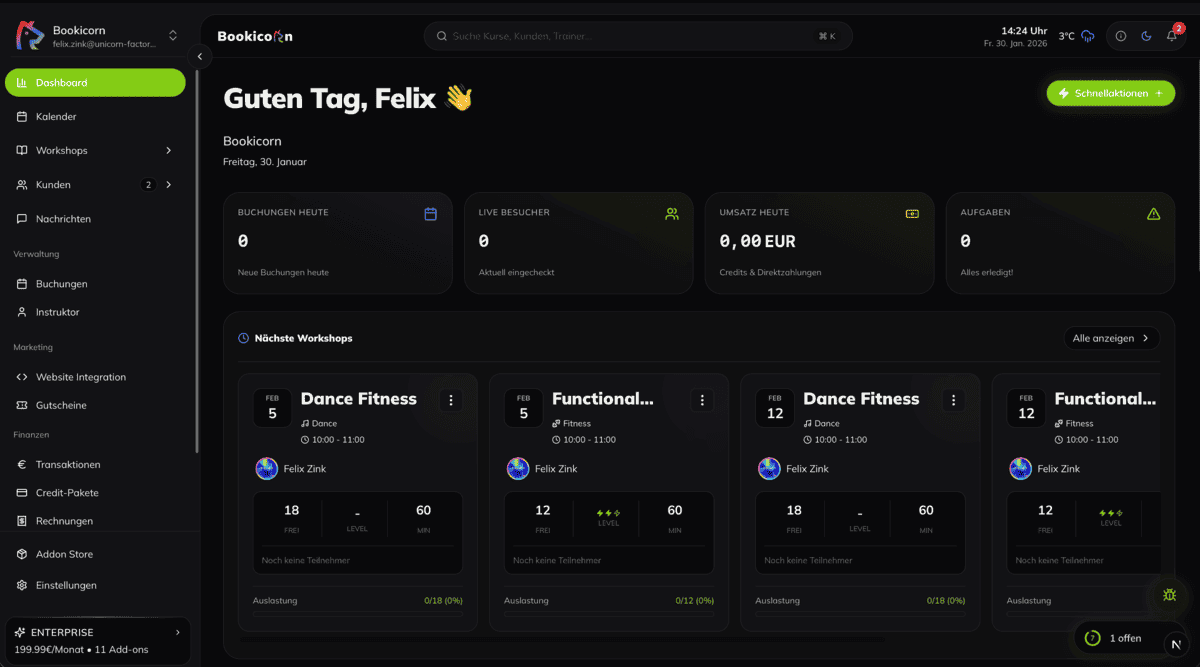
Modern booking software for martial arts schools allows prospects to book around the clock — without you lifting a finger. It lowers the barrier and captures inquiries in the evening and on weekends.
Welcome Email Within Minutes
Immediately after booking, an automated email should go out. It confirms the appointment, answers the most important questions, and removes uncertainty. Ten minutes after signing up, many prospects forget why they inquired in the first place. A smart welcome email pulls them back in.
The email should include: confirmation of date and time, address with parking notes, what to bring, dress code, name of the hosting coach, a short school profile or a training video. On opening, the guest should think: "Good, this will work."
Clearly Communicate Clothing and Gear
Uncertainty about clothing is the most common reason trial trainings get cancelled. Communicate crystal clear:
- Long sweatpants or shorts, T-shirt
- Barefoot or clean indoor shoes — depending on the style
- Towel, water bottle
- Mouthguard only if sparring is planned (usually not in a trial)
- No chains, watches, earrings (injury risk)
Make clear: special gear is provided during the trial. Nobody should have to buy boxing gloves, a gi, or a rashguard beforehand. This information often decides whether the guest shows up.
The Perfect Flow: Your 60-Minute Plan for the Trial Training
A good trial training follows a clear plan. The guest should not just drift along — they should go through a deliberate positive experience. The structure below has proven itself in many martial arts schools and works for boxing, kickboxing, karate, taekwondo, BJJ, MMA, and judo.
Minute 0 to 5: Personal Welcome
The coach or a designated host greets the guest at the entrance, not on the mat. Quick tour: changing room, bathroom, water cooler, training area. The guest does not introduce themselves to a group of strangers — they are eased into the environment calmly. Ask casually: what brought them to this sport? What are their goals? Any prior experience? You will use this info during training.
Minute 5 to 15: Shared Warm-Up
The warm-up starts together with the regular group — this lowers the social barrier. The guest sees the exercises are doable and naturally connects with other members. The coach gives small corrections, praises good movement, creates an open atmosphere. Important: the warm-up can be demanding but never humiliating. No push-up contest on day one.
Minute 15 to 35: Basic Technique Block
Now teach one simple, learnable technique — for example, fighting stance, a basic jab, a lunge, or a basic judo throw from a stable position. The guest experiences two things: they learn something concrete they will "know" by the end, and they notice the coach sees them and corrects individually.
Avoid this mistake: never show too many techniques at once. One technique learned well is worth more than five half-baked ones. The guest should go home and say: "Today I learned X." That sticks.
Minute 35 to 50: Application or Pad Work
Now apply the technique. For boxing and kickboxing, pad work with an experienced member or the coach is ideal. For karate/taekwondo: partner drill at slow tempo. For BJJ/judo: positional drilling without full resistance. The guest feels competent because they can apply the technique. At the same time, they meet training partners.
NEVER spar during a trial. Even if the guest looks wild or claims prior experience — full sparring is too risky and puts most people off. Show control and structure, not raw intensity.
Minute 50 to 60: Cool-Down, Conversation, Close
Gentle stretching with the group, then a structured 3- to 5-minute one-on-one conversation with the guest. Three key questions:
- How was it? What did you enjoy?
- Do you feel you can develop here?
- Would you like to come back for the next training?
IMPORTANT: no hard sell, no "would you like to sign the annual contract now?" on day one. The goal is the second training, not the membership. Those who come twice usually come thirty times.
After the Training: Follow-Up Decides Conversion
Many schools invest time and attention in the trial training, then let the guest leave and wait for them to reach out. That is the most expensive mistake in the entire process. Without a structured follow-up, you lose 30 to 60 percent of ready-to-convert prospects — not because they were unhappy, but because everyday life gets in the way.
Within 24 Hours: Personal Message
The next day, the coach should send a short personal message. No mass email, no template — a real, individual note. Reference the conversation: "Great having you yesterday. Your jab was already solid. If you want, sign up for Thursday — we will work on footwork." This shows the coach remembers and the guest is not just a number.
Communicate Clear Next Steps
In the follow-up, ALWAYS offer a concrete next step — a low-barrier one. Not: "Sign an annual contract." Instead: "Come to a second trial and we will see if it fits." Or: "This week we have beginner classes Thursday and Saturday — pick a slot.
The second trial is the most important metric after the first. Those who complete two trials convert to membership significantly more often. Lower the barrier to the second session as much as possible — even if you usually offer only one free trial, make an exception here.
After 3 to 5 Days: Friendly Reminder
If the guest does not reach out, send a friendly reminder after 3 to 5 days. No pressure, no sales rhetoric, just an honest: "If you still have questions or want to come to the next trial, I would love to hear from you." After that, stop. Anyone who does not respond to two messages is no longer a lead.
Tracking: Why People Did Not Come Back
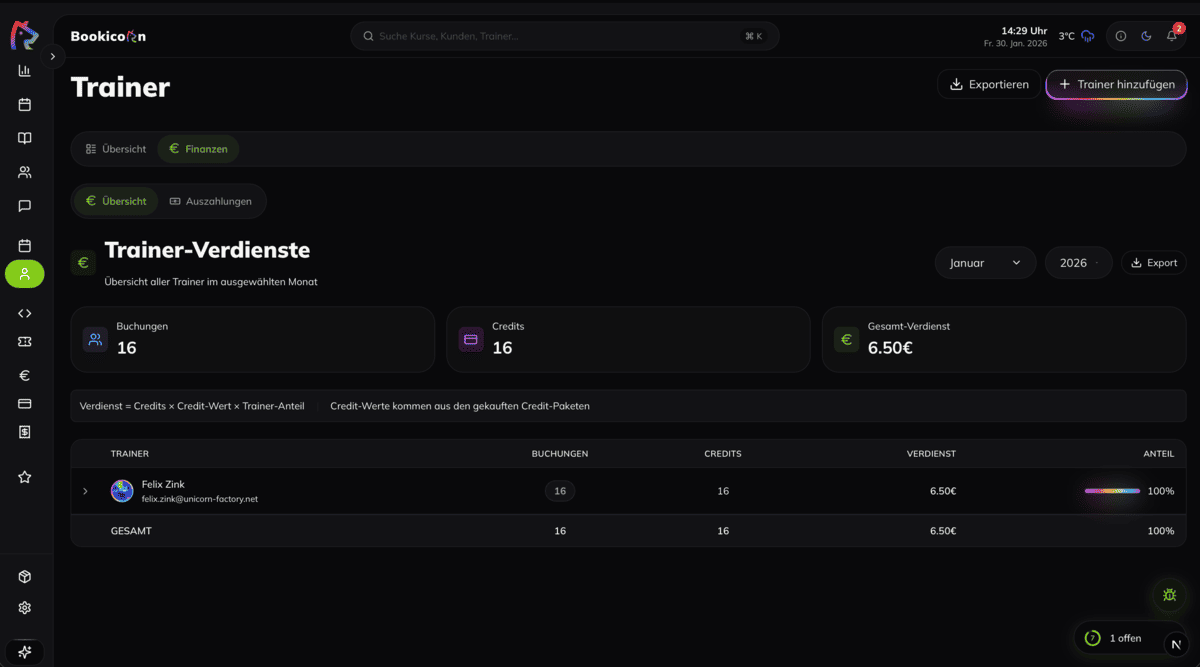
Keep records of your trials. Which channels bring the most prospects? What is the no-show rate? How many second-training guests convert to membership? This data shows you where your process has room to improve. Modern booking systems handle this reporting automatically.
The 7 Most Common Trial Training Mistakes — and How to Avoid Them
Observation across hundreds of martial arts schools reveals the same recurring pitfalls. Anyone who knows them saves conversion losses in the double-digit percent range.
Mistake 1: Throwing the Guest Into Ongoing Training
The classic: the guest arrives, the coach is busy with the group, the guest stands uncertainly at the edge. Unprofessional and costs sympathy instantly. Fix: personal welcome and a tour are not optional, they are mandatory. If the coach is occupied, a designated buddy takes over.
Mistake 2: Showing Too Many Complex Techniques
The guest is overloaded with combinations, technique names, and rules. They feel stupid, lose orientation, and go home thinking "this is not for me." Fix: one technique, cleanly drilled. Less is more.
Mistake 3: Full Sparring or Hard Contact Drills
Some coaches want to "show the guest how it works here." That scares off 9 out of 10 prospects. A trial training is acquisition, not a performance test. Sparring belongs in regular training with experienced members.
Mistake 4: No Care After the Training
The guest changes, walks out of the hall silently, and nobody speaks to them. The feeling: "I was not important." Fix: the 3-minute conversation is mandatory, not an optional bonus.
Mistake 5: Direct Price Talk on Day One
"So, the annual contract is 89 euros a month, 12 months minimum, ready to sign?" — that line after 60 minutes of training scares people off. Fix: only mention price if the guest actively asks. Otherwise: offer a second trial, hand over an info flyer, stay calm.
Mistake 6: No Follow-Up After the Trial
The guest is gone, the chapter is closed. Yet 40 to 50 percent of non-converters could still be won with a smart follow-up. Fix: the 24-hour message is followed by the 3-day reminder. No more, but these two are mandatory.
Mistake 7: No Metrics Tracking
If you do not know how many prospects show up, how many come for a second session, and how many convert to membership, you cannot improve the process. Fix: track three numbers per month — inquiries, trials, new members. From those, you get the conversion rate.
Frequently Asked Questions About Martial Arts Trial Training
The most important questions and answers about trial training in martial arts at a glance — from the studio operator perspective.
Conclusion: The Trial Training as a Strategic Growth Tool
A martial arts trial training is not a routine or a formality — it is the most important lever for turning interest into membership. Those who structure the process, from online booking through personal welcome, a clear 60-minute plan, to a follow-up within 24 hours, raise the conversion rate from 15-25 percent to 40-60 percent. With the same marketing budget, that means doubling your new members.
Our recommendation: start small. Implement three things first — a fixed 60-minute structure, the buddy system, and the 24-hour follow-up message. Measure the conversion rate over three months. You will be surprised how much room for growth your current process has. In the next step, automate online booking and reminders — this takes work off your plate and lowers the no-show rate. The rest follows.

Written by
Felix Zink
Felix built Bookicorn from the ground up – from the booking system and credit system to trainer payouts. As a full-stack developer at Unicorn Factory Media GmbH, he builds software that makes everyday life easier for studios.
Was this article helpful?
Rate this post