





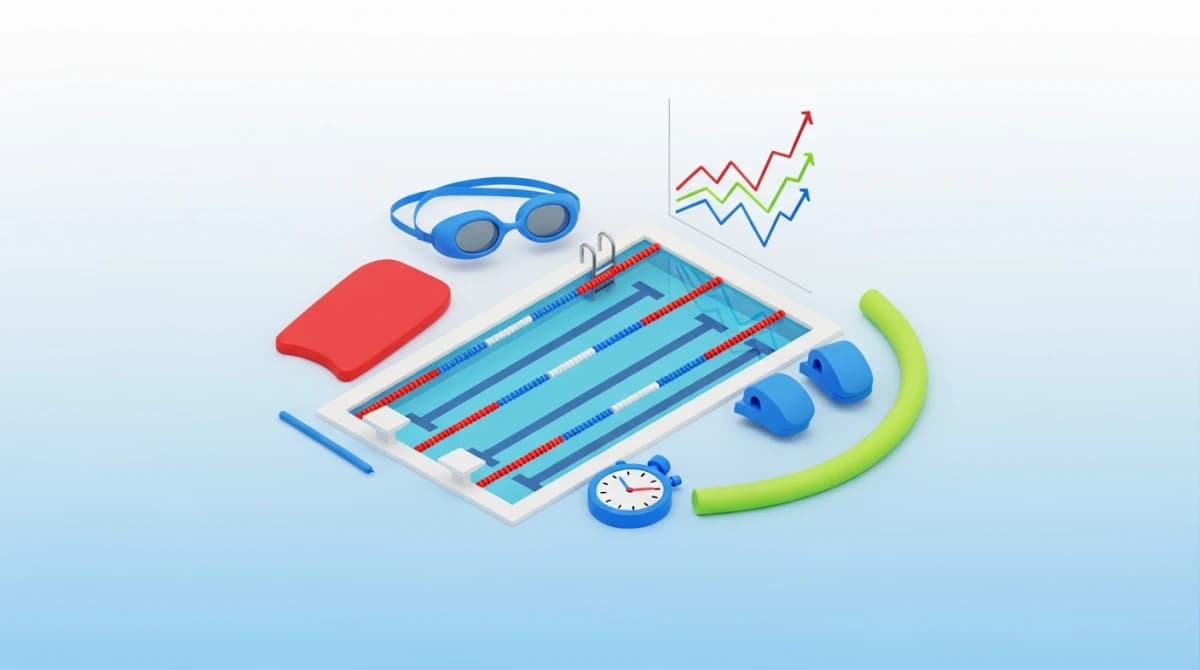
If you can't swim as an adult, you're in much bigger company than you think. Around 1 in 4 adults in the UK can't swim 25 metres unaided, and the share is similar across many English-speaking countries. Adult swimming lessons are designed exactly for this: small groups, warm water, and instructors who know how to take the fear out of the deep end without making you feel like a failure.
This guide walks you through how a proper beginner course is structured, what you'll actually learn, how long it usually takes, what it costs, and what to look for when choosing a class. Plus practical tips for the obstacles every adult learner runs into: anxiety, embarrassment, and the nagging feeling that you've "left it too late".
Can adults still learn to swim?
Yes, and it's rarely a question of age. Swimming is a motor skill you can pick up at 30, 50 or 70. What's different from children isn't your body, it's your brain: adults bring more fear, but also more focus.
What adult learners have on their side
You understand instructions, you can correct movement patterns deliberately, and you know why you're practising. Most adults reach independent swimming within 10 to 15 lessons of structured coaching, especially when the course follows a clear progression like the Swim England adult swim framework (Water confidence → Be a swimmer → Be a better swimmer).
What makes it harder
Your head. Bad water experiences in childhood, an over-active gag reflex, and self-consciousness around other learners are the three most common brakes. Good adult classes know this. They start with breathing, floating and water comfort, long before they teach you a stroke.
How an adult swimming course is structured
A good beginner course follows a clear progression: water confidence first, then breathing and buoyancy, only then a first stroke. Reverse that order and start with breaststroke immediately, and most adults stall on breath panic. Reputable schools follow the Swim England Adult Swim Framework (Water Confidence → Be a Swimmer → Be a Better Swimmer → Be a Master Swimmer) or the equivalent ASA Awards.
Stage 1: Water confidence
Getting comfortable with the water itself. You get used to water pressure, buoyancy, and how it feels around your eyes, ears, and nose. Typical drills: blowing bubbles, opening your eyes underwater, pushing off the side.
Stage 2: Breathing and body position
This is the breakthrough stage for adult learners. You learn to exhale steadily into the water and inhale above the surface. Alongside that: horizontal body position. Star floats on front and back, glides after pushing off. Crack this stage and you've done the hardest part.
Stage 3: Propulsion with legs and arms
Legs first (front-crawl kick or breaststroke kick with a kickboard), arms second. Backstroke is usually taught before front crawl or breaststroke because your face stays above water and breathing is easier. Breaststroke comes last for many adults because the leg coordination is genuinely tricky.
Stage 4: Swimming a length
The goal is swimming a continuous distance without stopping. Under the Swim England framework, "Be a Swimmer" includes a 5-10 m unaided swim, and the next level expects 400 m. The British equivalent of a basic certificate is the ASA 25 m Award. Most adults aim at swimming 25 to 50 m as their first concrete milestone.
How long does it take to learn to swim?
Honest answer: 8 to 15 hours of targeted lessons are enough for most adults to get comfortable in the water and swim a first length. Reaching a confident 200 m takes most people 20 to 30 hours. If you start with strong water anxiety, plan for 5 to 10 extra sessions on water confidence alone.
Typical course formats
Most providers offer a 10-lesson course at 45 to 60 minutes a week. Some run intensive week-long camps with a daily lesson; others offer flexible block bookings of 5 or 10 lessons without a fixed weekly slot.
What sets the pace
Three factors decide how quickly you progress: How much fear of water do you start with? How often do you practise outside lessons? How small is your group? In classes of more than 8 you lose individual practice time fast.
What to look for when choosing an adult swim course
Quality varies a lot between providers. Four signals tell you whether a beginner course is solid before you pay.
Small group sizes
A maximum of 6 to 8 learners per instructor. Beyond eight, you stop getting individual corrections, which is exactly what beginners need. Ask the question explicitly when you enrol.
Warm water
At least 82 °F (28 °C), ideally 86 °F (30 °C). Cold water makes beginners tense up and breathe shallowly, which feeds water anxiety. Most good adult classes run in dedicated learner pools or hydrotherapy pools, not in the main lane pool.
Qualified instructor
A recognised teaching qualification matters. In the UK, look for STA Level 2 or Swim England Level 2 (formerly ASA) certified teachers. Larger providers also have a documented teaching framework and clear progression levels.
Clear goals and progression
A good course tells you upfront where you'll be at the end: "swim 25 m unaided after 10 lessons" is a concrete promise. "Learn to swim" without a measurable milestone is marketing.
How much do adult swimming lessons cost?
In the UK, a typical 10-lesson group course costs between £80 and £200. Private lessons run £25 to £45 per 30-minute session. Council-run pools are usually the cheapest option; private swim schools with a strong adult programme cost more but typically run smaller groups and better-trained instructors.
What drives the price
Group size: smaller groups cost more but pay off for adult learners
Pool type: heated learner pools cost more to hire than the main lane pool
Instructor experience and adult-specific training
Location: London prices are usually 30 to 50 percent above the national average
Will the NHS pay for swimming lessons?
Standard learn-to-swim courses are not funded by the NHS. Some local Active Communities or GP referral schemes subsidise pool access for specific health conditions (back pain, post-rehab), and a handful of councils offer "Learn to Swim" subsidies for residents on low incomes. Check your local council and your GP referral options before paying full price.
Common obstacles and how to get past them
For adult beginners, the obstacle is almost never swimming itself, it's everything around it: fear, embarrassment, a stubborn gag reflex. The three brakes are so predictable that any decent instructor knows them by heart.
Fear of water and panic response
If your body reacts to water on your face with a sharp inhale, that's an automatic safety reflex, not a personality flaw. The fix isn't "be braver". It's systematic exposure with controlled stimuli: face washing, dipping your forehead, then opening your eyes underwater. Breathing drills come after.
Embarrassment around other beginners
Adult-only classes are worth their weight in gold here. An adult in a beginner class with 7-year-olds feels understandably out of place. Ask explicitly for adult-only sessions, or book private lessons for the first 3 to 5 sessions before joining a group.
Feeling "too old"
Plenty of people learn to swim at 65 or 70. What changes is the learning curve, not the learning potential. Budget a few extra hours and look for an instructor with adult-teaching experience specifically, not someone who mainly teaches children.
Frequently asked questions about adult swimming lessons
The most common questions about adult beginner courses, answered briefly.
Bottom line: it's never too late to learn
Adult swimming lessons aren't magic, but they're reliable. Eight to 15 hours of structured coaching takes most adults from a nervous poolside start to a confident 25 m swim. The conditions for a good outcome aren't secrets: a small group, warm water, an instructor who can handle adult beginners, and an honest progression from water confidence through breathing to a first stroke.
If you're still on the fence: ask your local pool about adult-only courses, check the group size, and don't be sold on marketing without specific learning goals. Swimming isn't a question of age. It's a question of method.

Written by
Felix Zink
Felix built Bookicorn from the ground up – from the booking system and credit system to trainer payouts. As a full-stack developer at Unicorn Factory Media GmbH, he builds software that makes everyday life easier for studios.
Was this article helpful?
Rate this post