



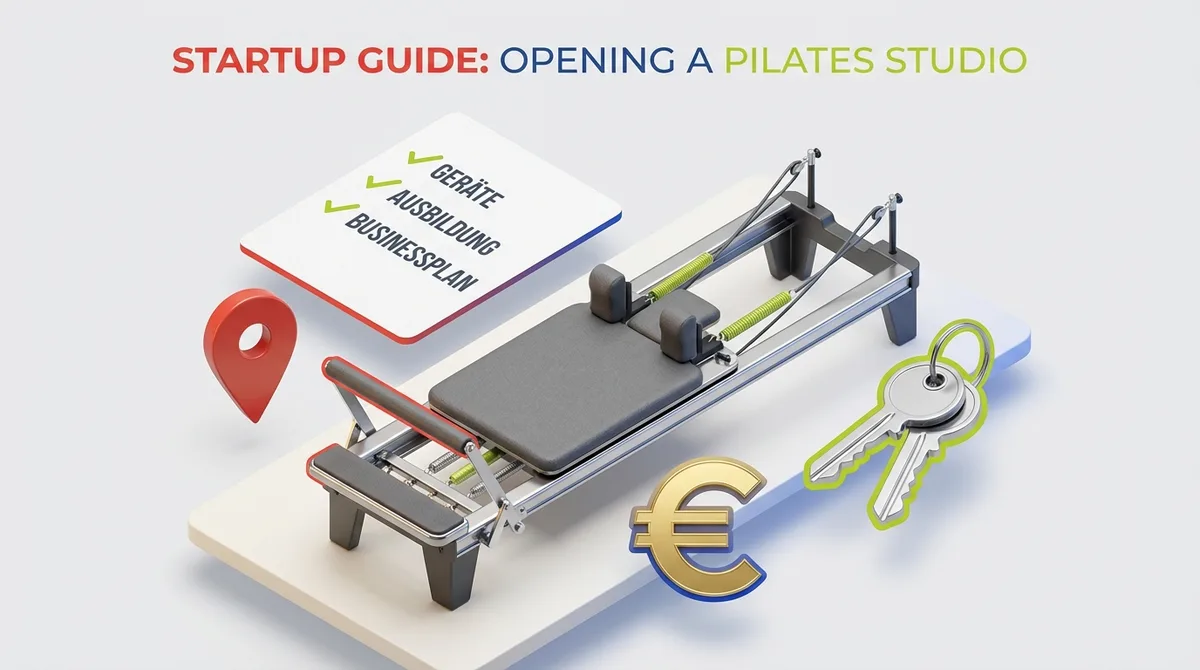
Pilates is booming like never before. According to industry data, Reformer Pilates has risen to second place among the world's most popular fitness trends in 2025 - a year earlier it was in 10th place. There are currently around 1,100 to 1,600 Pilates studios in Germany, and demand continues to grow: bookings for Reformer classes have risen by 66% year-on-year according to ClassPass data.
It's no wonder that more and more qualified Pilates instructors are venturing into self-employment. But there are many decisions to be made between the dream and the opening: What training do you need? How much does the facility cost? Business or freelance? And how do you find your first clients?
Do you want to open a Pilates studio? In this guide, you will learn everything you need to know step by step - with real cost breakdowns, legal principles and a concrete timetable. Whether it's a classic mat studio or a trendy reformer boutique studio.
Requirements: What you need for your Pilates studio
Pilates training (mat)
The basic requirement is a sound Pilates training. The best-known training providers in Germany and internationally are
- BASI Pilates (Body Arts and Science International) - internationally recognized, comprehensive curriculum
- Polestar Pilates - evidence-based, strong in rehab orientation
- STOTT PILATES / Merrithew - Canadian system, very common in studios
- Balanced Body - one of the largest equipment manufacturers, offers its own training
- German Pilates Association (DPV) - umbrella organization with quality standards
A mat training course typically comprises 300 to 500 teaching hours and costs around €2,000 to €4,000. Depending on the provider, the duration varies between 6 months (intensive course) and 1 to 2 years (part-time). Many providers also offer online modules that you can complete flexibly - but you have to complete the practical hours on site.
Additional reformer and device training
If you are planning a reformer studio, you will need additional equipment training. This builds on the mat training and includes training on the Reformer, Cadillac, Wunda Chair and Ladder Barrel. Expect to pay a further €3,000 to €6,000 and 200 to 400 additional training hours.
In total, you will invest between €5,000 and €10,000 for a complete Pilates training course (mat + equipment) - an investment that will quickly pay for itself as a studio owner.
Health insurance approval (ZPP)
For many Pilates studios, certification by the Central Prevention Testing Center (ZPP) is an important quality feature. This allows your participants to have the course fees reimbursed by their health insurance company - a huge competitive advantage.
Requirements for ZPP certification:
- State-recognized professional or academic qualification in the field of sports, health or physiotherapy
- Pilates training with at least 200 hours (depending on the provider)
- Proof of regular further training
- Submission of a standardized course concept to the ZPP
Without a suitable basic profession (e.g. sports science, physiotherapy), ZPP approval is much more difficult. Check early on whether you meet the requirements.
Business plan for your Pilates studio
If you want to open a Pilates studio, you need a solid business plan. It's not just important for the bank or funding - it forces you to really think through your concept. A good Pilates business plan comprises 6 to 15 pages and answers the key questions.
The most important elements
- Summary: Your concept in 1 page - what, where, for whom?
- Market analysis: How many Pilates studios are there in your catchment area? How large is the target group?
- Offer description: Mat, reformer, small groups, personal training? Which course formats?
- Marketing strategy: How do you win your first 50 customers?
- Financial plan: Investment costs, running costs, sales forecast, break-even point
- Legal form: Sole proprietorship, GbR, UG or GmbH?
Your unique selling proposition (USP)
The Pilates market is becoming more crowded. You need a clear USP. Examples of successful positioning:
- Reformer boutique studio: premium experience with a maximum of 8 participants, high-quality equipment, chic interior
- Pilates for rehab & prevention: with ZPP approval and cooperation with doctors and physiotherapists
- Prenatal & Postnatal Pilates: Specialization for pregnant women and new mothers
- Athletic Pilates: For athletes as supplementary training, e.g. for runners, golfers or CrossFitters
- Hybrid studio: combination of Pilates and yoga, barre or functional training
Costs: How much does it cost to open a Pilates studio?
The costs vary greatly - depending on whether you are planning a pure mat studio or a reformer studio. Here is a realistic list of the one-off costs:
One-off investment costs
Mat studio (50-80 m²):
- Rental deposit (3 months' rent): 1.500 - 4.500 €
- Renovation and conversion: € 2,000 - 10,000
- Mats, props and small equipment: € 1,000 - 3,000
- Reception area and furniture: € 1,000 - 3,000
- Music system and lighting: 500 - 1,500 €
- Website and branding: 1,000 - 3,000 €
- Business registration and administration: 500 - 1,500 €
Total mat studio: approx. 8,000 - 27,000 €
Reformer studio (80-150 m²):
- Rental deposit (3 months' rent): 3.000 - 9.000 €
- Renovation and conversion (incl. floor reinforcement): € 5,000 - 20,000
- Reformer devices (6-10 units at € 2,000-6,000 each): 12.000 - 60.000 €
- Further appliances (Cadillac, chair, barrel): 3.000 - 15.000 €
- Mats and small equipment: € 1,000 - 2,000
- Reception area, changing rooms, furniture: € 2,000 - 5,000
- Music system and lighting: € 1,000 - 2,500
- Website and branding: 1,500 - 4,000 €
- Business registration and administration: 500 - 1,500 €
Total reformer studio: approx. 29,000 - 119,000 €
The biggest cost factor in a reformer studio is the equipment. A studio-suitable reformer from Balanced Body, STOTT or Merrithew costs between €2,000 and €6,000. If you want to save money, buy second-hand equipment - but pay attention to the condition of the springs and pulleys.
Ongoing monthly costs
You have to reckon with these running costs:
- Rent: 800 - 3,000 € (depending on city and size, expect 10-20 €/m²)
- Service charges (electricity, water, heating): 150 - 400 €
- Professional liability insurance: approx. 60 - 200 €/year (i.e. 5 - 17 €/month)
- Public liability: approx. 200 - 500 €/year
- Booking software: 30 - 150 €
- Marketing (Google Ads, Social Media): 100 - 500 €
- GEMA fees: approx. 20 - 50 €
- Accounting/tax consultant: 100 - 300 €
- Consumables, cleaning: 50 - 150 €
- Reserves for device maintenance: 50 - 200 €
Total monthly fixed costs: approx. 1,400 - 5,000 € - depending on location, size and equipment.
How much does a Pilates instructor earn?
Employed: approx. €2,200 – €3,500 gross/month (full-time). Reformer instructors with experience tend to be at the upper end. Self-employed/Freelance: €40 – €80 per teaching hour. With Reformer small groups (6–8 participants at €30–40), €180 – €320 revenue per class is possible. As a studio owner: Your earnings depend on your utilization rate. A well-running mat studio with 20–25 classes per week can generate €4,000 – €8,000 net per month. Reformer studios with premium pricing can achieve significantly more.
Sample calculation: When will you break even?
Scenario: Reformer studio with 8 devices in a medium-sized city
Assumptions:
- Reformer course: 35 € per participant, max. 8 places
- 4 courses per day, 6 days a week = 24 courses/week
- Average capacity utilization: 70%
- Monthly fixed costs: € 3,500
Sales calculation:
- 24 courses × 8 places × 70 % capacity = ~134 participants/week
- 134 × 35 € = 4,690 € turnover/week
- 4.690 € × 4.3 weeks = approx. 20,170 € turnover/month
After deducting fixed costs (€ 3,500), this leaves around € 16,670 before tax.
With one-off costs of around €50,000 (reformer studio, medium equipment) and a monthly surplus of ~€10,000 (after tax and own salary), you will break even after around 5 to 8 months.
Note: This calculation is a simplified example calculation. In practice, most studios need 3 to 6 months to achieve 70% capacity utilization.
Legal basis: freelance or commercial?
This question regularly causes confusion among Pilates instructors. The short answer: it depends.
Freelance activity
Pilates lessons can be classified as a teaching activity and therefore as freelance work (§ 18 EStG). This is especially true if you:
- Teach yourself (not just organize)
- Do not employ trainers
- Teaching on a fee basis in various rooms
When does it become a trade?
As soon as you run your own studio, things get more complicated. The tax office usually classifies you as a business if:
- You rent your own premises and run a business
- You employ trainers or freelancers
- You sell products alongside your classes (Pilates accessories, drinks)
In practice: Most Pilates studio owners register a business. Business registration costs €30 to €40 and is possible at your city's public order office. The tax office decides on the tax classification on a case-by-case basis.
Compulsory insurance for Pilates studios
You absolutely need this insurance:
- Professional liability insurance: Protects you if a participant is injured during training. Costs: approx. 60 - 200 €/year (e.g. via the DPV or providers such as ensure-online.de)
- Public liability insurance: Covers damage to your premises. Costs: approx. 200 - 500 €/year
- Inventory insurance: Protects your equipment in the event of theft, fire or water damage. Particularly useful for expensive reformers
- Legal expenses insurance (optional): For disputes with landlords, customers or authorities
Tax tips for 2026: What you need to know
Small business regulation (§ 19 UStG)
If your turnover was less than €25,000 in the previous year and is not expected to exceed €100,000 in the current year, you can use the small business regulation. This means: no VAT on your invoices. This can make sense for the start - as soon as you grow, switching to standard taxation is often more worthwhile (because you can then deduct input tax on your equipment purchases).
Other important tax topics
- Trade tax: Allowance of € 24,500 annual profit. You do not pay trade tax on profits under this amount
- VAT on Pilates courses: Pilates courses are subject to the regular rate of 19%. One exception: ZPP-certified prevention courses may be VAT-exempt under certain circumstances (§ 4 No. 14 UStG) - have this checked
- Depreciation and amortization (AfA): Reformers and other equipment can be depreciated over their useful life (usually 7-10 years). GWG up to €800 net (e.g. mats, props) can be written off immediately
- Accounting: Up to € 600,000 turnover, a simple income statement (EÜR) is sufficient. Above this amount, you must prepare a balance sheet
Finding the right premises
Choice of location
The location is crucial to your success. Pay attention to:
- Footfall and visibility: A first floor with a shop window is ideal, but not absolutely necessary - many Pilates studios also work on upper floors or in backyards if the marketing is right
- Accessibility: Public transport connections and parking facilities are important. Less than 200 meters to the next stop is optimal
- Target group in the catchment area: Pilates mainly appeals to women between 25 and 55. Residential areas with medium to high incomes are ideal
- Competition: Check how many Pilates classes there are within a radius of 3-5 km
Size and layout
Mat studio:
- 50 - 80 m² course room (for 10-15 participants)
- At least 2.40 m ceiling height
- Small reception area, changing room, WC
Reformer Studio:
- 80 - 150 m² course room - reformers need considerably more space! Calculate approx. 5-6 m² per reformer space (incl. exercise room)
- At least 2.50 m ceiling height (for standing exercises on the Cadillac)
- Load-bearing floor (reformers weigh 40-60 kg, plus load from exercises)
- Separate storage room for props and accessories
Basic equipment for your Pilates studio
Mat studio:
- High-quality Pilates mats (thicker than yoga mats, approx. 15 mm)
- Pilates rings (Magic Circles)
- Resistance bands in various strengths
- Pilates balls (soft balls, exercise balls)
- Foam Roller
- Mirror (at least one wall)
- Music system with Bluetooth
Reformer Studio (additional):
- Reformer: The centerpiece. Recommended manufacturers: Balanced Body, STOTT/Merrithew, Gratz, Align-Pilates. Price range: 2,000 - 6,000 € per device
- Cadillac/Trapeze Table: approx. 3,000 - 7,000 €. For a small studio, 1 device is often enough for personal training
- Wunda Chair: approx. 800 - 2,500 €. Compact and versatile
- Ladder barrel: approx. 1,500 - 3,500 €. Optional, but a unique selling point
- Spine Corrector: approx. 200 - 600 €. Space-saving and versatile
Reformer Pilates Studio: The trend factor
Reformer Pilates is the fitness trend of recent years. Large franchise chains such as Club Pilates (over 600 studios worldwide) and Studio Pilates International are currently expanding into Germany. At the same time, more and more independent boutique studios are opening.
Why reformer studios are booming:
- Higher prices: Reformer classes cost €25 - €45 per hour (vs. €15 - €25 for mat classes). This means significantly more revenue per course
- Exclusivity: The limited number of participants (6-10 per course) creates a premium experience
- Social media factor: Reformer training is extremely photogenic and viral on Instagram and TikTok
- More effective training: the spring resistance enables more precise training that is easier on the joints than on the mat
But: Reformer studios also have higher hurdles:
- Significantly higher start-up capital (equipment, larger rooms)
- More maintenance work (springs, ropes, cushions have to be replaced regularly)
- Specialized training required
- Lower number of participants per course = you need more courses for the same turnover
Marketing & customer acquisition
Online marketing
- Google Business Profile: Absolutely important for local searches like "Pilates Studio in [city]". Maintain your profile with photos, opening hours and let satisfied customers leave reviews
- Instagram & TikTok: Pilates is visually powerful. Post reels of Reformer exercises, studio insights and transformation stories. Reformer content achieves particularly high reach on social media
- Own website with SEO: Optimize for local keywords such as "Pilates [city]" or "Reformer Pilates [city]"
- Google Ads: Local ads on "Pilates Studio [city]" have little competition and favorable click prices (often less than 1 €/click)
Offline marketing
- Cooperations: Work with physiotherapists, orthopaedists, midwives and local gyms. Many doctors recommend Pilates for back problems
- Trial lessons and taster days: Regularly offer free or discounted trial lessons. This lowers the inhibition threshold enormously
- Opening event: Invite neighbors, local press and influencers to an open day
- Flyers and local presence: Display in organic food stores, cafés and doctors' surgeries
The right booking software for your Pilates studio
Professional booking software saves you an enormous amount of time from day 1 and makes a professional impression on your customers. Pay attention to the following when choosing:
- Online booking: Customers should be able to book courses 24/7 - via your website, app or social media
- Course management: Create course schedule, set participant limits (especially important for reformer courses with limited equipment), manage waiting lists
- Payment processing: automatic billing of 10-pass cards, subscriptions and individual bookings
- Customer management: Participant history, contact details, automatic reminders
- Website integration: Embeddable booking widget for your own website
- Fair prices: Every euro counts, especially at the beginning. Avoid software with high commissions per booking
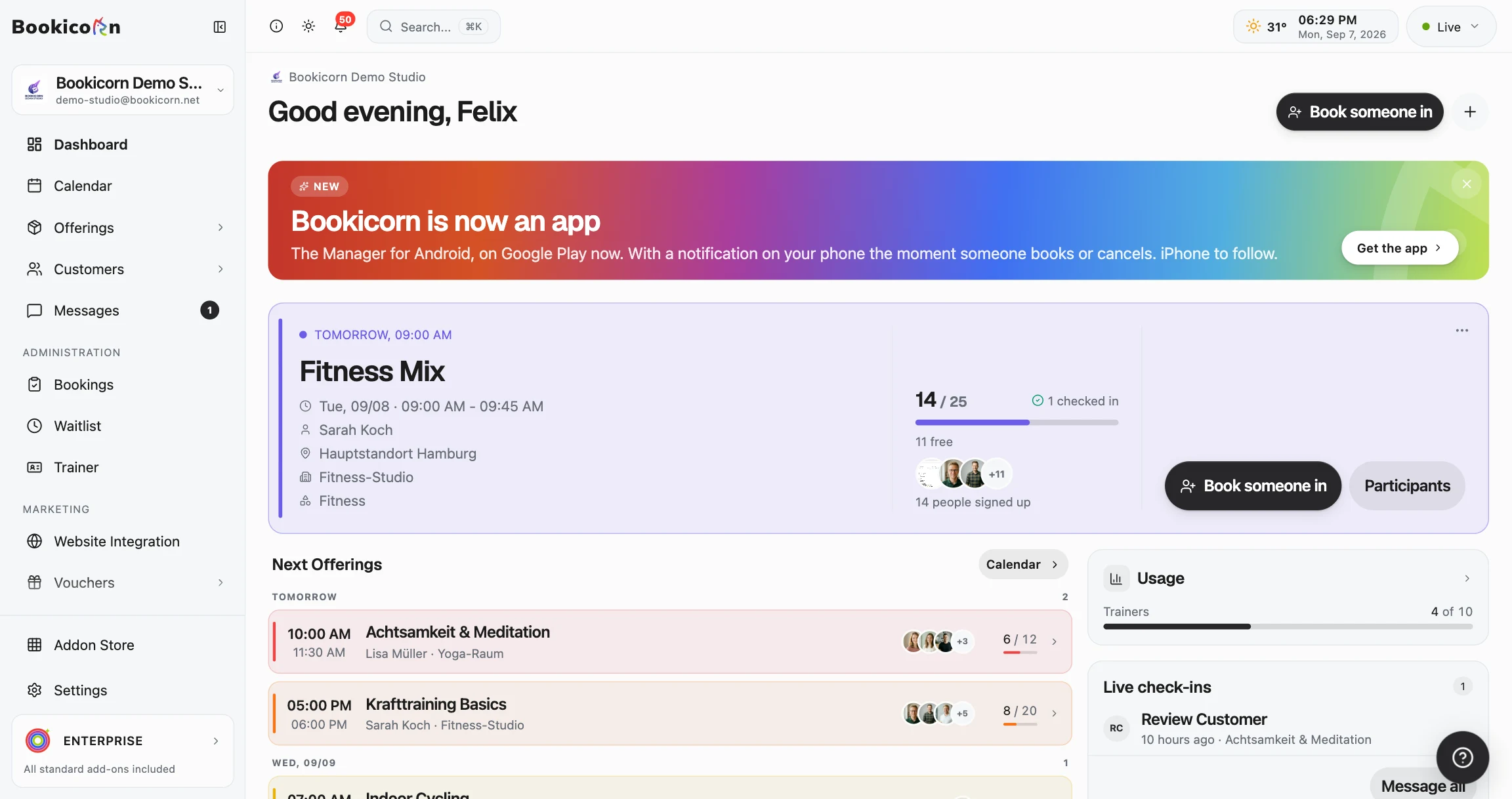
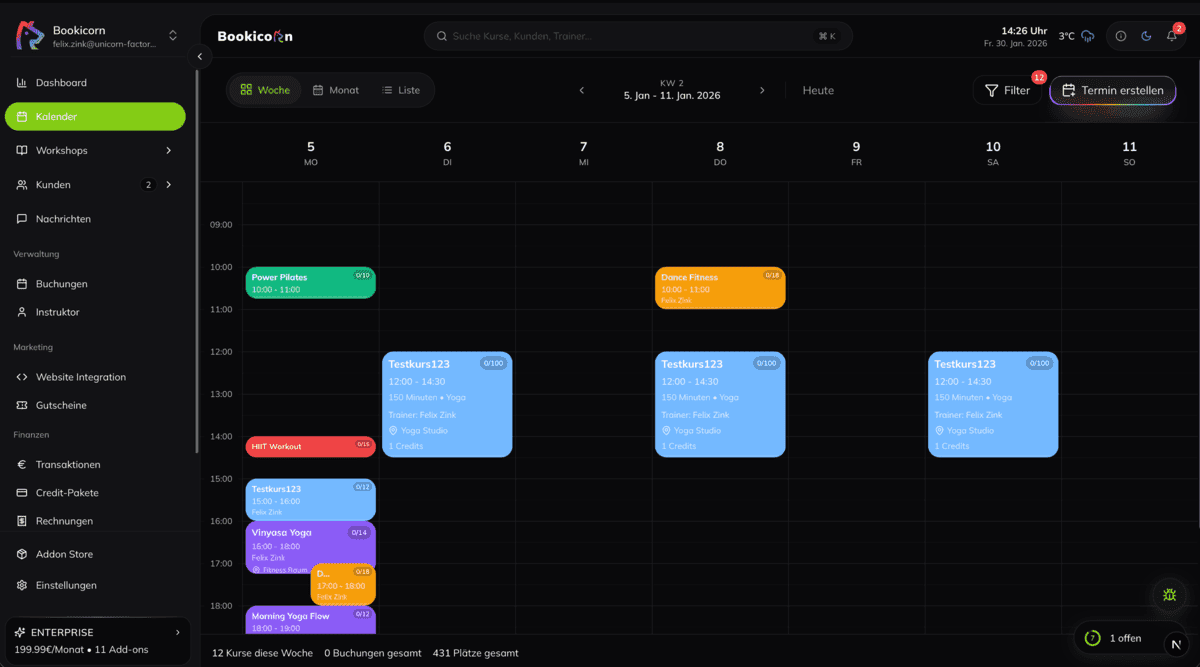
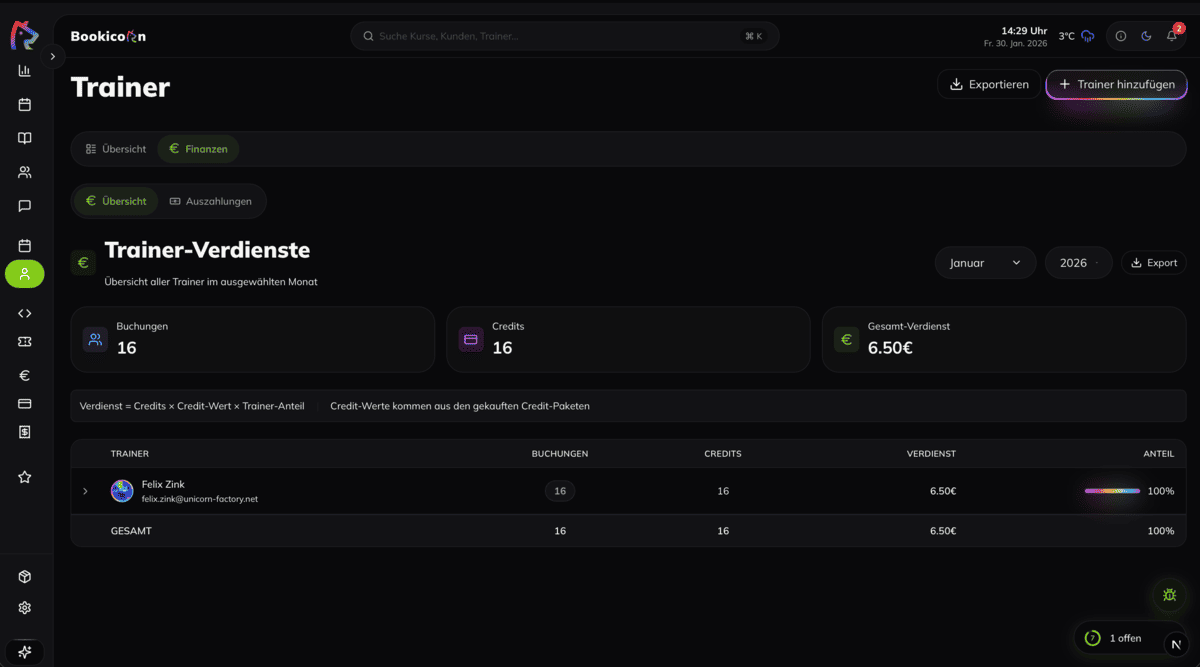
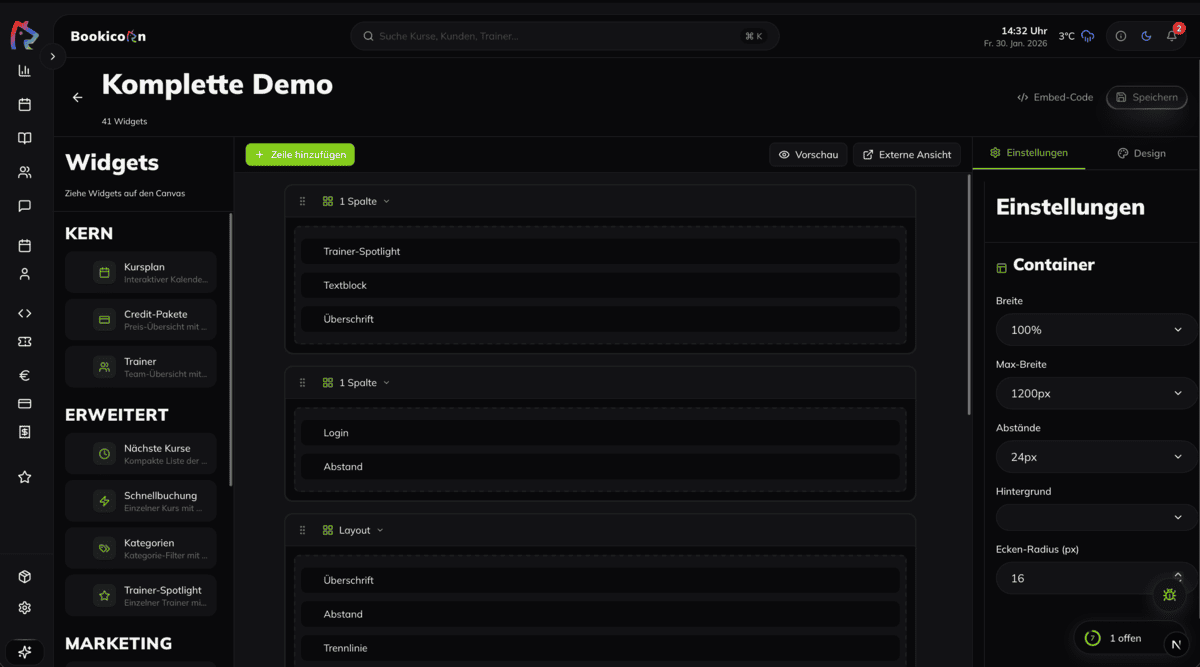
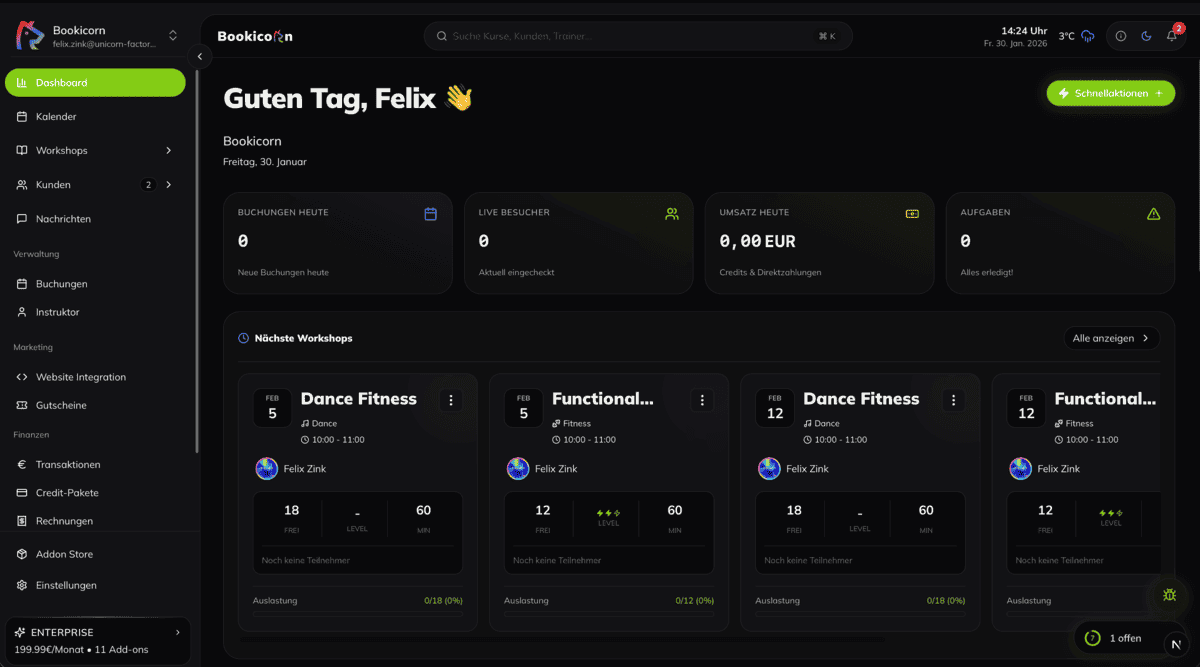
With Bookicorn you get all this in one system - specially developed for studios like yours. Course schedule, online booking, payments and customer management in one modern solution.
Pricing: How to calculate your Pilates classes
Standard market prices in Germany (2026)
Mat Pilates:
- Individual lesson (group, 60 min.): € 15 - 25
- 10-ticket: 120 - 200 €
- Monthly subscription (unlimited): 80 - 130 €
Reformer Pilates:
- Individual lesson (small group, 50 min.): € 25 - 45
- 10-ticket: 220 - 380 €
- Monthly subscription (unlimited): 150 - 250 €
Personal training:
- Mats (1:1): 50 - 80 €/hour
- Reformer (1:1): 70 - 120 €/hour
- Duo training (1:2): 45 - 70 € per person
Price calculation: The formula
Calculate your minimum price like this:
- Monthly fixed costs (rent, insurance, software, etc.) = e.g. € 3,500
- Desired profit = e.g. € 4,000 net/month
- Total requirement = € 7,500/month
- Planned courses = 20 courses/week × 4.3 weeks = 86 courses/month
- Average participants per course = e.g. 6
- Minimum price per participant = € 7,500 ÷ (86 × 6) = approx. € 14.50
That would be your absolute minimum price. In practice, you include a buffer of 20-30% to compensate for fluctuations in capacity utilization.
Avoid common mistakes
- Buying appliances that are too cheap: Inexpensive reformers for €800 - €1,200 are intended for home use. In studio use, they wear out quickly and inferior devices lead to injury risks and dissatisfied customers. Invest in studio-grade equipment from €2,000
- Do not allow for a buffer: You probably won't have full capacity utilization for the first 3 months. Plan reserves for at least 6 months of running costs
- Too much at once: It's better to start with 6 reformers than 12. You can add more at any time, but unused devices cost space and money
- Neglect marketing: "When I open, the customers will come" - that doesn't work. Start marketing at least 2 months before opening
- No booking system: WhatsApp messages and Excel lists work up to 20 customers. Above that, it gets chaotic. Start professionally from the beginning
- Wrong target group: Not every neighborhood has enough demand for a premium reformer studio. Do a market analysis beforehand
- Insurance forgotten: An accident on a course without professional liability insurance can threaten your livelihood. Take out insurance before you give your first course
Several pillars: Additional sources of income
Workshops and specials
Themed workshops are a great addition to the regular course schedule. Examples: "Pilates for runners" , "Reformer basics for beginners" or "Pilates and fascia training" . You can offer workshops for 40 - 80 € per participant.
Personal training
Offer individual lessons or duo sessions - especially on the reformer. Personal training has the highest margin and is ideal for clients with special needs (rehab, pregnancy, competitive sports).
Online courses
Mat Pilates is ideal for online formats. Offer live streams or on-demand videos as a supplement. This creates an additional source of income and retains customers who can't always come to the studio.
Other sources of income
- Prenatal/Postnatal Pilates: Special courses for pregnant women and new mothers are in high demand and easy to plan
- Corporate Pilates: Offer courses for companies - partially tax-deductible as a BGM measure (company health management)
- Room rental: Rent out your course room to other trainers during off-peak times (yoga, barre, meditation)
- Merchandise: Pilates socks (grip socks), water bottles, resistance bands with studio logo
Timetable: When to start planning?
6-12 months before
- Complete Pilates training (if not already available)
- Create a business plan
- Clarify financing, research subsidies (e.g. KfW start-up loan)
- Determine legal form, find a tax consultant
3-6 months before
- Finding a location and negotiating a rental agreement
- Register a business
- Take out insurance
- Order devices (reformers often have a delivery time of 4-8 weeks)
- Create a website and set up social media channels
1-3 months before
- Set up the studio and devices
- Set up booking system and create course schedule
- Trial lessons for friends and family (soft opening)
- Intensify marketing: Pre-sale for 10-card or founder subscriptions
- Create and optimize your Google Business profile
The last week
- Dress rehearsal: test all devices, check the music system, run through the booking system
- Preparing the opening event
- Giving first courses and collecting feedback
Conclusion: Your path to your own Pilates studio
Opening a Pilates studio - that sounds like a big step. And it is. But the market is there: the demand for Pilates, especially reformer Pilates, is growing rapidly and there are still too few offers in many German cities.
The most important points summarized:
- Education: Invest in a recognized Pilates training course (€2,000 - €10,000 depending on the scope)
- Costs: Plan with 8,000 - 27,000 € (mats) or 29,000 - 119,000 € (reformer) starting capital
- Right: In most cases, you will need a business registration and professional liability insurance
- Differentiation: Find your unique selling point - whether reformer boutique, rehab focus or prenatal specialization
- Start slim: Better to start small and grow than start with fixed costs that are too high
With a well thought-out business plan, the right software and a clear marketing concept, nothing stands in the way of your successful Pilates studio. Good luck!
Frequently asked questions about opening a Pilates studio

Written by
Felix Zink
Felix built Bookicorn from the ground up – from the booking system and credit system to trainer payouts. As a full-stack developer at Unicorn Factory Media GmbH, he builds software that makes everyday life easier for studios.
Was this article helpful?
Rate this post