






Starting a dog training school is a dream for many dog lovers who want to turn their passion into a profession. The market for professional dog training continues to grow: around 10.3 million dogs live in German households (Statista, 2025), and more owners than ever seek qualified support in training their four-legged companions. However, the path to self-employment as a dog trainer requires more than just a love for animals. From education and licensing under Section 11 of the Animal Welfare Act to costs, marketing, and administration – this guide covers everything you need to know about successfully opening a dog training school in 2026.
Requirements for Starting a Dog Training School
Before you open a dog training school, you should honestly assess your personal and professional suitability. Not every good dog owner automatically makes a good dog trainer.
Personal Aptitude and Soft Skills
As a dog trainer, you primarily work with people. You need to explain training methods clearly, resolve conflicts, and respond individually to each human-dog team. Patience, empathy, and strong communication skills are at least as important as expertise in canine behaviour.
Additionally, you need an entrepreneurial mindset. Accounting, client acquisition, and self-organization are part of daily life as a self-employed dog trainer. Anyone who only wants to work with dogs and avoids business tasks will struggle.
Dog Trainer Education
In Germany, there is no standardised qualification for dog trainers. The quality of programmes varies considerably. The following options are available:
- Chamber of Commerce certificate: The IHK offers competency exams in some regions. This certificate is recognised by veterinary authorities and conveys credibility.
- Private academies: Providers such as ATN or Ziemer & Falke offer programmes lasting 12 to 24 months. Costs: EUR 3,000 to 8,000.
- University degree: Animal behaviour therapy or related degree programmes offer the most scientifically grounded foundation.
- Internships: Regardless of theoretical training, you should gain at least 6 months of practical experience at an established dog school.
Competency Examination and Certifications
Since the amendment of the Animal Welfare Act, dog trainers must demonstrate their competency. The examination covers topics such as learning behaviour, ethology, animal welfare law, and husbandry conditions. Depending on the federal state, requirements may vary slightly. Examination fees typically range from EUR 200 to 500.
Additional certifications – such as behaviour consultant or in specific training methods – can enhance your credibility and help you stand out from the competition.
Legal Framework: Section 11 Animal Welfare Act and Business Registration
The legal requirements for a dog training school in Germany are clearly defined. Failure to comply risks fines and business closure.
Permit Under Section 11 of the Animal Welfare Act
Anyone who commercially trains dogs or instructs dog training requires a permit under Section 11(1)(8f) of the Animal Welfare Act. You submit the application to your local veterinary office. The following documents are typically required:
- Proof of competency (IHK certificate or equivalent)
- Police clearance certificate
- Proof of suitable premises or training areas
- Hygiene concept and emergency plan
- Proof of business liability insurance
Processing time varies between 4 to 12 weeks depending on the authority. Factor this lead time into your launch timeline.
Business Registration and Legal Structure
With your Section 11 permit in hand, register your business at the local trade office. Fees range from EUR 20 to 60. For getting started, a sole proprietorship is recommended – it is straightforward and cost-effective. Alternatively, a civil-law partnership (GbR) offers advantages if you are founding with a partner.
Also register with the tax office (tax registration questionnaire) and check whether the small business regulation (Section 19 VAT Act) applies to you. With annual revenue below EUR 22,000, you may be exempt from VAT.
Insurance for Your Dog Training School
Without adequate insurance coverage, a single incident could threaten your livelihood. These policies are recommended:
- Business liability insurance: Covers damages occurring during training. Essential! Cost: approx. EUR 300–600/year.
- Professional liability insurance: Protects against claims from faulty advice.
- Business contents insurance: Secures equipment and supplies.
- Health insurance: As a self-employed person, you must insure yourself – privately or through voluntary statutory insurance.
Costs and Financing a Dog Training School
Startup costs for a dog training school range between EUR 5,000 and 30,000 depending on the concept. Those who start mobile can manage with less. A dedicated training ground significantly increases the investment.
Startup Costs Overview
The major cost items when starting a dog training school are:
- Education and certificates: EUR 3,000–8,000 for trainer education, EUR 200–500 for competency exam
- Equipment: EUR 1,000–3,000 for agility equipment, leashes, dummies, clickers and training materials
- Training ground: EUR 0 (using public spaces) to EUR 15,000 (lease, fencing, shelter)
- Marketing and website: EUR 500–2,000 for logo, website, business cards and initial advertising
- Insurance: EUR 300–600/year for business liability
- Registration and permits: EUR 100–300 for registration, Section 11 application and clearance certificate
Calculating Running Costs
In addition to startup costs, monthly fixed expenses apply. Plan for the following:
- Ground rent/lease: EUR 200–800/month depending on location and size
- Insurance: EUR 25–50/month
- Marketing: EUR 50–200/month for online advertising and social media
- Software and tools: EUR 30–80/month for booking system, accounting
- Consumables: EUR 50–100/month for treats, cleaning, wear
- Health insurance: EUR 200–400/month as self-employed
In total, plan for running costs of EUR 600 to 1,600 monthly. Build a financial buffer of at least 6 months before reaching break-even.
Financing Options
Various financing options are available:
- Equity: The safest option. Ideal if you start part-time and build gradually.
- Startup grant: The employment agency supports business formations from unemployment. Requirement: remaining ALG I entitlement.
- KfW startup loan: Low-interest loans from KfW Bank for entrepreneurs up to EUR 125,000.
- Micro-loans: For smaller amounts up to EUR 25,000 through special micro-loan programmes.
Practical tip: Create a detailed business plan with revenue projections. Calculate conservatively and plan a 20% buffer on all cost items. Many founders underestimate the time needed to reach profitability.
Training Ground, Equipment, and Business Models
The choice between a stationary and mobile setup significantly determines your cost structure and client spectrum. Both models have clear advantages and disadvantages.
Stationary Dog School vs. Mobile Training
Stationary dog school: You rent or lease a site with a fenced training area. This creates professionalism and enables group classes. Disadvantage: High fixed costs and location dependency.
Mobile training: You travel to your clients or use changing public spaces. Lower startup costs and maximum flexibility. Disadvantage: Limited options for group classes and weather dependency.
Hybrid model: Many successful dog trainers combine both approaches. Group classes on their own grounds and individual training at the client’s home. This model maximises utilisation and appeals to different target groups.
Finding and Setting Up a Training Ground
A good training ground is at least 500 square metres, fenced (fence at least 1.80 m high) and easily accessible. Ideal locations are on the outskirts of town with parking facilities. Pay attention to:
- Permission for commercial use (check building regulations)
- Noise protection requirements of the municipality
- Water connection and sanitary facilities
- Shelter or container for rainy days
- Lighting for classes during the darker months
Contact your municipality or local farmers. Often meadows or vacant plots can be leased affordably.
Equipment and Supplies
The basic equipment for a dog training school includes:
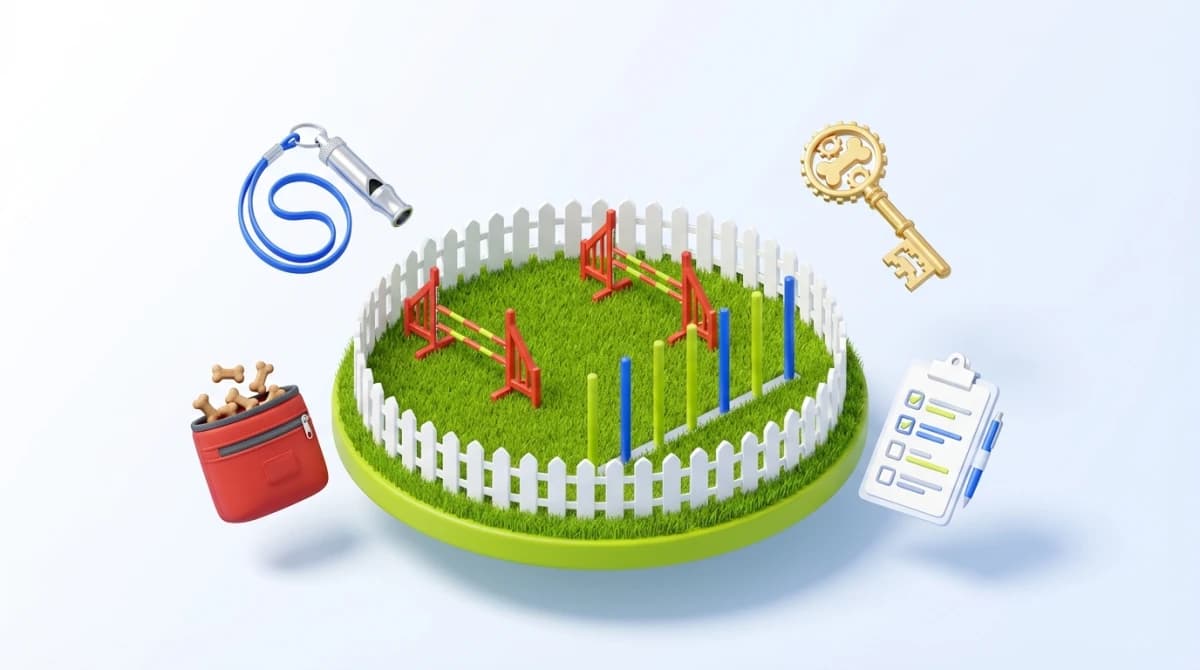
- Agility equipment: Tunnels, hurdles, slalom poles, seesaw (from EUR 500 as a set)
- Training materials: Tracking leashes (10–15 m), clickers, target sticks, dummies, treat pouches
- Safety: First aid kit for dogs and humans, muzzles in various sizes
- Administration: Laptop, printer, booking software for scheduling and client management
- Comfort: Seating for owners, poop bag dispensers, drinking water for dogs
Marketing and Client Acquisition
The best dog school is useless if nobody knows about it. A well-thought-out marketing strategy is crucial for your success – especially in the first months.
Building an Online Presence
Your website is the shop window of your dog training school. It should look professional, present your qualifications, and enable easy contact. Essential elements:
- Overview of your courses and pricing
- Introduction of yourself and your qualifications
- Contact form and online booking option
- Client testimonials and reviews
- Blog with tips on dog training (great for SEO)
Also set up a Google Business Profile. It is free and ensures your dog school appears in local searches like "dog school near me". Actively collect Google reviews – they are the most important trust factor for new clients.
Social Media and Local Advertising
Instagram and Facebook are the most important channels for dog schools. Share training videos, before-and-after stories, and tips. Short reels showing training successes achieve particularly high reach.
Complementary local measures:
- Distribute flyers at veterinary practices, pet shops, and dog groomers
- Partnerships with animal shelters and breeders
- Open day with free trial sessions
- Sponsor or organise local dog events
- Referral programme for existing clients (discount for recommendations)
Pricing and Structuring Your Offers
Pricing depends on your region, qualifications, and services. Reference values for Germany:
- Individual training: EUR 50–80 per hour (60 min)
- Group class: EUR 15–25 per participant per hour (4–6 teams)
- Puppy course (8 sessions): EUR 120–200
- Behaviour consultation: EUR 80–120 for initial consultation (90 min)
Practical tip: Offer packages and subscriptions. A 10-session card system or monthly flat rates increase client retention and provide predictable income. Calculate your prices so that at realistic utilisation (60–70% of available hours), you cover costs and earn an adequate income.
Digital Administration and Organisation
Well-organised administration saves time and prevents chaos. Especially as a sole proprietor, you need to manage courses, clients, and finances efficiently.
Booking System and Client Management
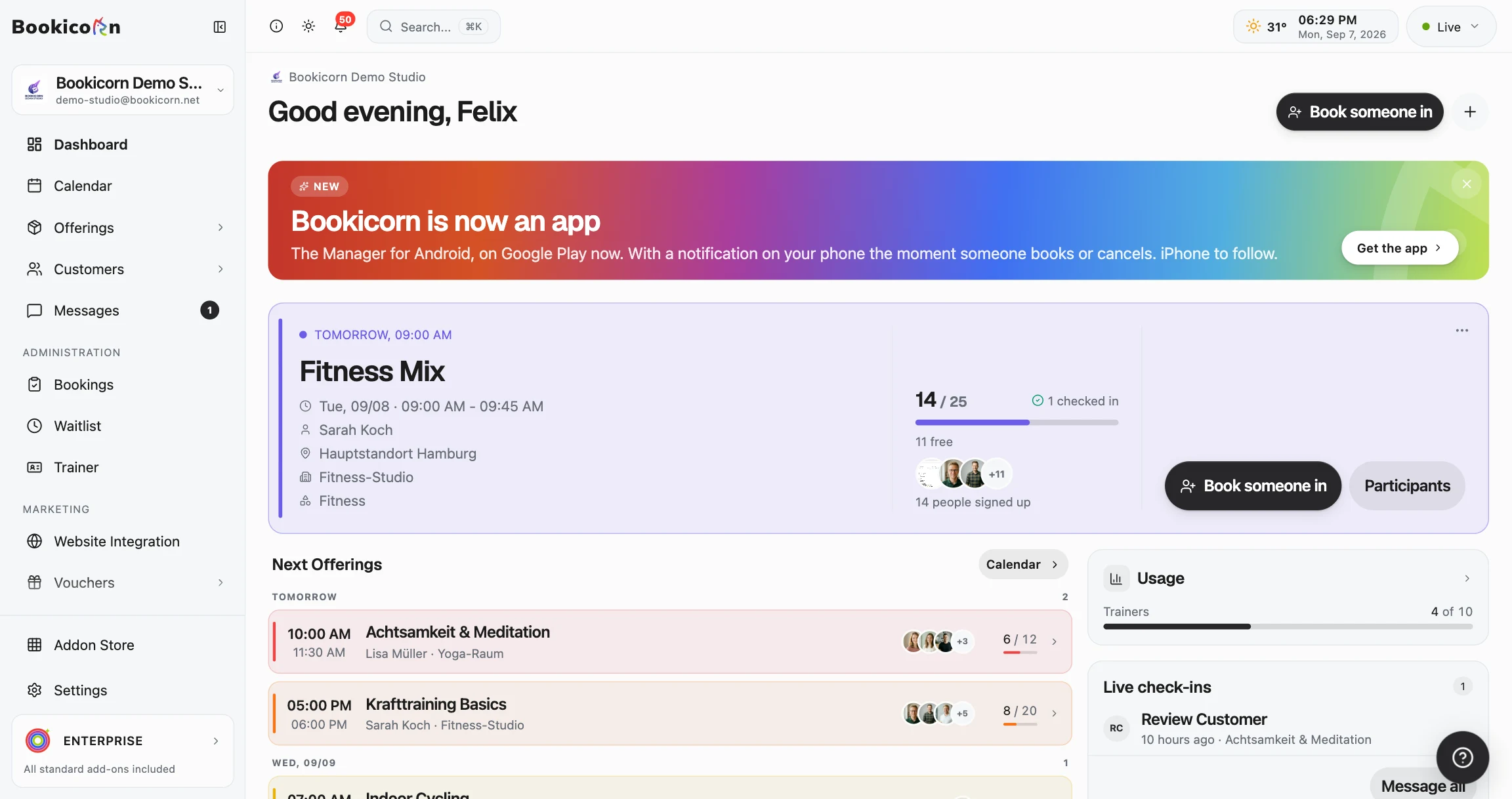
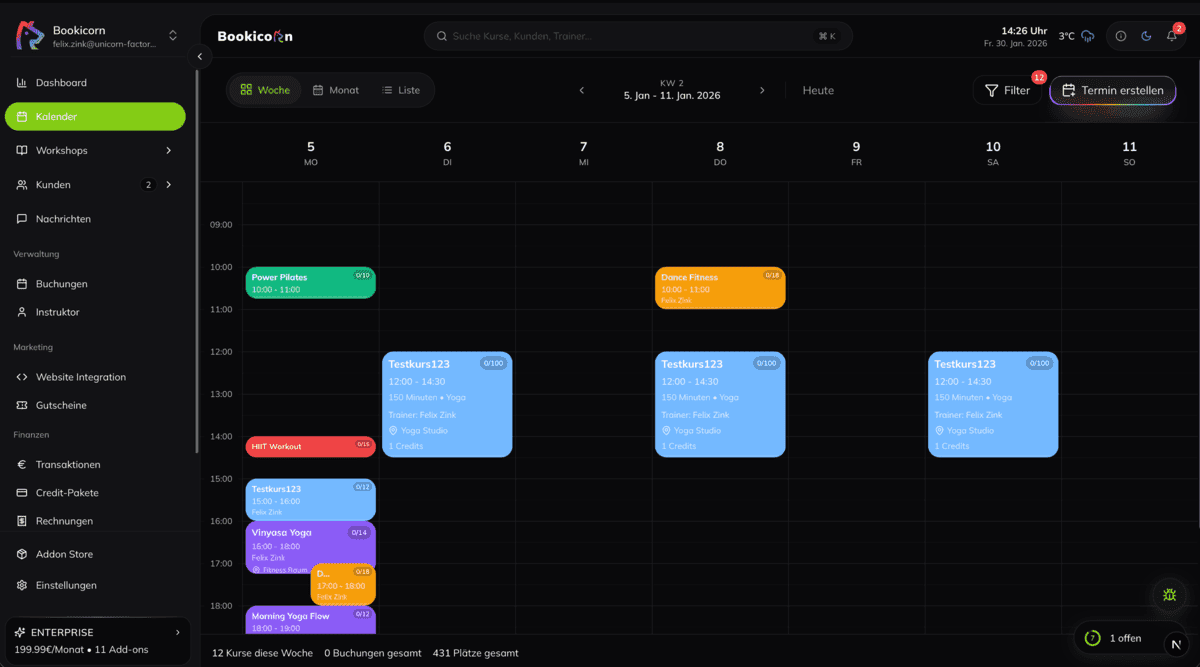
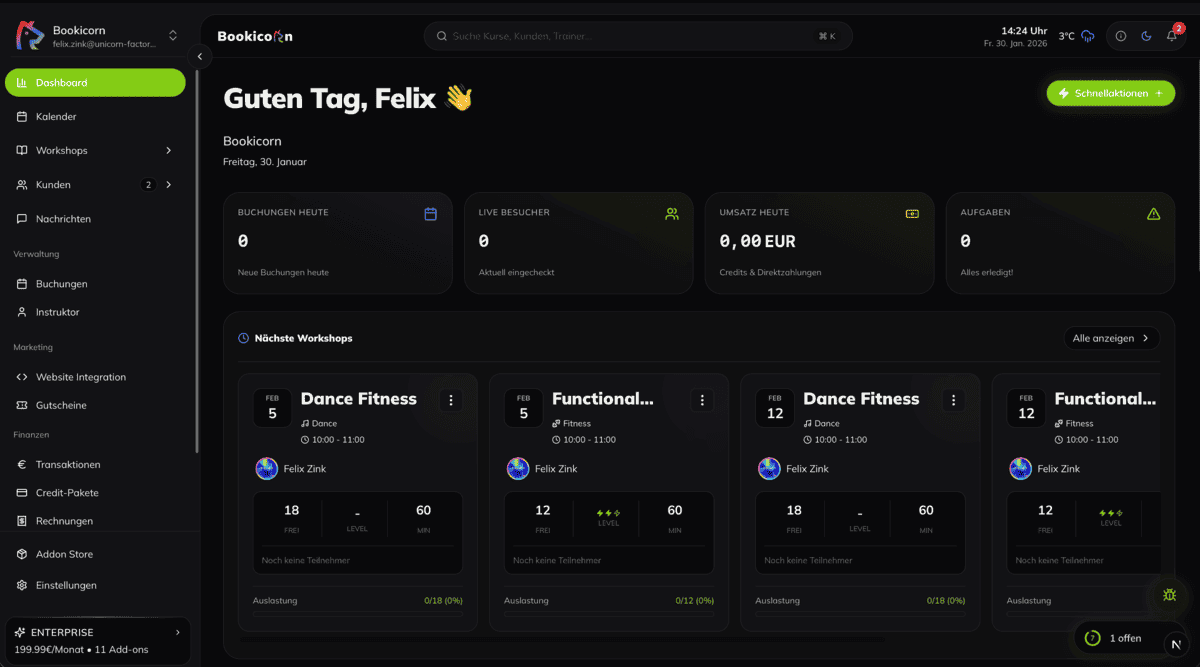
A professional booking system is essential for a modern dog training school. Clients expect to be able to book and pay for courses online. Manual management via phone, WhatsApp, and spreadsheets quickly becomes confusing and error-prone.
When choosing your software, look for:
- Online booking: Clients book independently without you needing to answer every call
- Client database: All information about dog and owner in one place
- Course planning: Clear calendar with automatic capacity management
- Payment processing: Direct online payment reduces no-shows and collection effort
- Communication: Automatic reminders and notifications to participants
Accounting and Invoicing
As a business owner, you are obligated to maintain proper bookkeeping. Use accounting software from the start such as Lexoffice, SevDesk, or FastBill. Strictly separate business and personal accounts.
Key tasks:
- Monthly VAT advance returns (under standard taxation)
- Issue invoices with all mandatory details
- Digitise and store receipts
- Annual income tax return
- Trade tax return (exemption: EUR 24,500)
Practical tip: Invest early in tax advisory. The costs (approx. EUR 100–200/month) are quickly recouped through optimised tax burden and avoided mistakes.
Developing Specialisations and Course Offerings
A well-thought-out course programme is the core of your dog training school. The clearer your profile, the easier it is to attract the right clients. Avoid the mistake of trying to offer everything to everyone.
Foundation Courses as the Base
These courses form the foundation and provide regular income:
- Puppy course (8–12 weeks): Socialisation, basic commands, house training. Most dog owners seek professional help immediately after purchasing a puppy. This course is your most important entry channel for new clients.
- Adolescent dog course (5–12 months): Advanced commands, leash walking, recall training. Many owners struggle with setbacks during their dog’s adolescent phase – demand is particularly high here.
- Basic obedience for adult dogs: Sit, down, stay, leash walking, recall. Dogs from rescue organisations also frequently need solid basic training.
- Individual training: Personalised problem-solving for specific behavioural issues. Highest margin but limited capacity.
Specialist Courses as Your USP
Specialist courses set you apart from the competition and reach new target groups:
- Anti-poison-bait training: Extremely popular in urban areas. Many dog owners have great fear of laid-out poison baits.
- Mantrailing: Scent work and search games are very popular with dog owners. Low material costs, high participant satisfaction.
- Agility courses: Athletic training with obstacle courses. High client retention as participants stay long-term.
- Social walks: Guided group walks. Low entry barrier for new clients and ideal upselling channel for further courses.
- Therapy dog training: Niche with premium pricing. Requires additional qualifications.
- Dog owner seminars: Theory evenings on topics like body language, nutrition, or first aid for dogs. Scalable and suitable for online delivery.
Defining Target Groups
Clearly define which target groups you want to address. Typical segments for dog schools:
- First-time owners: Need comprehensive support from the puppy phase. Highest willingness to pay due to uncertainty.
- Experienced owners: Seek specialist courses and sporting challenges like agility or obedience.
- Rescue adopters: Dogs from rescue often have behavioural issues. Partnerships with shelters create win-win situations.
- Families with children: Safe child-dog interactions are a growing concern. Family courses are a unique selling point.
Practical tip: Start with 3–4 foundation courses and add a specialist course every 3–6 months. This allows you to grow organically without overextending.
Earnings and Growth Prospects
How much you earn as a dog trainer depends on your business model, location, and capacity utilisation. Here are realistic figures for the German market.
Realistic Income as a Dog Trainer
In the first year, calculate conservatively. Typical income progression:
- Months 1–6: EUR 500–1,500 net. Building clients, marketing, increasing visibility. Many founders maintain a side job during this phase.
- Months 7–12: EUR 1,500–2,500 net. Regular clients established, first referrals, collecting Google reviews.
- From year 2: EUR 2,500–4,000 net with good utilisation. Group courses running, waiting lists for popular courses.
- From year 3+: EUR 3,000–5,000+ net possible through specialisation, higher prices, and potentially first employees.
Important: These figures apply to full-time dog trainers who actively pursue marketing. Those who don’t build an online presence and rely solely on word of mouth need significantly longer.
Revenue Calculation: An Example
Let’s take a realistic scenario for a stationary dog school in its second year:
- 4 group courses per week with 6 participants at EUR 20 = EUR 480/week
- 5 individual sessions per week at EUR 65 = EUR 325/week
- 1 specialist course on weekends with 8 participants at EUR 25 = EUR 200/week
This yields a weekly revenue of approx. EUR 1,005 or around EUR 4,020/month gross. After deducting running costs of EUR 800–1,200, approximately EUR 2,800–3,200 remain before tax. After taxes and social contributions, that’s approximately EUR 2,000–2,500 net.
Growth Strategy: From Solo Trainer to Team
When your dog school is running well, several growth paths are available:
- Hiring staff: From 80%+ consistent utilisation, a second trainer is worthwhile. Start with freelancers on an hourly basis before permanent employment.
- Online courses: Theory modules as video training enable scalable income without additional working hours.
- Franchising or licensing: If your concept is proven, you can license it to other trainers.
- Product sales: Training materials, treat bags, or your own treat line as additional revenue.
Practical tip: Track your key metrics from day one: client numbers, course utilisation, revenue per course type. Only with data can you make informed decisions about price increases, new courses, or hiring.
Frequently Asked Questions About Starting a Dog School
The most important questions and answers about starting a dog training school at a glance.
Conclusion: Successfully Starting Your Dog Training School
Opening a dog training school is a realistic goal for anyone who brings expertise, entrepreneurial thinking, and a passion for dogs. The path requires careful planning: from education and Section 11 permits through cost planning to marketing – there are many steps, but none are insurmountable.
Start with a clear business plan, secure the necessary permits, and build your online presence early. Whether stationary, mobile, or hybrid – find the concept that suits your strengths and your market.
The market for professional dog training continues to grow. With the right preparation and a professional appearance, you can build a stable livelihood while living your passion.

Written by
Felix Zink
Felix built Bookicorn from the ground up – from the booking system and credit system to trainer payouts. As a full-stack developer at Unicorn Factory Media GmbH, he builds software that makes everyday life easier for studios.
Was this article helpful?
Rate this post